Thank you for visiting SNEWPapers!
Sign up free
Editorial
October 14, 1834
The New Hampshire Gazette
Portsmouth, Rockingham County, New Hampshire
What is this article about?
An editorial sharply criticizes Daniel Webster's Concord speech, accusing him of hypocrisy, party bias, and libeling the U.S. government by claiming it relies on bribery and deception. It defends Jackson's removal of bank deposits and attacks Webster's views on currency and politics.
Clipping
OCR Quality
95%
Excellent
Full Text
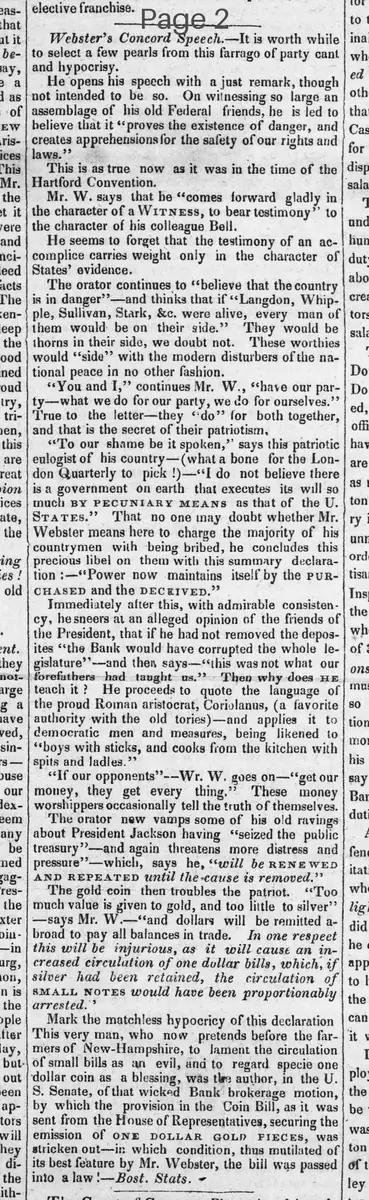
Webster's Concord Speech.-It is worth while to select a few pearls from this farrago of party cant and hypocrisy.
He opens his speech with a just remark, though not intended to be so. On witnessing so large an assemblage of his old Federal friends, he is led to believe that it "proves the existence of danger, and creates apprehensions for the safety of our rights and laws."
This is as true now as it was in the time of the Hartford Convention.
Mr. W. says that he "comes forward gladly in the character of a WITNESS, to bear testimony" to the character of his colleague Bell.
He seems to forget that the testimony of an accomplice carries weight only in the character of State's evidence.
The orator continues to "believe that the country is in danger"—and thinks that if "Langdon, Whipple, Sullivan, Stark, &c. were alive, every man of them would be on their side." They would be thorns in their side, we doubt not. These worthies would "side" with the modern disturbers of the national peace in no other fashion.
"You and I," continues Mr. W., "have our party-what we do for our party, we do for ourselves."
True to the letter—they "do" for both together, and that is the secret of their patriotism,
"To our shame be it spoken,"says this patriotic eulogist of his country-(what a bone for the London Quarterly to pick !)-"I do not believe there is a government on earth that executes its will so much BY PECUNIARY MEANS as that of the U. STATES." That no one may doubt whether Mr. Webster means here to charge the majority of his countrymen with being bribed, he concludes this precious libel on them with this summary declaration :-"Power now maintains itself by the PURCHASED and the DECEIVED."
Immediately after this, with admirable consistency, he sneers at an alleged opinion of the friends of the President, that if he had not removed the deposites "the Bank would have corrupted the whole legislature"—and then says-"this was not what our forefathers had taught us." Then why does HE teach it ? He proceeds to quote the language of the proud Roman aristocrat, Coriolanus, (a favorite authority with the old tories)-and applies it to democratic men and measures, being likened to "boys with sticks, and cooks from the kitchen with spits and ladles."
"If our opponents"—Mr. W. goes on—"get our money, they get every thing." These money worshippers occasionally tell the truth of themselves.
The orator now vamps some of his old ravings about President Jackson having "seized the public treasury"-and again threatens more distress and pressure"—which, says he, "will be RENEWED AND REPEATED until the cause is removed."
The gold coin then troubles the patriot. "Too much value is given to gold, and too little to silver' -says Mr. W.-"and dollars will be remitted abroad to pay all balances in trade. In one respect this will be injurious, as it will cause an increased circulation of one dollar bills, which, if silver had been retained, the circulation of SMALL NOTES would have been proportionably arrested.'
Mark the matchless hypocrisy of this declaration This very man, who now pretends before the farmers of New-Hampshire, to lament the circulation of small bills as an evil, and to regard specie one dollar coin as a blessing, was the author, in the U. S. Senate, of that wicked Bank brokerage motion, by which the provision in the Coin Bill, as it was sent from the House of Representatives, securing the EMISSION OF ONE DOLLAR GOLD PIECES, WAS stricken out--in which condition, thus mutilated of its best feature by Mr. Webster, the bill was passed into a law!--Bost. Stats.
He opens his speech with a just remark, though not intended to be so. On witnessing so large an assemblage of his old Federal friends, he is led to believe that it "proves the existence of danger, and creates apprehensions for the safety of our rights and laws."
This is as true now as it was in the time of the Hartford Convention.
Mr. W. says that he "comes forward gladly in the character of a WITNESS, to bear testimony" to the character of his colleague Bell.
He seems to forget that the testimony of an accomplice carries weight only in the character of State's evidence.
The orator continues to "believe that the country is in danger"—and thinks that if "Langdon, Whipple, Sullivan, Stark, &c. were alive, every man of them would be on their side." They would be thorns in their side, we doubt not. These worthies would "side" with the modern disturbers of the national peace in no other fashion.
"You and I," continues Mr. W., "have our party-what we do for our party, we do for ourselves."
True to the letter—they "do" for both together, and that is the secret of their patriotism,
"To our shame be it spoken,"says this patriotic eulogist of his country-(what a bone for the London Quarterly to pick !)-"I do not believe there is a government on earth that executes its will so much BY PECUNIARY MEANS as that of the U. STATES." That no one may doubt whether Mr. Webster means here to charge the majority of his countrymen with being bribed, he concludes this precious libel on them with this summary declaration :-"Power now maintains itself by the PURCHASED and the DECEIVED."
Immediately after this, with admirable consistency, he sneers at an alleged opinion of the friends of the President, that if he had not removed the deposites "the Bank would have corrupted the whole legislature"—and then says-"this was not what our forefathers had taught us." Then why does HE teach it ? He proceeds to quote the language of the proud Roman aristocrat, Coriolanus, (a favorite authority with the old tories)-and applies it to democratic men and measures, being likened to "boys with sticks, and cooks from the kitchen with spits and ladles."
"If our opponents"—Mr. W. goes on—"get our money, they get every thing." These money worshippers occasionally tell the truth of themselves.
The orator now vamps some of his old ravings about President Jackson having "seized the public treasury"-and again threatens more distress and pressure"—which, says he, "will be RENEWED AND REPEATED until the cause is removed."
The gold coin then troubles the patriot. "Too much value is given to gold, and too little to silver' -says Mr. W.-"and dollars will be remitted abroad to pay all balances in trade. In one respect this will be injurious, as it will cause an increased circulation of one dollar bills, which, if silver had been retained, the circulation of SMALL NOTES would have been proportionably arrested.'
Mark the matchless hypocrisy of this declaration This very man, who now pretends before the farmers of New-Hampshire, to lament the circulation of small bills as an evil, and to regard specie one dollar coin as a blessing, was the author, in the U. S. Senate, of that wicked Bank brokerage motion, by which the provision in the Coin Bill, as it was sent from the House of Representatives, securing the EMISSION OF ONE DOLLAR GOLD PIECES, WAS stricken out--in which condition, thus mutilated of its best feature by Mr. Webster, the bill was passed into a law!--Bost. Stats.
What sub-type of article is it?
Partisan Politics
Economic Policy
What keywords are associated?
Daniel Webster
Concord Speech
Party Hypocrisy
Bank Deposits
Currency Policy
Jackson Administration
Federalist Fears
Hartford Convention
What entities or persons were involved?
Daniel Webster
President Jackson
Bell
Langdon
Whipple
Sullivan
Stark
Coriolanus
Bank Of The United States
Editorial Details
Primary Topic
Critique Of Daniel Webster's Concord Speech On Banking And National Danger
Stance / Tone
Strongly Critical And Satirical Of Webster's Hypocrisy
Key Figures
Daniel Webster
President Jackson
Bell
Langdon
Whipple
Sullivan
Stark
Coriolanus
Bank Of The United States
Key Arguments
Webster's Speech Reveals Party Hypocrisy And Fear Mongering Like The Hartford Convention.
Webster's Testimony For Colleague Bell Is Like An Accomplice's.
Webster Libels The U.S. Government By Claiming It Uses Bribery And Deception.
Webster Hypocritically Criticizes Corruption While Implying It Himself.
Webster Misapplies Historical Figures And Roman Analogies To Democrats.
Opponents Gaining Money Means Gaining Everything, Admitting Money Worship.
Webster Revives False Claims Of Jackson Seizing The Treasury.
Webster's Complaints About Currency Ignore His Own Role In Removing Gold Dollar Provisions.