Thank you for visiting SNEWPapers!
Sign up free
Lancaster Daily Intelligencer
Lancaster, Lancaster County, Pennsylvania
What is this article about?
Reports indicate hay-fever is less prevalent this year. Dr. Alonzo Clark explains it's caused by pollen from plants like ragweed, varying by plant abundance, wind, and individual susceptibility. Escape to pollen-free areas like mountains or sea provides temporary relief. Henry Ward Beecher reportedly avoided his usual trip.
Clipping
OCR Quality
Full Text
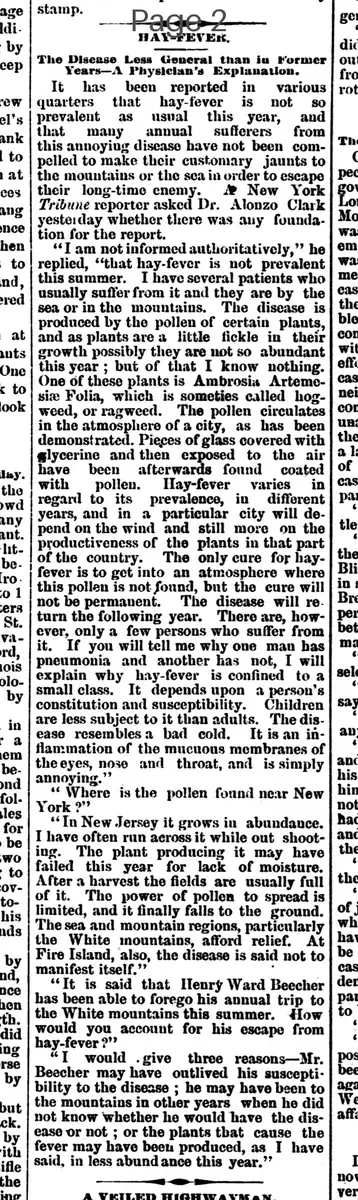
The Disease Less General than in Former Years—A Physician's Explanation.
It has been reported in various quarters that hay-fever is not so prevalent as usual this year, and that many annual sufferers from this annoying disease have not been compelled to make their customary jaunts to the mountains or the sea in order to escape their long-time enemy. A New York Tribune reporter asked Dr. Alonzo Clark yesterday whether there was any foundation for the report.
"I am not informed authoritatively," he replied, "that hay-fever is not prevalent this summer. I have several patients who usually suffer from it and they are by the sea or in the mountains. The disease is produced by the pollen of certain plants, and as plants are a little fickle in their growth possibly they are not so abundant this year; but of that I know nothing. One of these plants is Ambrosia Artemisia Folia, which is sometimes called hog-weed, or ragweed. The pollen circulates in the atmosphere of a city, as has been demonstrated. Pieces of glass covered with glycerine and then exposed to the air have been afterwards found coated with pollen. Hay-fever varies in regard to its prevalence, in different years, and in a particular city will depend on the wind and still more on the productiveness of the plants in that part of the country. The only cure for hay-fever is to get into an atmosphere where this pollen is not found, but the cure will not be permanent. The disease will return the following year. There are, however, only a few persons who suffer from it. If you will tell me why one man has pneumonia and another has not, I will explain why hay-fever is confined to a small class. It depends upon a person's constitution and susceptibility. Children are less subject to it than adults. The disease resembles a bad cold. It is an inflammation of the mucous membranes of the eyes, nose and throat, and is simply annoying.
"Where is the pollen found near New York?"
"In New Jersey it grows in abundance. I have often run across it while out shooting. The plant producing it may have failed this year for lack of moisture. After a harvest the fields are usually full of it. The power of pollen to spread is limited, and it finally falls to the ground. The sea and mountain regions, particularly the White Mountains, afford relief. At Fire Island, also, the disease is said not to manifest itself."
"It is said that Henry Ward Beecher has been able to forego his annual trip to the White mountains this summer. How would you account for his escape from hay-fever?"
"I would give three reasons—Mr. Beecher may have outlived his susceptibility to the disease; he may have been to the mountains in other years when he did not know whether he would have the disease or not; or the plants that cause the fever may have been produced, as I have said, in less abundance this year."
What sub-type of article is it?
What themes does it cover?
What keywords are associated?
What entities or persons were involved?
Where did it happen?
Story Details
Key Persons
Location
New York, New Jersey, White Mountains, Fire Island
Event Date
This Summer
Story Details
Hay-fever, caused by pollen from plants like Ambrosia Artemisia Folia (ragweed), is less prevalent this year possibly due to reduced plant growth from lack of moisture. It affects susceptible individuals, resembling a bad cold with inflammation of mucous membranes. Relief found in pollen-free areas like mountains or sea, but not permanent. Varies by year, wind, and plant abundance.