Thank you for visiting SNEWPapers!
Sign up free
Editorial
September 6, 1942
Imperial Valley Press
El Centro, Imperial County, California
What is this article about?
Editorial urges increased scrap metal collection for steel production to support WWII efforts, highlighting shortages, potential from junked cars, and British examples of civilian sacrifices.
Clipping
OCR Quality
98%
Excellent
Full Text
METAL SCRAP
WAR NECESSITY
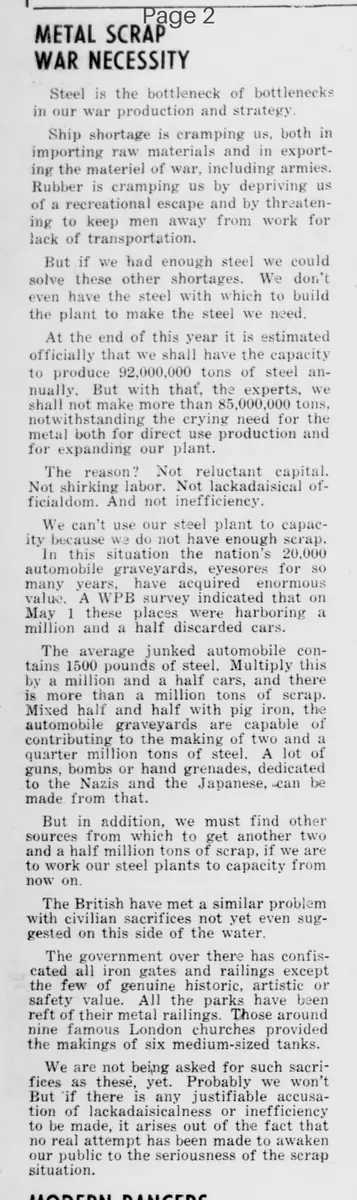
Steel is the bottleneck of bottlenecks in our war production and strategy. Ship shortage is cramping us, both in importing raw materials and in exporting the materiel of war, including armies. Rubber is cramping us by depriving us of a recreational escape and by threatening to keep men away from work for lack of transportation.
But if we had enough steel we could solve these other shortages. We don't even have the steel with which to build the plant to make the steel we need. At the end of this year it is estimated officially that we shall have the capacity to produce 92,000,000 tons of steel annually. But with that, the experts say, we shall not make more than 85,000,000 tons, notwithstanding the crying need for the metal both for direct use production and for expanding our plant.
The reason? Not reluctant capital. Not shirking labor. Not lackadaisical officialdom. And not inefficiency. We can't use our steel plant to capacity because we do not have enough scrap.
In this situation the nation's 20,000 automobile graveyards, eyesores for so many years, have acquired enormous value. A WPB survey indicated that on May 1 these places were harboring a million and a half discarded cars. The average junked automobile contains 1500 pounds of steel. Multiply this by a million and a half cars, and there is more than a million tons of scrap. Mixed half and half with pig iron, the automobile graveyards are capable of contributing to the making of two and a quarter million tons of steel. A lot of guns, bombs or hand grenades, dedicated to the Nazis and the Japanese, can be made from that.
But in addition, we must find other sources from which to get another two and a half million tons of scrap, if we are to work our steel plants to capacity from now on.
The British have met a similar problem with civilian sacrifices not yet even suggested on this side of the water. The government over there has confiscated all iron gates and railings except the few of genuine historic, artistic or safety value. All the parks have been reft of their metal railings. Those around nine famous London churches provided the makings of six medium-sized tanks.
We are not being asked for such sacrifices as these, yet. Probably we won't. But if there is any justifiable accusation of lackadaisicalness or inefficiency to be made, it arises out of the fact that no real attempt has been made to awaken our public to the seriousness of the scrap situation.
WAR NECESSITY
Steel is the bottleneck of bottlenecks in our war production and strategy. Ship shortage is cramping us, both in importing raw materials and in exporting the materiel of war, including armies. Rubber is cramping us by depriving us of a recreational escape and by threatening to keep men away from work for lack of transportation.
But if we had enough steel we could solve these other shortages. We don't even have the steel with which to build the plant to make the steel we need. At the end of this year it is estimated officially that we shall have the capacity to produce 92,000,000 tons of steel annually. But with that, the experts say, we shall not make more than 85,000,000 tons, notwithstanding the crying need for the metal both for direct use production and for expanding our plant.
The reason? Not reluctant capital. Not shirking labor. Not lackadaisical officialdom. And not inefficiency. We can't use our steel plant to capacity because we do not have enough scrap.
In this situation the nation's 20,000 automobile graveyards, eyesores for so many years, have acquired enormous value. A WPB survey indicated that on May 1 these places were harboring a million and a half discarded cars. The average junked automobile contains 1500 pounds of steel. Multiply this by a million and a half cars, and there is more than a million tons of scrap. Mixed half and half with pig iron, the automobile graveyards are capable of contributing to the making of two and a quarter million tons of steel. A lot of guns, bombs or hand grenades, dedicated to the Nazis and the Japanese, can be made from that.
But in addition, we must find other sources from which to get another two and a half million tons of scrap, if we are to work our steel plants to capacity from now on.
The British have met a similar problem with civilian sacrifices not yet even suggested on this side of the water. The government over there has confiscated all iron gates and railings except the few of genuine historic, artistic or safety value. All the parks have been reft of their metal railings. Those around nine famous London churches provided the makings of six medium-sized tanks.
We are not being asked for such sacrifices as these, yet. Probably we won't. But if there is any justifiable accusation of lackadaisicalness or inefficiency to be made, it arises out of the fact that no real attempt has been made to awaken our public to the seriousness of the scrap situation.
What sub-type of article is it?
Economic Policy
Military Affairs
War Or Peace
What keywords are associated?
Scrap Metal
Steel Production
War Effort
Automobile Graveyards
Civilian Sacrifices
What entities or persons were involved?
Wpb
British Government
Nazis
Japanese
Editorial Details
Primary Topic
Scrap Metal Shortage For Steel Production In War Effort
Stance / Tone
Urgent Call For Public Awareness And Action
Key Figures
Wpb
British Government
Nazis
Japanese
Key Arguments
Steel Is Critical Bottleneck In War Production
Lack Of Scrap Prevents Full Use Of Steel Capacity
Junked Cars Provide Over A Million Tons Of Scrap
Need Additional 2.5 Million Tons Of Scrap
British Example Of Confiscating Metal For Tanks