Thank you for visiting SNEWPapers!
Sign up free
Editorial
November 24, 1796
Gazette Of The United States, & Philadelphia Daily Advertiser
Philadelphia, Philadelphia County, Pennsylvania
What is this article about?
This editorial, under the pseudonym Phocion, concludes a critique of Thomas Jefferson's 1790 report on establishing uniform weights and measures for the U.S., highlighting technical flaws and oversights, while launching a broader partisan assault on his philosophical, political, and moral character, warning of dangers from his potential presidency.
Clipping
OCR Quality
95%
Excellent
Full Text
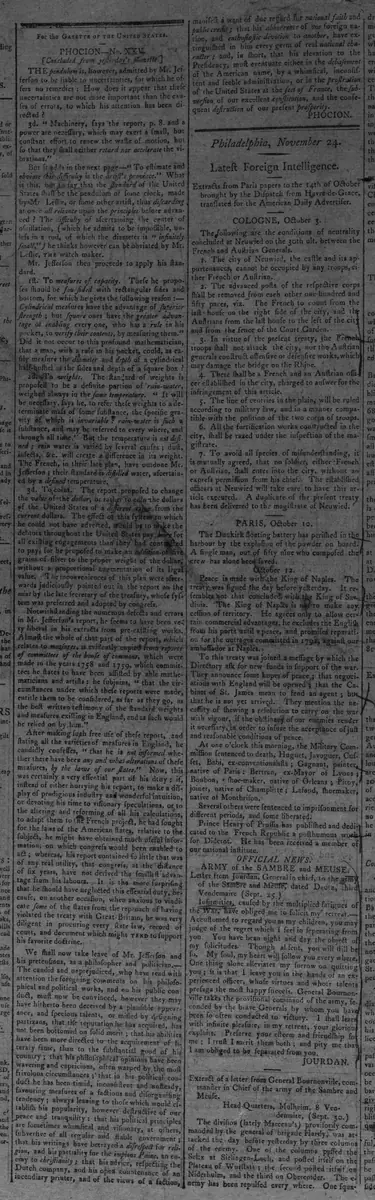
FOR the GAZETTE of the UNITED STATES
PHOCION No. XXV.
[Concluded from yesterday's Gazette]
THE pendulum is, however, admitted by Mr. Jefferson to be liable to uncertainties, for which he offers no remedies: How does it appear that these uncertainties are not more important than the causes of errors, to which his attention has been directed?
3d. "Machinery, says the report, p. 8. and a power are necessary, which may exert a small, but constant effort to renew the waste of motion, but so that they shall neither retard nor accelerate the vibrations."
But it adds in the next page- "To estimate and obviate this difficulty is the artist's province." What is this, but to say that the standard of the United States shall be the pendulum of some clock, made by Mr. Leslie, or some other artist, thus discarding at once all reliance upon the principles before advanced? The difficulty of ascertaining the center of oscillation, (which he admits to be impossible, unless in a rod, of which the diameter is "infinitely small,"), he thinks however can be obviated by Mr. Leslie, THE watch-maker.
Mr. Jefferson then proceeds to apply his standard.
1st. To measures of capacity. These he proposes should be formed with rectangular sides and bottom, for which he gives the following reason: -
Cylindrical measures have the advantage of superior strength; but square ones have the greater advantage of enabling every one, who has a rule in his pocket, to verify their contents, by measuring them."
Did it not occur to this profound mathematician, that a man, with a rule in his pocket, could, as easily measure the diameter and depth of a cylindrical half-bushel as the sides and depth of a square box?
2d, To weights. The standard of weights is proposed to be a definite portion of rain-water, weighed always in the same temperature. "It will be necessary, says he, to refer these weights to a determinate mass of some substance, the specific gravity of which is invariable? rain-water is such a substance, and may be referred to every where, and through all time." But the temperature is not defined; rain water is varied by several causes; dust, insects, &c. will create a difference in its weight.
The French, in their late plan, have outdone Mr. Jefferson; their standard is distilled water, ascertained by a defined temperature.
3d. To coins. The report proposed to change the value of the dollar, or rather to coin the dollars of the United States of a different value from the current dollars. The effect of this system to which he could not have adverted, would be to make the debtors throughout the United States pay more for all existing engagements than they had contracted to pay, for he proposed to make an addition of five grains of silver to the proper weight of the dollar, without a proportional augmentation of its legal value. The inconveniences of this plan were afterwards judiciously pointed out in the report on the mint by the late Secretary of the treasury, whose system was preferred and adopted by congress.
Notwithstanding the numerous defects and errors in Mr. Jefferson's report, he seems to have been very liberal in his extracts from pre-existing works. Almost the whole of that part of the report, which relates to measures, is evidently copied from reports of committees of the house of commons, which were made in the years 1758 and 1759, which committees he states to have been assisted by able mathematicians and artists: he subjoins, "that the circumstances under which these reports were made, entitle them to be considered, as far as they go, as the best written testimony of the standard weights and measures existing in England, and as such would be relied on by him."
After making such free use of these reports, and stating all the varieties of measures in England, he candidly confesses, "that he is not informed whether there have been any and what alterations of these measures, by the laws of our states." Now, this was certainly a very essential part of his duty: if, instead of either hurrying his report, to make a display of prodigious industry and wonderful intuition, or devoting his time to visionary speculations, or to the altering and reforming of all his calculations, to adapt them to the French project, he had sought for the laws of the American states, relative to the subject, he might have obtained much useful information, on which congress would have been enabled to act; whereas, his report contained so little that was of any real utility, that congress, at the distance of six years, have not derived the smallest advantage from his labours. It is the more surprising that he should have neglected this essential duty, because, on another occasion, when anxious to vindicate some of the states from the reproach of having violated the treaty with Great Britain, he was very diligent in procuring every state law, record of court, and document which might tend to support his favorite doctrine.
We shall now take leave of Mr. Jefferson and his pretensions, as a philosopher and politician.-- The candid and unprejudiced, who have read with attention the foregoing comments on his philosophical and political works, and on his public conduct, must now be convinced, however they may have hitherto been deceived by a plausible appearance, and specious talents, or misled by designing partisans, that the reputation he has acquired, has not been bottomed on solid merit; that his abilities have been more directed to the acquirement of literary fame, than to the substantial good of his country; that his philosophical opinions have been wavering and capricious, often warped by the most frivolous circumstances; that in his political conduct he has been timid, inconsistent and unsteady, favouring measures of a factious and disorganizing tendency; always leaning to those which would establish his popularity, however destructive of our peace and tranquility: that his political principles are sometimes whimsical and visionary, at others, subversive of all regular and stable government; that his writings have betrayed a disrespect for religion, and his partiality for the impious Paine, an enemy to christianity; that his advice, respecting the Dutch company, and his open countenance of an incendiary printer, and of the views of a faction, manifest a want of due regard for national faith and public credit; that his abhorrence of one foreign nation, and enthusiastic devotion to another, have extinguished in him every germ of real national character; and, in short, that his elevation to the Presidency, must eventuate either in the debasement of the American name, by a whimsical, inconsistent and feeble administration, or in the prostration of the United States at the feet of France, the subversion of our excellent constitution, and the consequent destruction of our present prosperity.
PHOCION.
PHOCION No. XXV.
[Concluded from yesterday's Gazette]
THE pendulum is, however, admitted by Mr. Jefferson to be liable to uncertainties, for which he offers no remedies: How does it appear that these uncertainties are not more important than the causes of errors, to which his attention has been directed?
3d. "Machinery, says the report, p. 8. and a power are necessary, which may exert a small, but constant effort to renew the waste of motion, but so that they shall neither retard nor accelerate the vibrations."
But it adds in the next page- "To estimate and obviate this difficulty is the artist's province." What is this, but to say that the standard of the United States shall be the pendulum of some clock, made by Mr. Leslie, or some other artist, thus discarding at once all reliance upon the principles before advanced? The difficulty of ascertaining the center of oscillation, (which he admits to be impossible, unless in a rod, of which the diameter is "infinitely small,"), he thinks however can be obviated by Mr. Leslie, THE watch-maker.
Mr. Jefferson then proceeds to apply his standard.
1st. To measures of capacity. These he proposes should be formed with rectangular sides and bottom, for which he gives the following reason: -
Cylindrical measures have the advantage of superior strength; but square ones have the greater advantage of enabling every one, who has a rule in his pocket, to verify their contents, by measuring them."
Did it not occur to this profound mathematician, that a man, with a rule in his pocket, could, as easily measure the diameter and depth of a cylindrical half-bushel as the sides and depth of a square box?
2d, To weights. The standard of weights is proposed to be a definite portion of rain-water, weighed always in the same temperature. "It will be necessary, says he, to refer these weights to a determinate mass of some substance, the specific gravity of which is invariable? rain-water is such a substance, and may be referred to every where, and through all time." But the temperature is not defined; rain water is varied by several causes; dust, insects, &c. will create a difference in its weight.
The French, in their late plan, have outdone Mr. Jefferson; their standard is distilled water, ascertained by a defined temperature.
3d. To coins. The report proposed to change the value of the dollar, or rather to coin the dollars of the United States of a different value from the current dollars. The effect of this system to which he could not have adverted, would be to make the debtors throughout the United States pay more for all existing engagements than they had contracted to pay, for he proposed to make an addition of five grains of silver to the proper weight of the dollar, without a proportional augmentation of its legal value. The inconveniences of this plan were afterwards judiciously pointed out in the report on the mint by the late Secretary of the treasury, whose system was preferred and adopted by congress.
Notwithstanding the numerous defects and errors in Mr. Jefferson's report, he seems to have been very liberal in his extracts from pre-existing works. Almost the whole of that part of the report, which relates to measures, is evidently copied from reports of committees of the house of commons, which were made in the years 1758 and 1759, which committees he states to have been assisted by able mathematicians and artists: he subjoins, "that the circumstances under which these reports were made, entitle them to be considered, as far as they go, as the best written testimony of the standard weights and measures existing in England, and as such would be relied on by him."
After making such free use of these reports, and stating all the varieties of measures in England, he candidly confesses, "that he is not informed whether there have been any and what alterations of these measures, by the laws of our states." Now, this was certainly a very essential part of his duty: if, instead of either hurrying his report, to make a display of prodigious industry and wonderful intuition, or devoting his time to visionary speculations, or to the altering and reforming of all his calculations, to adapt them to the French project, he had sought for the laws of the American states, relative to the subject, he might have obtained much useful information, on which congress would have been enabled to act; whereas, his report contained so little that was of any real utility, that congress, at the distance of six years, have not derived the smallest advantage from his labours. It is the more surprising that he should have neglected this essential duty, because, on another occasion, when anxious to vindicate some of the states from the reproach of having violated the treaty with Great Britain, he was very diligent in procuring every state law, record of court, and document which might tend to support his favorite doctrine.
We shall now take leave of Mr. Jefferson and his pretensions, as a philosopher and politician.-- The candid and unprejudiced, who have read with attention the foregoing comments on his philosophical and political works, and on his public conduct, must now be convinced, however they may have hitherto been deceived by a plausible appearance, and specious talents, or misled by designing partisans, that the reputation he has acquired, has not been bottomed on solid merit; that his abilities have been more directed to the acquirement of literary fame, than to the substantial good of his country; that his philosophical opinions have been wavering and capricious, often warped by the most frivolous circumstances; that in his political conduct he has been timid, inconsistent and unsteady, favouring measures of a factious and disorganizing tendency; always leaning to those which would establish his popularity, however destructive of our peace and tranquility: that his political principles are sometimes whimsical and visionary, at others, subversive of all regular and stable government; that his writings have betrayed a disrespect for religion, and his partiality for the impious Paine, an enemy to christianity; that his advice, respecting the Dutch company, and his open countenance of an incendiary printer, and of the views of a faction, manifest a want of due regard for national faith and public credit; that his abhorrence of one foreign nation, and enthusiastic devotion to another, have extinguished in him every germ of real national character; and, in short, that his elevation to the Presidency, must eventuate either in the debasement of the American name, by a whimsical, inconsistent and feeble administration, or in the prostration of the United States at the feet of France, the subversion of our excellent constitution, and the consequent destruction of our present prosperity.
PHOCION.
What sub-type of article is it?
Partisan Politics
Economic Policy
What keywords are associated?
Jefferson Critique
Weights Measures
Partisan Attack
Federalist Perspective
Political Inconsistency
What entities or persons were involved?
Thomas Jefferson
Mr. Leslie
Secretary Of The Treasury
Phocion
Thomas Paine
French
Editorial Details
Primary Topic
Critique Of Jefferson's Report On Weights And Measures And His Political Character
Stance / Tone
Strongly Critical And Partisan Attack On Thomas Jefferson
Key Figures
Thomas Jefferson
Mr. Leslie
Secretary Of The Treasury
Phocion
Thomas Paine
French
Key Arguments
Jefferson's Pendulum Standard Is Uncertain And Unreliable
Proposal For Measures Favors Square Over Cylindrical Without Valid Reason
Weights Based On Rain Water Are Flawed Due To Variability
Coin Proposal Would Harm Debtors By Increasing Silver Content Without Value Adjustment
Jefferson Copied Extensively From British Reports Without Crediting Properly
Neglected To Research American State Laws On Measures
Broader Criticisms Of Jefferson's Wavering Philosophy, Inconsistent Politics, And Favoritism Toward France