Thank you for visiting SNEWPapers!
Sign up free
Story
August 30, 1866
Daily Ohio Statesman
Columbus, Franklin County, Ohio
What is this article about?
Wendell Phillips critiques the Philadelphia Rebel Convention as a strategic move by Southern forces to undermine Negro suffrage through political intrigue, warning that Republican success in fall elections may not secure civil rights, potentially allowing rebels back into Congress without true reforms.
Clipping
OCR Quality
90%
Excellent
Full Text
Philadelphia Convention
(From the Anti-Slavery Standard, August 25.)
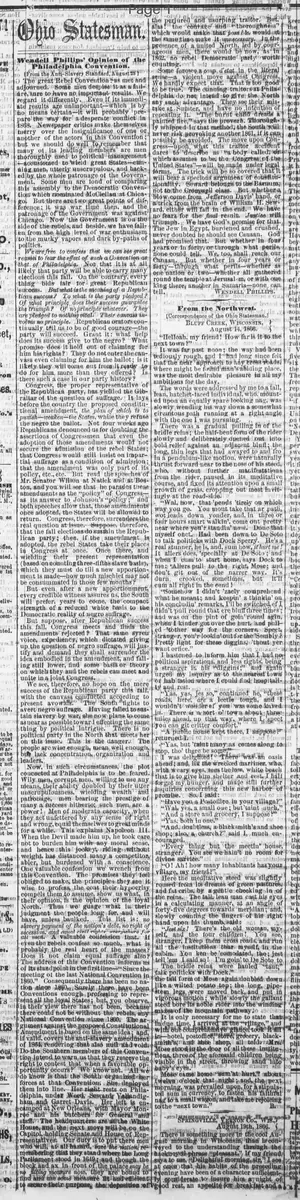
The great Rebel Convention has met and adjourned. Some men despise it as a failure. In our sure to have no important results. We regard it differently. Even if its immediate results are unimportant which is by no means certain—it will probably prepare the way for a desperate conflict in the future. Newspaper critics make themselves merry over the insignificance of one or another of the actors in this Convention; but we should do well to remember that many of its leading members are men thoroughly used to political management—accustomed to wield great States—cunning men, utterly unscrupulous, and backed by the whole patronage of the Government. Some men are fond of comparing this assembly to the Democratic Convention which nominated McClellan at Chicago. But there are two great points of difference: it was war time then, and the patronage of the Government was against Chicago. Now the Government is on the side of the rebels, and beside, we have fallen from the high level of war enthusiasm to the murky vapors and dark by-paths of politics.
We are free to confess that we can see great reason to fear the effect of such a Convention as that of Philadelphia. Not, that it is at all likely that party will be able to carry many elections this fall. On the contrary, every thing bids fair for great Republican success. But what is the meaning of a Republican success? To what is the party pledged? Of what principle, does their success guarantee the triumph? Or no principle whatever. They are pledged to nothing vital. Their canvass involves no principle. Republican orators continually tell us to be of good courage—the party will succeed. Grant it: what help does its success give to the negro? What promise does it hold out of claiming for him his rights? They do not enter the canvass even claiming for him the ballot; is it likely they will come out from it ready to do for him, more than they offered? Is there such a case in our party history?
Congress, the proper representative of the Republican party, has yielded the Gibraltar of the question of suffrage. It lays before the country the proposed constitutional amendment, the plan of which is to punish—weaken the States, while they refuse the negro the ballot. Not four weeks ago Republicans denounced us for doubting the assertions of Congressmen that even "the adoption of those amendments would not secure the admission of the rebel States; that Congress would still insist on impartial suffrage as a condition of admission; that the amendment was only part of its policy, etc., etc." But read the speeches of Mr. Senator Wilson at Natick and at Boston, and you will see that he parades these amendments as the "policy" of Congress as its answer to Johnson's "policy;" and both speeches allow that, those amendments once adopted, the States will be allowed to return. Congress, therefore, surrenders the real question at issue.
Suppose, therefore, that the fall elections do sustain the Republican party; then, if the amendment is adopted, the rebel States take their places in Congress at once. Once there, and wielding their present representation (based on counting three-fifths slave basis), which they must do till a new apportionment is made—how much mischief may not be consummated in those few months? But even after a new apportionment, every credible witness assures us, the South will prefer, years to come, the compact strength of a reduced white basis to the Democratic reality of negro suffrage.
But suppose, after Republican success this fall, Congress meets and finds the amendments rejected. That same siren voice, expediency, which dictated giving up the question of negro suffrage, will justify and demand they shall surrender the idea embodied in the amendment, and falling still lower, find some basis or theory on which they and the rebels can meet and unite in a joint Congress.
We see, therefore, no hope on the mere success of the Republican party this fall, with the canvass conducted according to present avowals. The South fights to avert negro suffrage. Having failed to sustain slavery by war, she now plans to come as near as possible toward effecting the same thing by political intrigue. There is no political party in the North that meets her on this issue. This is the danger. The people are wise enough, mean well enough, but lack concentration, organization and leaders.
Now, in such circumstances, the plot concocted at Philadelphia is to be feared. Wily men, corrupt men, willing to use any means, their ability doubled by their utter unscrupulousness, wielding wealth and patronage, men bearing the prestige of many a success hitherto; such men are a power. Men of moderate capacity, when they act unfettered by any sense of right and wrong, equal themselves to great minds for a while. This explains Napoleon III. When the Devil made him up, he took care not to burden him with any moral sense, and hence his jockey riding without weight, has distanced many a competitor, abler, but burdened with a conscience.
One valuable confession we wrench from this Convention. The promises they feel obliged to make, the principles they see it wise to profess, the coat their hypocrisy compels them to assume, show us what, in their opinion, is the opinion of the loyal North. Thus we gauge what in their judgment the people long for, and will have, unless baulked. This list is: no slavery, payment of the nation's debt, no right of secession, and equal civil rights over churches for all men. A valuable confession that. If even the rebels confess so much, what is probably the real heart of the masses? Does it not claim equal suffrage also?
The address of this Convention informs us of its standpoint in the first direct "Since the meeting of the last National Convention in 1860." Consequently there has been no nation since 1860. Surely, there have been Conventions enough, professing to represent all the loyal States; but, you observe, in their view there has not been, because there could not be without the rebels, any National Convention since 1860. The argument against the proposed Constitutional Amendment is based on the same idea; and, if valid, covers the anti-slavery amendment of 1864, rendering that also null and void.
Do the Southern members of this Convention intend to warn us that they reserve the right to contest that when a favorable opportunity occurs? We know not. All we do know is that the South organized her forces at that Convention. She deployed them into line. Her right rests on Philadelphia, under Weed, Seward, Vallandigham, and Garrett Davis. Her left is encamped at New Orleans, with Mayor Monroe and his butchers; of General and staff. The headquarters are at the White House, and the next move will be on the Capitol, holding Senate and House of Representatives. Our duty is to put there men who will, at all hazard, save the nation, remembering that they stand where the Long Parliament stood in 1649 and, though the block and axe in front of the palace may be no fitting measure now, they are bound to find and use some measure fit and efficient.
the perjured and Usurping traitor. But alas! the courage and thoroughness which would make it bad possible, would at the same time make it unnecessary. In the presence of a united North, led by courageous men, there would be now, as in '62, no rebel Democratic party worthy of counting. Some foresee a coup d'etat in the literal sense—a violent move against Congress. We hardly expect that. That is too good to be true. The cunning traitors at Philadelphia do not intend to give the North any such advantage. They see their mistake at Sumter, and have no intention of repeating it. The burnt child dreads painted fire, says the proverb. Thoroughly whipped in that method, the South will never risk provoking another, if it can possibly be avoided. The move upon Congress—upon "what this traitor accident dares to describe as a body called the Congress of the United States"—will be made under legal forms. The trick will be so covered that it will bear a specious argument of constitutionality. Seward belongs to the Barnum, not to the Cromwell class. But whether a blow come from Jefferson Davis' hand, or a trick from the brain of William H. Seward, either will fail in the end. We have no fears for the final result. Justice will triumph. We have God's promise for that. The Jew in Egypt, burdened and crushed, never doubted he should see Canaan. God had promised that. But whether in four years or in forty, or through what perils, none could tell. We, too, shall reach our Canaan. But whether in four years or forty—through what perils—whether as one nation or two—whether all gathered round the temple at Jerusalem, or with one king there another in Samaria—none can tell.
WENDELL PHILLIPS
(From the Anti-Slavery Standard, August 25.)
The great Rebel Convention has met and adjourned. Some men despise it as a failure. In our sure to have no important results. We regard it differently. Even if its immediate results are unimportant which is by no means certain—it will probably prepare the way for a desperate conflict in the future. Newspaper critics make themselves merry over the insignificance of one or another of the actors in this Convention; but we should do well to remember that many of its leading members are men thoroughly used to political management—accustomed to wield great States—cunning men, utterly unscrupulous, and backed by the whole patronage of the Government. Some men are fond of comparing this assembly to the Democratic Convention which nominated McClellan at Chicago. But there are two great points of difference: it was war time then, and the patronage of the Government was against Chicago. Now the Government is on the side of the rebels, and beside, we have fallen from the high level of war enthusiasm to the murky vapors and dark by-paths of politics.
We are free to confess that we can see great reason to fear the effect of such a Convention as that of Philadelphia. Not, that it is at all likely that party will be able to carry many elections this fall. On the contrary, every thing bids fair for great Republican success. But what is the meaning of a Republican success? To what is the party pledged? Of what principle, does their success guarantee the triumph? Or no principle whatever. They are pledged to nothing vital. Their canvass involves no principle. Republican orators continually tell us to be of good courage—the party will succeed. Grant it: what help does its success give to the negro? What promise does it hold out of claiming for him his rights? They do not enter the canvass even claiming for him the ballot; is it likely they will come out from it ready to do for him, more than they offered? Is there such a case in our party history?
Congress, the proper representative of the Republican party, has yielded the Gibraltar of the question of suffrage. It lays before the country the proposed constitutional amendment, the plan of which is to punish—weaken the States, while they refuse the negro the ballot. Not four weeks ago Republicans denounced us for doubting the assertions of Congressmen that even "the adoption of those amendments would not secure the admission of the rebel States; that Congress would still insist on impartial suffrage as a condition of admission; that the amendment was only part of its policy, etc., etc." But read the speeches of Mr. Senator Wilson at Natick and at Boston, and you will see that he parades these amendments as the "policy" of Congress as its answer to Johnson's "policy;" and both speeches allow that, those amendments once adopted, the States will be allowed to return. Congress, therefore, surrenders the real question at issue.
Suppose, therefore, that the fall elections do sustain the Republican party; then, if the amendment is adopted, the rebel States take their places in Congress at once. Once there, and wielding their present representation (based on counting three-fifths slave basis), which they must do till a new apportionment is made—how much mischief may not be consummated in those few months? But even after a new apportionment, every credible witness assures us, the South will prefer, years to come, the compact strength of a reduced white basis to the Democratic reality of negro suffrage.
But suppose, after Republican success this fall, Congress meets and finds the amendments rejected. That same siren voice, expediency, which dictated giving up the question of negro suffrage, will justify and demand they shall surrender the idea embodied in the amendment, and falling still lower, find some basis or theory on which they and the rebels can meet and unite in a joint Congress.
We see, therefore, no hope on the mere success of the Republican party this fall, with the canvass conducted according to present avowals. The South fights to avert negro suffrage. Having failed to sustain slavery by war, she now plans to come as near as possible toward effecting the same thing by political intrigue. There is no political party in the North that meets her on this issue. This is the danger. The people are wise enough, mean well enough, but lack concentration, organization and leaders.
Now, in such circumstances, the plot concocted at Philadelphia is to be feared. Wily men, corrupt men, willing to use any means, their ability doubled by their utter unscrupulousness, wielding wealth and patronage, men bearing the prestige of many a success hitherto; such men are a power. Men of moderate capacity, when they act unfettered by any sense of right and wrong, equal themselves to great minds for a while. This explains Napoleon III. When the Devil made him up, he took care not to burden him with any moral sense, and hence his jockey riding without weight, has distanced many a competitor, abler, but burdened with a conscience.
One valuable confession we wrench from this Convention. The promises they feel obliged to make, the principles they see it wise to profess, the coat their hypocrisy compels them to assume, show us what, in their opinion, is the opinion of the loyal North. Thus we gauge what in their judgment the people long for, and will have, unless baulked. This list is: no slavery, payment of the nation's debt, no right of secession, and equal civil rights over churches for all men. A valuable confession that. If even the rebels confess so much, what is probably the real heart of the masses? Does it not claim equal suffrage also?
The address of this Convention informs us of its standpoint in the first direct "Since the meeting of the last National Convention in 1860." Consequently there has been no nation since 1860. Surely, there have been Conventions enough, professing to represent all the loyal States; but, you observe, in their view there has not been, because there could not be without the rebels, any National Convention since 1860. The argument against the proposed Constitutional Amendment is based on the same idea; and, if valid, covers the anti-slavery amendment of 1864, rendering that also null and void.
Do the Southern members of this Convention intend to warn us that they reserve the right to contest that when a favorable opportunity occurs? We know not. All we do know is that the South organized her forces at that Convention. She deployed them into line. Her right rests on Philadelphia, under Weed, Seward, Vallandigham, and Garrett Davis. Her left is encamped at New Orleans, with Mayor Monroe and his butchers; of General and staff. The headquarters are at the White House, and the next move will be on the Capitol, holding Senate and House of Representatives. Our duty is to put there men who will, at all hazard, save the nation, remembering that they stand where the Long Parliament stood in 1649 and, though the block and axe in front of the palace may be no fitting measure now, they are bound to find and use some measure fit and efficient.
the perjured and Usurping traitor. But alas! the courage and thoroughness which would make it bad possible, would at the same time make it unnecessary. In the presence of a united North, led by courageous men, there would be now, as in '62, no rebel Democratic party worthy of counting. Some foresee a coup d'etat in the literal sense—a violent move against Congress. We hardly expect that. That is too good to be true. The cunning traitors at Philadelphia do not intend to give the North any such advantage. They see their mistake at Sumter, and have no intention of repeating it. The burnt child dreads painted fire, says the proverb. Thoroughly whipped in that method, the South will never risk provoking another, if it can possibly be avoided. The move upon Congress—upon "what this traitor accident dares to describe as a body called the Congress of the United States"—will be made under legal forms. The trick will be so covered that it will bear a specious argument of constitutionality. Seward belongs to the Barnum, not to the Cromwell class. But whether a blow come from Jefferson Davis' hand, or a trick from the brain of William H. Seward, either will fail in the end. We have no fears for the final result. Justice will triumph. We have God's promise for that. The Jew in Egypt, burdened and crushed, never doubted he should see Canaan. God had promised that. But whether in four years or in forty, or through what perils, none could tell. We, too, shall reach our Canaan. But whether in four years or forty—through what perils—whether as one nation or two—whether all gathered round the temple at Jerusalem, or with one king there another in Samaria—none can tell.
WENDELL PHILLIPS
What sub-type of article is it?
Historical Event
What themes does it cover?
Justice
Deception
Moral Virtue
What keywords are associated?
Philadelphia Convention
Rebel Convention
Negro Suffrage
Republican Party
Constitutional Amendment
Political Intrigue
Civil Rights
What entities or persons were involved?
Wendell Phillips
Mcclellan
Johnson
Wilson
Weed
Seward
Vallandigham
Garrett Davis
Monroe
Jefferson Davis
Napoleon Iii
Where did it happen?
Philadelphia
Story Details
Key Persons
Wendell Phillips
Mcclellan
Johnson
Wilson
Weed
Seward
Vallandigham
Garrett Davis
Monroe
Jefferson Davis
Napoleon Iii
Location
Philadelphia
Event Date
August 25
Story Details
The Philadelphia Rebel Convention organizes Southern political forces to resist Negro suffrage through intrigue, as Republicans compromise on civil rights via constitutional amendments, potentially allowing rebels back into Congress without reforms, per Wendell Phillips' analysis.