Thank you for visiting SNEWPapers!
Sign up free
Herald Of The Times
Newport, Newport County, Rhode Island
What is this article about?
Account of John Randolph of Roanoke's eccentric and troublesome conduct as U.S. envoy aboard the USS Concord in 1830, from Hampton Roads to Russia, annoying Captain M.C. Perry and officers with complaints, false accusations, and whims despite their efforts to accommodate him.
Merged-components note: Continuation of the John Randolph story across pages, based on sequential reading order and text flow.
Clippings
1 of 2
OCR Quality
Full Text
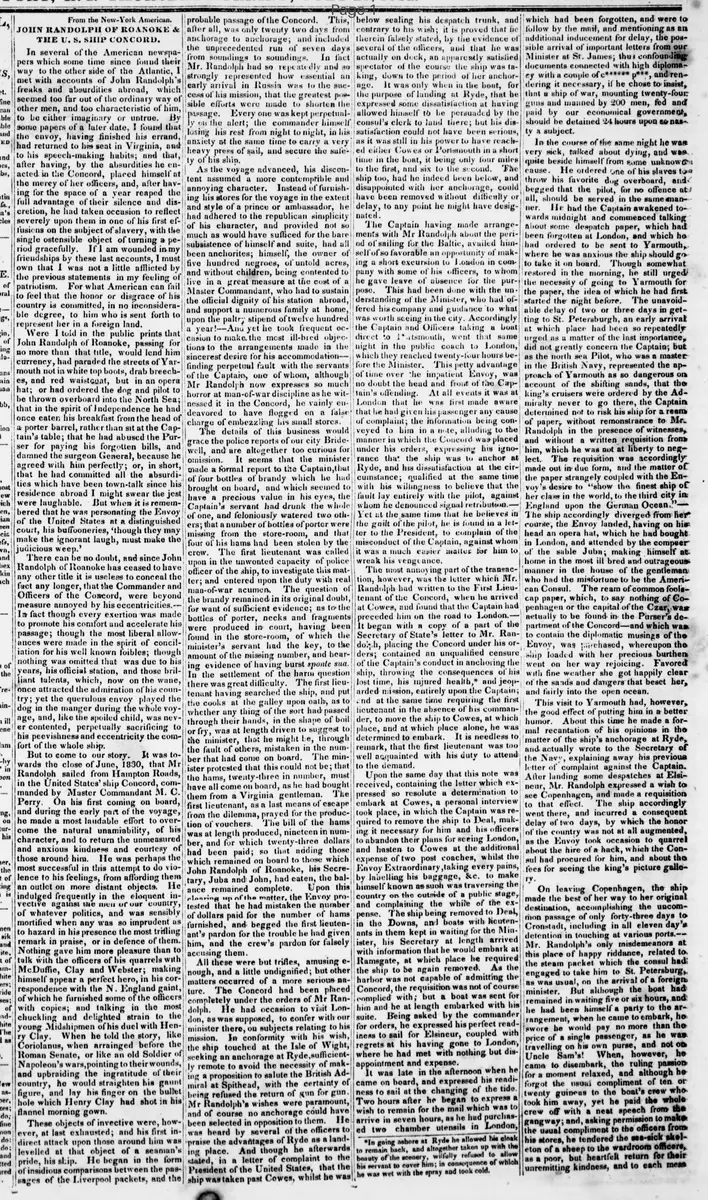
JOHN RANDOLPH OF ROANOKE &
The U. S. Ship Concord.
In several of the American newspapers which some time since found their way to the other side of the Atlantic, I met with accounts of John Randolph's freaks and absurdities abroad, which seemed too far out of the ordinary way of other men, and too characteristic of him, to be either imaginary or untrue. By some papers of a later date, I found that the envoy, having finished his errand, had returned to his seat in Virginia, and to his speech-making habits; and that, after having, by the absurdities he enacted in the Concord, placed himself at the mercy of her officers, and, after having for the space of a year reaped the full advantage of their silence and discretion, he had taken occasion to reflect severely upon them in one of his first efforts on the subject of slavery, with the single ostensible object of turning a period gracefully. If I am wounded in my friendships by these last accounts, I must own that I was not a little afflicted by the previous statements in my feeling of patriotism. For what American can fail to feel that the honor or disgrace of his country is committed, in no inconsiderable degree, to him who is sent forth to represent her in a foreign land.
Were I told in the public prints that John Randolph of Roanoke, passing for no more than that title, would lend him currency, had paraded the streets of Yarmouth not in white top boots, drab breeches, and red waistcoat, but in an opera hat; or had ordered the dog and pilot to be thrown overboard into the North Sea: that in the spirit of Independence he had once eaten his breakfast from the head of a porter barrel, rather than sit at the Captain's table; that he had abused the Purser for paying his forgotten bills, and damned the surgeon General, because he agreed with him perfectly; or, in short, that he had committed all the absurdities which have been town-talk since his residence abroad I might swear the jest were laughable. But when it is remembered that he was personating the Envoy of the United States at a distinguished court, his buffooneries, though they may make the ignorant laugh, must make the judicious weep.
There can be no doubt, and since John Randolph of Roanoke has ceased to have any other title it is useless to conceal the fact any longer, that the Commander and Officers of the Concord, were beyond measure annoyed by his eccentricities.— In fact though every exertion was made to promote his comfort and accelerate his passage; though the most liberal allowances were made in the spirit of conciliation for his well known foibles; though nothing was omitted that was due to his years, his official station, and those brilliant talents, which, now on the wane, once attracted the admiration of his country; yet the querulous envoy played the dog in the manger during the whole voyage, and, like the spoiled child, was never contented, perpetually sacrificing to his peevishness and eccentricity the comfort of the whole ship:
But to come to our story. It was towards the close of June, 1830, that Mr Randolph sailed from Hampton Roads, in the United States' ship Concord, commanded by Master Commandant M. C. Perry. On his first coming on board, and during the early part of the voyage, he made a most laudable effort to overcome the natural unamiability, of his character, and to return the unmeasured and anxious kindness and courtesy of those around him. He was perhaps the most successful in this attempt to do violence to his feelings, from affording them an outlet on more distant objects. He indulged frequently in the eloquent invective against the men of our 'country, of whatever politics, and was sensibly mortified when any was so imprudent as to hazard in his presence the most trifling remark in praise, or in defence of them. Nothing gave him more pleasure than to talk with the officers of his quarrels with McDuffie, Clay and Webster; making himself appear a perfect hero, in his correspondence with the N. England giant, of which he furnished some of the officers with copies; and talking in the most chuckling and delighted strain to the young Midshipmen of his duel with Henry Clay. When he told the story, like Coriolanus, when arraigned before the Roman Senate, or like an old Soldier of Napoleon's wars, pointing to their wounds, and upbraiding the ingratitude of their country, he would straighten his gaunt figure, and lay his finger on the bullet hole which Henry Clay had shot in his flannel morning gown.
These objects of invective were, however, at last exhausted; and his first indirect attack upon those around him was levelled at that object of a seaman's pride, his ship. He began in the form of insidious comparisons between the passages of the Liverpool packets, and the probable passage of the Concord. This, after all, was only twenty two days from anchorage to anchorage; and included the unprecedented run of seven days from soundings to soundings. In fact Mr. Randolph had so repeatedly and so strongly represented how essential an early arrival in Russia was to the success of his mission, that the greatest possible efforts were made to shorten the passage. Every one was kept perpetually on the alert; the commander himself losing his rest from night to night, in his anxiety at the same time to carry a very heavy press of sail, and secure the safety of his ship.
As the voyage advanced, his discontent assumed a more contemptible and annoying character. Instead of furnishing his stores for the voyage in the extent and style of a prince or ambassador, he had adhered to the republican simplicity of his character, and provided not so much as would have sufficed for the bare subsistence of himself and suite, had all been anchorites; himself, the owner of five hundred negroes, of untold acres, and without children, being contented to live in a great measure at the cost of a Master Commandant, who had to sustain the official dignity of his station abroad, and support a numerous family at home, upon the paltry stipend of twelve hundred a year!—And yet he took frequent occasion to make the most ill-bred objections to the arrangements made in the sincerest desire for his accommodation—finding perpetual fault with the servants of the Captain, one of whom, although Mr Randolph now expresses so much horror at man-of-war discipline as he witnessed it in the Concord, he vainly endeavored to have flogged on a false charge of embezzling his small stores.
The details of this business would grace the police reports of our city Bridewell, and are altogether too curious for omission. It seems that the minister made a formal report to the Captain, that of four bottles of brandy which he had brought on board, and which seemed to have a precious value in his eyes, the Captain's servant had drunk the whole of one, and feloniously watered two others; that a number of bottles of porter were missing from the store-room, and that four of his hams had been stolen by the crew. The first lieutenant was called upon in the unwonted capacity of police officer of the ship, to investigate this matter; and entered upon the duty with real man-of-war acumen. The question of the brandy remained in its original doubt, for want of sufficient evidence; as to the bottles of porter, necks and fragments were produced in court, having been found in the store-room, of which the minister's servant had the key, to the amount of the missing number, and bearing evidence of having burst spontaneously. In the settlement of the ham question there was great difficulty. The first lieutenant having searched the ship, and put the cooks at the galley upon oath, as to whether any thing of the sort had passed through their hands, in the shape of boil or fry, was at length driven to suggest to the minister, that he might be, through the fault of others, mistaken in the number that had come on board. The minister protested that this could not be; that the hams, twenty-three in number, must have all come on board, as he had bought them from a Virginia gentleman. The first lieutenant, as a last means of escape from the dilemma, prayed for the production of vouchers. The bill of the hams was at length produced, nineteen in number, and for which twenty-three dollars had been paid; so that adding those which remained on board to those which John Randolph of Roanoke, his Secretary, Juba and John, had eaten, the balance remained complete. Upon this clearing up of the matter, the Envoy protested that he had mistaken the number of dollars paid for the number of hams furnished, and begged the first lieutenant's pardon for the trouble he had given him, and the crew's pardon for falsely accusing them.
All these were but trifles, amusing enough, and a little undignified; but other matters occurred of a more serious nature. The Concord had been placed completely under the orders of Mr Randolph. He had occasion to visit London, as was supposed, to confer with our minister there, on subjects relating to his mission. In conformity with his wish, the ship touched at the Isle of Wight, seeking an anchorage at Ryde, sufficiently remote to avoid the necessity of making a proposition to salute the British Admiral at Spithead, with the certainty of being refused the return of gun for gun. Mr Randolph's wishes were paramount, and of course no anchorage could have been selected in opposition to them. He was heard by several of the officers to praise the advantages of Ryde as a landing place. And though he afterwards stated, in a letter of complaint to the President of the United States, that the ship was taken past Cowes, whilst he was below sealing his despatch trunk, and contrary to his wish; it is proved that he therein falsely stated, by the evidence of several of the officers, and that he was actually on deck, an apparently satisfied spectator of the course the ship was taking, down to the period of her anchorage. It was only when in the boat, for the purpose of landing at Ryde, that he expressed some dissatisfaction at having allowed himself to be persuaded by the consul's clerk to land there; but his dissatisfaction could not have been serious, as it was still in his power to have reached either Cowes or Portsmouth in a short time in the boat, it being only four miles to the first, and six to the second. The ship too, had he indeed been below, and disappointed with her anchorage, could have been removed without difficulty or delay, to any point he might have designated.
The Captain having made arrangements with Mr Randolph about the period of sailing for the Baltic, availed himself of so favorable an opportunity of making a short excursion to London in company with some of his officers, to whom he gave leave of absence for the purpose. This had been done with the understanding of the Minister, who had offered his company and guidance to what was worth seeing in the city. Accordingly the Captain and Officers taking a boat direct to Portsmouth, went that same night in the public coach to London which they reached twenty-four hours before the Minister. This petty advantage of time over the impatient Envoy, was no doubt the head and front of the Captain's offending. At all events it was at London that he was first made aware that he had given his passenger any cause of complaint; the information being conveyed to him in a note, alluding to the manner in which the Concord was placed under his orders, expressing his ignorance that the ship was to anchor at Ryde, and his dissatisfaction at the circumstance; qualified at the same time with his willingness to believe that the fault lay entirely with the pilot, against whom he denounced signal retribution.— Yet at the same time that he believes in the guilt of the pilot, he is found in a letter to the President, to complain of the misconduct of the Captain, against whom it was a much easier matter for him to wreak his vengeance.
The most annoying part of the transaction, however, was the letter which Mr. Randolph had written to the First Lieutenant of the Concord, when he arrived at Cowes, and found that the Captain had preceded him on the road to London.— It began with a copy of a part of the Secretary of State's letter to Mr. Randolph, placing the Concord under his orders; contained an unqualified censure of the Captain's conduct in anchoring the ship, throwing the consequences of his lost time, his injured health,* and jeopardized mission, entirely upon the Captain; and at the same time requiring the first lieutenant in the absence of his commander, to move the ship to Cowes, at which place, and at which place alone, he was determined to embark. It is needless to remark, that the first lieutenant was too well acquainted with his duty to attend to the demand.
Upon the same day that this note was received, containing the letter which expressed so resolute a determination to embark at Cowes, a personal interview took place, in which the Captain was required to remove the ship to Deal, making it necessary for him and his officers to abandon their plans for seeing London, and hasten to Cowes at the additional expense of two post coaches, whilst the Envoy Extraordinary, taking every pains, by labelling his baggage, &c. to make himself known as such was traversing the country on the outside of a public stage, and complaining the while of the expense. The ship being removed to Deal in the Downs, and boats with lieutenants in them kept in waiting for the Minister, his Secretary at length arrived with information that he would embark at Ramsgate, at which place he required the ship to be again removed. As the harbor was not capable of admitting the Concord, the requisition was not of course complied with; but a boat was sent for him and he at length embarked with his suite. Being asked by the commander for orders, he expressed his perfect readiness to sail for Elsinore, coupled with regrets at his having gone to London; where he had met with nothing but disappointment and expense.
It was late in the afternoon when he came on board, and expressed his readiness to sail at the changing of the tide. Two hours after he began to express a wish to remain for the mail which was to arrive in seven hours, as he had purchased two chamber utensils in London; to remain back, and altogether taken up with the beauty of the scenery, wilfully refused to allow which had been forgotten, and were to follow by the mail, and mentioning as an additional inducement for delay, the possible arrival of important letters from our Minister at St. James; thus confounding documents connected with high diplomacy with a couple of chamber pots, and rendering it necessary, if he chose to insist, that a ship of war, mounting twenty-four guns and manned by 200 men, fed and paid by our economical government, should be detained 24 hours upon so nasty a subject.
In the course of the same night he was very sick, talked about dying, and was quite beside himself from some unknown cause. He ordered one of his slaves to throw his favorite dog overboard, and begged that the pilot, for no offence at all, should be served in the same manner. He had the Captain awakened towards midnight and commenced talking about some despatch paper, which had been forgotten at London, and which he had ordered to be sent to Yarmouth, where he was anxious the ship should go to take it on board. Though somewhat restored in the morning, he still urged the necessity of going to Yarmouth for the paper, the idea of which he had first started the night before. The unavoidable delay of two or three days in getting to St. Petersburg, an early arrival at which place had been so repeatedly urged as a matter of the last importance, did not greatly concern the Captain; but as the north sea Pilot, who was a master in the British Navy, represented the approach of Yarmouth as so dangerous on account of the shifting sands, that the king's cruisers were ordered by the Admiralty never to go there, the Captain determined not to risk his ship for a ream of paper; without remonstrance to Mr. Randolph in the presence of witnesses, and without a written requisition from him, which he was not at liberty to neglect. The requisition was accordingly made out in due form, and the matter of the paper strangely coupled with the Envoys desire to "show the finest ship of her class in the world, to the third city in England upon the German Ocean."
The ship accordingly diverged from her course, the Envoy landed, having on his head an opera hat, which he had bought in London, and attended by the compeer of the sable Juba; making himself at home in the most ill bred and outrageous manner in the house of the gentleman who had the misfortune to be the American Consul. The ream of common foolscap paper, which, to say nothing of Copenhagen or the capital of the Czar, was actually to be found in the Purser's department of the Concord—and which was to contain the diplomatic musings of the Envoy, was purchased, whereupon the ship loaded with her precious burthen went on her way rejoicing. Favored with fine weather she got happily clear of the sands and dangers' that beset her, and fairly into the open ocean.
This visit to Yarmouth had, however, the good effect of putting him in a better humor. About this time he made a formal recantation: of his opinions in the matter of the ship's anchorage at Ryde, and actually wrote to the Secretary of the Navy, explaining away his previous letter of complaint against the Captain. After landing some despatches at Elsinore, Mr. Randolph expressed a wish to see Copenhagen, and made a requisition to that effect. The ship accordingly went there, and incurred a consequent delay of two days, by which the honor of the country was not at all augmented, as the Envoy took occasion to quarrel about the hire of a hack, which the Consul had procured for him, and about the fees for seeing the king's picture gallery.
On leaving Copenhagen, the ship made the best of her way to her original destination, accomplishing the uncommon passage of only forty-three days to Cronstadt, including in all eleven days' detention in touching at various ports.— Mr. Randolph's only misdemeanors at this place of happy riddance, related to the steam packet which the consul had engaged to take him to St. Petersburg as was usual, on the arrival of a foreign minister. But although the boat had remained in waiting five or six hours, and he had been himself a party to the arrangement, he swore he would pay no more than the price of a single passenger, as he was travelling on his own purse, and not on Uncle Sam's! When, however, he came to disembark, the ruling passion for a moment relaxed, and although he forgot the usual compliment of ten. or twenty guineas to the boat's crew who took him away, yet he paid the whole crew off with a neat speech from the gangway; and, asking permission to make the usual compliment to the officers from his stores, he tendered the sea-sick skeleton of a sheep to the wardroom officers, as a poor, but heartfelt return of their unremitting kindness, and to each mess of midshipmen, the characteristic offering of a Virginia ham. His remaining stores, his empty bottles, followed with Juba & with John; and the ship in high feather, her yards manned with cheering sailors hand in hand, and her cannon fondly resounding, saluted the departing minister. And here I might say something in refutation of his charge of severity against the officers of the Concord. I might dwell upon that unity of feeling, that pride in their ship, which unites every soul within her walls of honest oak.— Perhaps I cannot better convey an idea of this, than by describing a scene which I once witnessed on board of her. She was lying safely moored in Old Mahon, the snuggest and most picturesque of harbors; the home of our sailors in the Mediterranean. It was a fine afternoon towards the beginning of spring; I had been dining on board of her, and was finishing a well served dinner with cigar, coffee and conversation, under the top gallant forecastle; when my attention was attracted by a group of blue jackets about the starboard gangway, many of them in tears. Struck by the unwonted spectacle of a crying sailor, I threw away my segar, and went aft. There was a draft of men going away, some sick and disabled, some whose terms of service was about expiring, and who were to be transferred to another ship, then preparing to return home. They were going slowly and reluctantly over the side, assisted by their messmates who were passing along their bags and hammocks, and pausing to say a parting word to each of their officers; there was a hearty shake of the hand, the fervent Godspeed, with wishes of fair weather and leading breezes; and then the honestly affectionate farewell! As they put off in the boat, their messmates still looked out from the forecastle and through the ports, encountering their returning gaze, as they shifted from side to side, to keep still in view of their ship and shipmates. It was just then that their favorite bugle, so long familiar to their ears, struck up "Home, sweet Home!" sent back by the surrounding cliffs in prolonged and saddened echoes. The well known air seemed less to remind them of the estranged home to which they were returning, than of that floating one, more recently, and, it may be, more strongly dear to them, which they had that instant left. And this is the Concord, where the men are so much worse off than John Randolph's negroes! the ship which, her sailors will tell you, can do anything but talk; the ship, perfect in construction, equipment and discipline, which has never been dishonored, except by the presence of John Randolph, of Roanoke; which is at once the pride of our Navy, and of the element on which she swims! But enough of the Concord; enough of John Randolph; enough of this Errant Envoy, this diplomatic Don Quixote.— But for this unworthy comparison, I beg the sorrowful Knight's pardon, whom in truth I dearly love, and whom methinks I now see "in my mind's eye" leaning upon his lance, his long and pensive face turned towards me.
*In going ashore at Ryde he allowed his servant to cover him; in consequence of which he was wet with the spray and took cold.
What sub-type of article is it?
What themes does it cover?
What keywords are associated?
What entities or persons were involved?
Where did it happen?
Story Details
Key Persons
Location
Uss Concord, From Hampton Roads To Cronstadt Via Yarmouth, London, Ryde, Cowes, Deal, Ramsgate, Elsinore, Copenhagen
Event Date
June 1830
Story Details
John Randolph, U.S. envoy to Russia, exhibits eccentric behavior and makes unfounded complaints during his voyage on the USS Concord under Captain Perry, including false accusations against the crew, demands for ship movements, and whimsical delays, despite the crew's accommodations.