Thank you for visiting SNEWPapers!
Sign up free
The Virginia Gazette
Richmond, Williamsburg, Richmond County, Virginia
What is this article about?
Junius addresses the Duke of Grafton, condemning his corruption, lack of virtue, and undue influence over the crown, exemplified by obstructing timber supply from Whittlebury Forest for the Navy despite royal needs, as a symptom of broader moral and political decay in England.
Merged-components note: Continuation of the Junius letter to the Duke of Grafton across pages 2 and 3; merged for coherence as a single logical unit.
Clippings
1 of 2
OCR Quality
Full Text
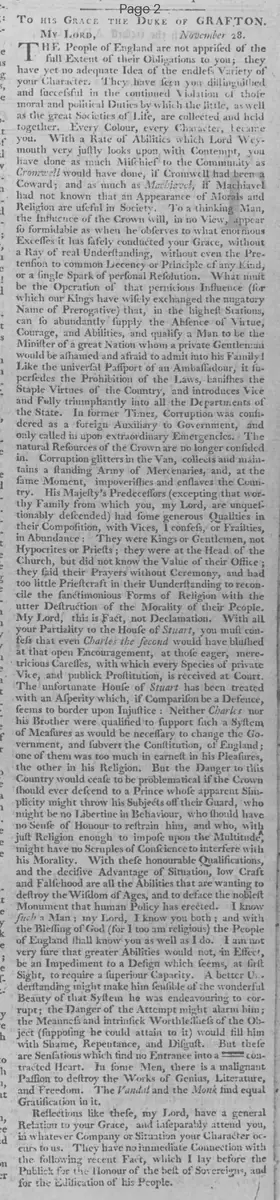
My Lord,
November 28.
The People of England are not apprised of the full Extent of their Obligations to you; they have yet no adequate Idea of the endless Variety of your Character. They have seen you distinguished and successful in the continued Violation of those moral and political Duties by which the little, as well as the great Societies of Life, are collected and held together. Every Colour, every Character, requires you. With a Rate of Abilities which Lord Weymouth very justly looks upon with Contempt, you have done as much Mischief to the Community as Cromwell would have done, if Cromwell had been a Coward; and as much as Machiavel, if Machiavel had not known that an Appearance of Morals and Religion are useful in Society. To a thinking Man, the Influence of the Crown will, in no View, appear so formidable as when he observes to what enormous Excesses it has safely conducted your Grace, without a Ray of real Understanding, without even the Pre tension to common Decency or Principle of any Kind, or a single Spark of personal Resolution. What must be the Operation of that pernicious Influence (for which our Kings have wisely exchanged the nugatory Name of Prerogative) that, in the highest Stations, can so abundantly supply the Absence of Virtue, Courage, and Abilities, and qualify a Man to be the Minister of a great Nation whom a private Gentleman would be ashamed and afraid to admit into his Family! Like the universal Passport of an Ambassador, it supersedes the Prohibition of the Laws, banishes the Staple Virtues of the Country, and introduces Vice and Folly triumphantly into all the Departments of the State. In former Times, Corruption was considered as a foreign Auxiliary to Government, and only called in upon extraordinary Emergencies. The natural Resources of the Crown are no longer confided in. Corruption glitters in the Van, collects and maintains a standing Army of Mercenaries, and, at the same Moment, impoverishes and enslaves the Country. His Majesty's Predecessors (excepting that worthy Family from which you, my Lord, are unquestionably descended) had some generous Qualities in their Composition, with Vices, I confess, or Frailties, in Abundance: They were Kings or Gentlemen, not Hypocrites or Priests; they were at the Head of the Church, but did not know the Value of their Office; they said their Prayers without Ceremony, and had too little Priestcraft in their Understanding to reconcile the sanctimonious Forms of Religion with the utter Destruction of the Morality of their People.
My Lord, this is Fact, not Declamation. With all your Partiality to the House of Stuart, you must confess that even Charles the Second would have blushed at that open Encouragement, at those eager, meretricious Caresses, with which every Species of private Vice, and publick Prostitution, is received at Court. The unfortunate House of Stuart has been treated with an Asperity which, if Comparison be a Defence, seems to border upon Injustice: Neither Charles nor his Brother were qualified to support such a System of Measures as would be necessary to change the Government, and subvert the Constitution, of England; one of them was too much in earnest in his Pleasures, the other in his Religion. But the Danger to this Country would cease to be problematical if the Crown should ever descend to a Prince whose apparent Simplicity might throw his Subjects off their Guard, who might be no Libertine in Behaviour, who should have no Sense of Honour to restrain him, and who, with just Religion enough to impose upon the Multitude might have no Scruples of Conscience to interfere with his Morality. With these honourable Qualifications, and the decisive Advantage of Situation, low Craft and Falsehood are all the Abilities that are wanting to destroy the Wisdom of Ages, and to deface the noblest Monument that human Policy has erected. I know such a Man; my Lord, I know you both; and with the Blessing of God (for I too am religious) the People of England shall know you as well as I do. I am not very sure that greater Abilities would not, in Effect, be an Impediment to a Design which seems, at first Sight, to require a superior Capacity. A better Understanding might make him sensible of the wonderful Beauty of that System he was endeavouring to corrupt; the Danger of the Attempt might alarm him; the Meanness and intrinsick Worthlessness of the Object (supposing he could attain to it) would fill him with Shame, Repentance, and Disgust. But these are Sensations which find no Entrance into a contracted Heart. In some Men, there is a malignant Passion to destroy the Works of Genius, Literature, and Freedom. The Vandal and the Monk find equal Gratification in it.
Reflections like these, my Lord, have a general Relation to your Grace, and inseparably attend you, in whatever Company or Situation your Character occurs to us. They have no immediate Connection with the following recent Fact, which I lay before the Publick for the Honour of the best of Sovereigns, and for the Edification of his People.
A Prince (whose Piety and Self-Denial, one would think, might secure him from such a Multitude of worldly Necessities) with an annual Revenue of near a Million Sterling, unfortunately wants Money. The Navy of England, by an equally strange Concurrence of unforeseen Circumstances (though not quite so unfortunately for his Majesty) is in equal Want of Timber. The World knows in what a hopeful Condition you delivered the Navy to your Successor, and in what a Condition we found it in the Moment of Distress. You were determined it should continue in the Situation in which you left it. Upon a Representation from the Admiralty of the extraordinary Want of Timber, for the indispensable Repairs of the Navy, the Surveyor General was directed to make a Survey of the Timber in all the Royal Chases and Forests in England. Having obeyed his Orders with Accuracy and Attention, he reported that the finest Timber he had anywhere met with, and the properest, in every Respect, for the Purposes of the Navy, was in Whittlebury Forest, of which your Grace, I think, is hereditary Ranger. In Consequence of this Report, the usual Warrant was prepared at the Treasury, and delivered to the Surveyor, by which he, or his Deputy, were authorised to cut down any Trees in Whittlebury Forest which should appear to be proper for the Purposes above mentioned. The Deputy, being informed that the Warrant was signed and delivered to his Principal in London, crosses the Country to Northamptonshire, and, with an officious Zeal for the public Service, begins to do his Duty in the Forest. Unfortunately for him, he had not the Warrant in his Pocket. The Oversight was erroneous, and you have punished him for it accordingly. You have insisted that an active, useful Officer, should be dismissed from his Place; you have ruined an innocent Man, and his Family. In what Language shall I address so black, so cowardly a Tyrant! thou worse than one of the Brunswicks, and all the Stuarts! To them who know Lord North it is unnecessary to say that he was mean and base enough to submit to you. This, however, is but a small Part of the Fact. After ruining the Surveyor's Deputy, for acting without the Warrant, you attacked the Warrant itself. You declared it was illegal, and swore, in a Fit of foaming, frantic Passion, that it never should be executed. You asserted, upon your Honour, that in the Grant of the Rangership of Whittlebury Forest, made by Charles the Second (whom, with a Modesty that would do Honour to Mr. Rigby, you are pleased to call your Ancestor) to one of his Bastards (from whom I make no Doubt of your Descent) the Property of the Timber is vested in the Ranger. I have examined the original Grant, and now, in the Face of the Publick, contradict you directly upon the Fact. The very Reverse of what you have asserted, upon your Honour, is the Truth. The Grant, expressly, and by a particular Clause, reserves the Property of the Timber for the Use of the Crown. In Spite of this Evidence, in Defiance of the Representations of the Admiralty, in perfect Mockery of the notorious Distresses of the English Navy, and those equally pressing and almost equally notorious Necessities of your pious Sovereign, here the Matter rests. The Lords of the Treasury recall their Warrant; the Deputy Surveyor is ruined for doing his Duty; Mr. John Pitt (whose Name, I suppose, is offensive to you) submits to be browbeaten and insulted; the Oaks keep their Ground; the King is defrauded; and the Navy of England may perish for Want of the best and finest Timber in the Island. And all this is submitted to, to appease the Duke of Grafton! to gratify the Man who has involved the King, and his Kingdom, in Confusion and Distress, and who, like a treacherous Coward, deserted his Sovereign in the Midst of it! There has been a strange Alteration in your Doctrines since you thought it advisable to rob the Duke of Portland of his Property, in Order to strengthen the Interest of Lord Bute's Son in Law before the last general Election. Nullum Tempus occurrit Regi was then your boasted Motto, and the Cry of all your Hungry Partisans. Now, it seems, a Grant of Charles the Second to one of his Bastards is to be held sacred and inviolable! It must not be questioned by the King's Servants, nor submitted to any Interpretation but your own. My Lord, this was not the Language you held when it suited you to insult the Memory of the glorious Deliverer of England from that detested Family to which you are still more nearly allied in Principle than in Blood. In the Name of Decency and Common Sense, what are your Grace's Merits, either with King or Ministry, that should entitle you to assume this domineering Authority over both? Is it the fortunate Consanguinity you claim with the House of Stuart? Is it the secret Correspondence you have for so many Years carried on with Lord Bute, by the assiduous Assistance of your Cream coloured Parasite? Could not your Gallantry find sufficient Employment for him in those gentle Offices by which he first acquired the tender Friendship of Lord Barrington? Or is it only that wonderful Sympathy of Manners which subsists between your Grace and one of your Superiors, and does so much Honour to you both? Is the Union of Blifil and Black George no longer a Romance? From whatever Origin your Influence in this Country arises, it is a Phenomenon in the History of human Virtue and Understanding. Good Men can hardly believe the Fact; wise Men are unable to account for it. Religious Men find Exercise for their Faith, and make it the last Effort of their Piety not to repine against Providence.
JUNIUS.
What sub-type of article is it?
What themes does it cover?
What keywords are associated?
What entities or persons were involved?
Letter to Editor Details
Author
Junius.
Recipient
His Grace The Duke Of Grafton
Main Argument
the duke of grafton exemplifies corruption and undue crown influence, obstructing vital timber supply from whittlebury forest for the navy to protect personal interests, threatening england's constitution and morality.
Notable Details