Thank you for visiting SNEWPapers!
Sign up free
Rhode Island Republican
Newport, Newport County, Rhode Island
What is this article about?
Thomas Paine's fourth letter to U.S. citizens congratulates on recent elections, critiques federalist papers' vulgarity and past administration's unjust expenditures, defends his political independence, recounts return to America, and affirms commitment to truth over expediency. Dated Dec. 3, 1802.
Merged-components note: These three components form a continuous letter by Thomas Paine, serialized across columns on page 1, with sequential reading order and seamless text flow.
Clipping
OCR Quality
Full Text
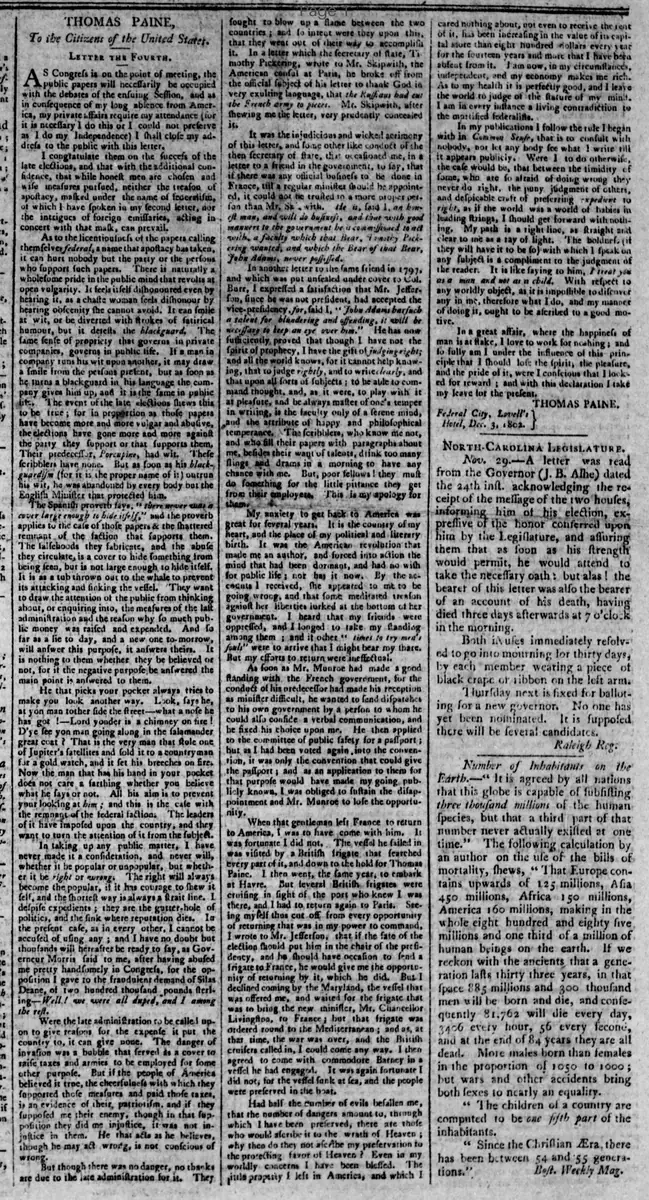
To the Citizens of the United States.
Letter the Fourth.
As Congress is on the point of meeting, the public papers will necessarily be occupied with the debates of the ensuing Session, and as in consequence of my long absence from America, my private affairs require my attendance (for it is necessary I do this or I could not preserve as I do my Independence) I shall close my address to the public with this letter.
I congratulate them on the success of the late elections, and that with the additional confidence, that while honest men are chosen and wise measures pursued, neither the treason of apostacy, masked under the name of federalism, of which I have spoken in my second letter, nor the intrigues of foreign ministers, acting in concert with that mask, can prevail.
As to the licentiousness of the papers calling themselves federal, a name that apostacy has taken, it can hurt nobody but the party or the persons who support such papers. There is naturally a wholesome pride in the public mind that revolts at open vulgarity. It feels itself dishonoured even by hearing it, as a chaste woman feels dishonour by hearing obscenity she cannot avoid. It can smile at wit, or be diverted with strokes of satirical humour, but it detests the blackguard. The same sense of propriety that governs in private companies, governs in public life. If a man in company turns his wit upon another, it may draw a smile from the persons present, but as soon as he turns a blackguard in his language the company gives him up, and it is the same in public life. The event of the late elections shows this to be true; for in proportion as those papers have become more and more vulgar and abusive, the elections have gone more and more against the party they support or that supports them.
Their predecessor, Porcupine, had wit. These scribblers have none. But as soon as his blackguardism (for it is the proper name of it) outran his wit, he was abandoned by every body but the English Minister that protected him.
The Spanish proverb says, "there never was a cover large enough to hide itself" and the proverb applies to the case of those papers & the shattered remnant of the faction that supports them. The falsehoods they fabricate, and the abuse they circulate, is a cover to hide Something from being seen, but is not large enough to hide itself. It is as a tub thrown out to the whale to prevent its attacking and sinking the vessel. They want to draw the attention of the public from thinking about, or enquiring into, the measures of the last administration and the reason why so much public money was raised and expended. And so far as a lie to day, and a new one to-morrow, will answer this purpose, it answers theirs. It is nothing to them whether they be believed or not, for if the negative purpose be answered the main point is answered to them.
He that picks your pocket always tries to make you look another way. Look, says he, at yon man tother side the street--what a nose he has got!--Lord yonder is a chimney on fire! D'ye see yon man going along in the salamander great coat? That is the very man that stole one of Jupiter's satellites and sold it to a countryman for a gold watch, and it set his breeches on fire: Now the man that has his hand in your pocket does not care a farthing whether you believe what he says or not. All his aim is to prevent your looking at him: and this is the case with the remnant of the federal faction: The leaders of it have imposed upon the country, and they want to turn the attention of it from the subject.
In taking up any public matter, I have never made it a consideration, and never will whether it be popular or unpopular, but whether it be right or wrong: The right will always become the popular, if it has courage to shew itself, and the shortest way is always a right line. I despise expedients; they are the gutter-hole of politics, and the ink where reputation dies. In the present case, as in every other, I cannot be accused of using any: and I have no doubt but thousands will hereafter be ready to say, as Governor Morris said to me, after having abused me pretty handsomely in Congress, or the opposition I gave to the fraudulent demand of Silas Deane, of two hundred thousand pounds sterling--Well, we were all duped, and I among the rest.
Were the late administration to be called upon to give reasons for the expense it put the country to, it can give none. The danger of invasion was a bubble that served as a cover to raise taxes and armies to be employed for some other purpose. But if the people of America believed it true, the cheerfulness with which they supported those measures and paid those taxes, is an evidence of their patriotism. and if they supposed me their enemy, though in that supposition they did me injustice, it was not injustice in them. He that acts as he believes, though he may act wrong, is not conscious of wrong.
But though there was no danger, no thanks are due to the late administration for it. They ought to blow up a flame between the two countries; and so intent were they upon this, that they went out of their way to accomplish it. In a letter which the secretary of state, Timothy Pickering, wrote to Mr. Skipwith, the American consul at Paris, he broke off from the official object of his letter to thank God in very exulting language, that the Russians had cut the French army to pieces. Mr. Skipwith, after showing me the letter, very prudently concealed it.
It was the injudicious and wicked acrimony of this letter and some other like conduct of the then secretary of state, that occasioned me, in a letter to a friend in the government, to say, that if there was any official business to be done in France, till a regular minister should be appointed, it could not be trusted to a more proper person than Mr. Skipwith. He is, and I am honest man, and will do business, and that with good manners to the government he is commissioned to act with, a faculty which that secretary Pickering wanted, and which the head of that department, John Adams, never possessed.
In another letter to the same friend in 1797. and which was not unsealed under cover to Col. Burr, I expressed a satisfaction that Mr. Jefferson, since he was not president, had accepted the vice-presidency, for, said I, "John Adams has such a talent for blundering and offending, it will be necessary to keep an eye over him." He has now sufficiently proved that though I have not the spirit of prophecy, I have the gift of judging right; and all the world knows, for it cannot help knowing, that to judge rightly, and to write clearly, and that upon all sorts of subjects: to be able to command thought, and, as it were, to play with it at pleasure, and be always master of one's temper in writing, is the faculty only of a serene mind, and the attribute of happy and philosophical temperance. The scribblers, who know me not, and who fill their papers with paragraphs about me, besides their want of talents, drink too many glasses and drams in a morning to have any chance with me. But, poor fellows! they must do something for the little pittance they get from their employers. This is my apology for them.
My anxiety to get back to America was great for several years. It is the country of my heart, and the place of my political and literary birth. It was the American revolution that made me an author, and forced into action the mind that had been dormant, and had no wish for public life; nor have I now. By the accounts I received, the appeared to me to be going wrong, and that some meditated treason against her liberties lurked at the bottom of her government. I heard that my friends were oppressed, and I longed to take my standing among them; and if other "times to try men's souls" were to arrive that I might bear my share. But my efforts to return were ineffectual.
As soon as Mr. Monroe had made a good standing with the French government, for the conduct of his predecessor had made his reception as minister difficult, he wanted to send dispatches to his own government by a person to whom he could also confide a verbal communication, and he fixed his choice upon me. He then applied to the committee of public safety for a passport; but as I had been voted again into the convention, it was only the convention that could give the passport; and as an application to them for that purpose would have made my going publicly known, I was obliged to sustain the disappointment and Mr. Monroe to lose the opportunity.
When that gentleman left France to return to America, I was to have come with him. It was fortunate I did not. The vessel he sailed in was visited by a British frigate that searched every part of it, and down to the hold for Thomas Paine. I then went, the same year, to embark at Havre. But several British frigates were cruising in sight of the port who knew I was there, and I had to return again to Paris. Seeing myself thus cut off from every opportunity of returning that was in my power to command, I wrote to Mr. Jefferson, that if the fate of the election should put him in the chair of the presidency, and he should have occasion to send a private to France, he would give me the opportunity of returning by it, which he did. But I decided coming by the Maryland, the vessel that was offered me, and waited for the frigate that was to bring the new minister, Mr. Chancellor Livingston, to France; but that frigate was ordered round to the Mediterranean; and as, at that time, the war was over, and the British cruisers called in, I could come any way. I then agreed to come with commodore Barney in a vessel he had engaged. It was again fortunate I did not; for the vessel sank at sea, and the people were preserved in the boat.
Had half the number of evils befallen me, that the number of dangers amount to, through which I have been preserved, there are those who would ascribe it to the wrath of Heaven; why then do they not ascribe my preservation to the protecting favor of Heaven? Even in my worldly concerns I have been blessed. The little property I left in America, and which I cared nothing about, not even to receive the rent of it, has been increasing in the value of its capital state than eight hundred dollars every year for the fourteen years and more that I have been absent from it. I am now, in my circumstances, independent, and my economy makes me rich. As to my health it is perfectly good, and I leave the world to judge of the stature of my mind. I am in every instance a living contradiction to the mprtiied federalists.
In my publications I follow the rule I began with in Common Sense, that is to consult with nobody, nor let any body see what I write till it appears publicly.: Were I to do otherwise, the case would be, that between the timidity of some, who are so afraid of doing wrong they never do right, the puny judgment of others, and despicable curse of preferring expediency to right, as if the world was a world of babies in leading strings, I should get forward with nothing. My path is a right line, as straight and clear to me as a ray of light. The boldness (it they will have it to be so) with which I speak on any subject is a compliment to the judgment of the reader. It is like saying to him, I treat you as a man and not as a child. With respect to any worldly object, as it is impossible to discover any in me, therefore what I do, and my manner of doing it, ought to be ascribed to a good motive.
In a great affair, where the happiness of man is at stake, I love to work for nothing: and so fully am I under the influence of this principle that I should lose the spirit, the pleasure, and the pride of it, were I conscious that I looked for reward; and with this declaration I take my leave for the present.
THOMAS PAINE.
Federal City, Lovell's Hotel, Dec. 3, 1802.
What sub-type of article is it?
What themes does it cover?
What keywords are associated?
What entities or persons were involved?
Literary Details
Title
To The Citizens Of The United States. Letter The Fourth.
Author
Thomas Paine
Subject
Congratulation On Elections And Critique Of Federalist Policies And Past Administration
Key Lines