Thank you for visiting SNEWPapers!
Sign up free
New Hampshire Statesman
Concord, Merrimack County, New Hampshire
What is this article about?
A letter from Albany dated September 26, 1823, describes the completion of New York's Grand Canal to the Hudson River, with waters entering the basin on September 25 amid public excitement. It details the basin facilities, future trade prospects, and calls for Pennsylvania to emulate with its own canal projects. A note from the New-York Evening Post praises the canal's progress as noted in London papers.
Merged-components note: Sequential components on the same topic of the Grand Canal's progress and its implications, from related sources; merge for coherent domestic news item.
Clipping
OCR Quality
Full Text
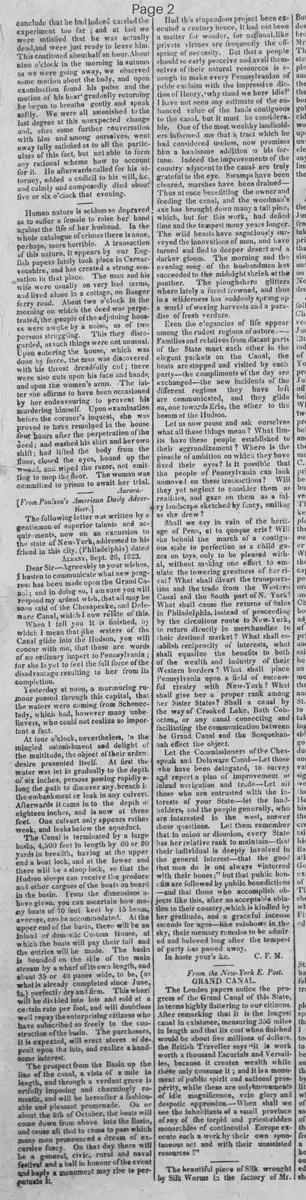
[From Poulson's American Daily Advertiser.]
The following letter was written by a gentleman of superior talents and acquirements, now on an excursion to the state of New-York, addressed to his friend in this city, (Philadelphia) dated ALBANY, Sept. 26, 1823.
Dear Sir—Agreeably to your wishes, I hasten to communicate what new progress has been made upon the Grand Canal; and in doing so, I am sure you will respond my ardent wish, that all may be soon said of the Chesapeake, and Delaware Canal, which I now relate of this. When I tell you it is finished, by which I mean that the waters of the Canal glide into the Hudson, you will concur with me, that these are words of no ordinary import to Pennsylvania; for she is yet to feel the full force of the disadvantage resulting to her from its completion.
Yesterday at noon, a murmuring rumour passed through this capital, that the waters were coming from Schenectady, which had, however many unbelievers, who could not realize so important a fact. At four o'clock, nevertheless, on the mingled astonishment and delight of the multitude, the object of their ardent desire presented itself. At first the water was let in gradually to the depth of six inches, persons passing rapidly along the path to discover any breach in the embankment or leak in any culvert. Afterwards it came in to the depth of eighteen inches, and is now at three feet. One culvert only appears rather weak, and leaks below the aqueduct.
The Canal is terminated by a large basin, 4,500 feet in length by 60 or 80 yards in breadth, having at the upper end a boat lock, and at the lower end there will be a sloop lock, so that the Hudson sloops can receive the produce and other cargoes of the boats on board in the basin. From the dimensions above given, you can ascertain how many boats of 70 feet keel by 15 beam, average, can be accommodated. At the upper end of the basin, there will be an inland or domestic Custom House, at which the boats will pay their toll and the entries will be made. The basin is bounded on the side of the main stream by a wharf of its own length, and about 35 or 40 paces wide, to be, (as what is already completed since June; is) perfectly dry and firm. This wharf will be divided into lots and sold at a certain rate per foot, and will doubtless well repay the enterprising citizens who have subscribed so freely to the construction of the basin. The purchasers, it is expected, will erect stores of deposit upon the lots, and realize a handsome interest.
The prospect from the Basin up the line of the canal, a vista of a mile in length, and through a verdant grove is artfully imposing and charmingly romantic, and will be hereafter a fashionable and pleasant promenade. On or about the 8th of October, the boats will come down from above into the Basin, and cause all that to come to pass which many men pronounced a dream of excursive fancy. On that day there will be a general, civic, rural and naval festival and a ball in honour of the event and haply a monument may rise to perpetuate it.
Had this stupendous project been executed a century hence, it had not been a matter for wonder, for national, like private virtues are frequently the offspring of necessity. But that a people should so early perceive and avail themselves of their natural resources is enough to make every Pennsylvanian of pride exclaim with the impressive diction of Henry, 'why stand we here idle?'
I have not seen any estimate of the enhanced value of the lands contiguous to the canal, but it must be considerable. One of the most wealthy landholders informed me that a tract which he had considered useless, now promises him a handsome addition to his fortune. Indeed the improvements of the country adjacent to the canal are truly grateful to the eye. Swamps have been cleared, marshes have been drained—Thus at once benefitting the owner and feeding the canal, and the woodman's axe has brought down many a tall pine, which, but for this work, had defied time and the tempest many years longer. The wild beasts have sagaciously surveyed the innovations of men, and have turned and fled to deeper desert and a darker gloom. The morning and the evening song of the husbandmen has succeeded to the midnight shriek of the panther. The ploughshare glitters where lately a forest frowned, and thus in a wilderness has suddenly sprung up a world of waving harvests and a paradise of fresh verdure.
Even the elegancies of life appear among the rudest regions of nature. Families and relatives from distant parts of the State meet each other in the elegant packets on the Canal, the boats are stopped and visited by each party—the compliments of the day are exchanged—the new incidents of the different regions they have left are communicated, and they glide on, one towards Erie, the other to the bosom of the Hudson.
Let us now pause and ask ourselves what all these things mean? What limits have these people established to their aggrandizement? Where is the pinnacle of ambition on which they have fixed their eyes? Is it possible that the people of Pennsylvania can look unmoved on these transactions? Will they yet neglect to consider them as realities, and gaze on them as a fairy landscape sketched by fancy, smiling as she drew?
Shall we say in vain of the heritage of Penn, et tu quoque eris? Will she behold the march of a contiguous state to perfection as a child gazes on toys, only to be pleased withal, without making one effort to emulate the towering greatness of her rival? What shall divert the transportation and the trade from the Western Canal and the South part of N. York? What shall cause the returns of Sales in Philadelphia, instead of proceeding by the circuitous route to New-York, to return directly in merchandize to their destined market? What shall establish reciprocity of interests, what shall equalize the benefits to both of the wealth and industry of their Western borders? What shall place Pennsylvania upon a field of successful rivalry with New-York? What shall give her a proper rank among her Sister States? Shall a canal by the way of Crooked Lake, Bath, Cohocton, or any canal connecting and facilitating the communication between the Grand Canal and the Susquehannah effect the object.
Let the Commissioners of the Chesapeake and Delaware Canal—Let those who have been delegated, to survey and report a plan of improvement of inland navigation and trade—Let all those who are entrusted with the interests of your State—let the landholders, and the people generally, who are interested in the west, answer these questions. Let them remember that in union or disunion, every State has her relative rank to maintain—that their individual is deeply involved in the general interest—that the good that men do is not always "interred with their bones;" but that public benefits are followed by public benedictions—and that those who accomplish objects like this, after an acceptable oblation to their country, which is kindled by her gratitude, and a graceful incense ascends for ages—like rainbows in the sky, their memory remains to be admired and beloved long after the tempest of party has passed away.
In haste yours &c.
C. F. M.
From the New-York E. Post.
GRAND CANAL.
The London papers notice the progress of the Grand Canal of this State, in terms highly flattering to our citizens. After remarking that it is the longest canal in existence, measuring 353 miles in length and that its cost when finished would be about five millions of dollars, the British Traveller says "it is work worth a thousand Escurials and Versailles, because it creates wealth while these only consume it; and it is a monument of public spirit and national prosperity, while these are only monuments of idle magnificence, vain glory and despotic oppression.—When shall we see the inhabitants of a small province of any of the torpid and priest-ridden monarchies of continental Europe execute such a work by their own spontaneous act and with their unassisted resources?"
What sub-type of article is it?
What keywords are associated?
What entities or persons were involved?
Where did it happen?
Domestic News Details
Primary Location
Albany, New York
Event Date
Sept. 26, 1823
Key Persons
Outcome
waters successfully let into the canal basin to a depth of three feet with one minor leak; future boat arrivals expected on or about october 8, 1823, with festival; enhanced land values and regional improvements reported.
Event Details
Letter reports the completion of the Grand Canal to the Hudson River, with waters arriving from Schenectady on September 25, 1823, observed in Albany; describes basin dimensions, locks, wharf, custom house, and prospects for trade and promenades; urges Pennsylvania to develop competing canals like Chesapeake and Delaware to rival New York's advantages; includes praise from London papers via New-York Evening Post on the canal's significance.