Thank you for visiting SNEWPapers!
Sign up free
Literary
April 12, 1843
The North Carolina Standard
Raleigh, Wake County, North Carolina
What is this article about?
In early 19th-century Georgia Appalachians, blacksmith Ned Forgeron, a bully who assaults Methodist preachers, is subdued and converted by the sturdy Rev. Mr. Stubbleworth, who beats him into submission and inspires his religious awakening, transforming him into a Methodist preacher.
Clipping
OCR Quality
98%
Excellent
Full Text
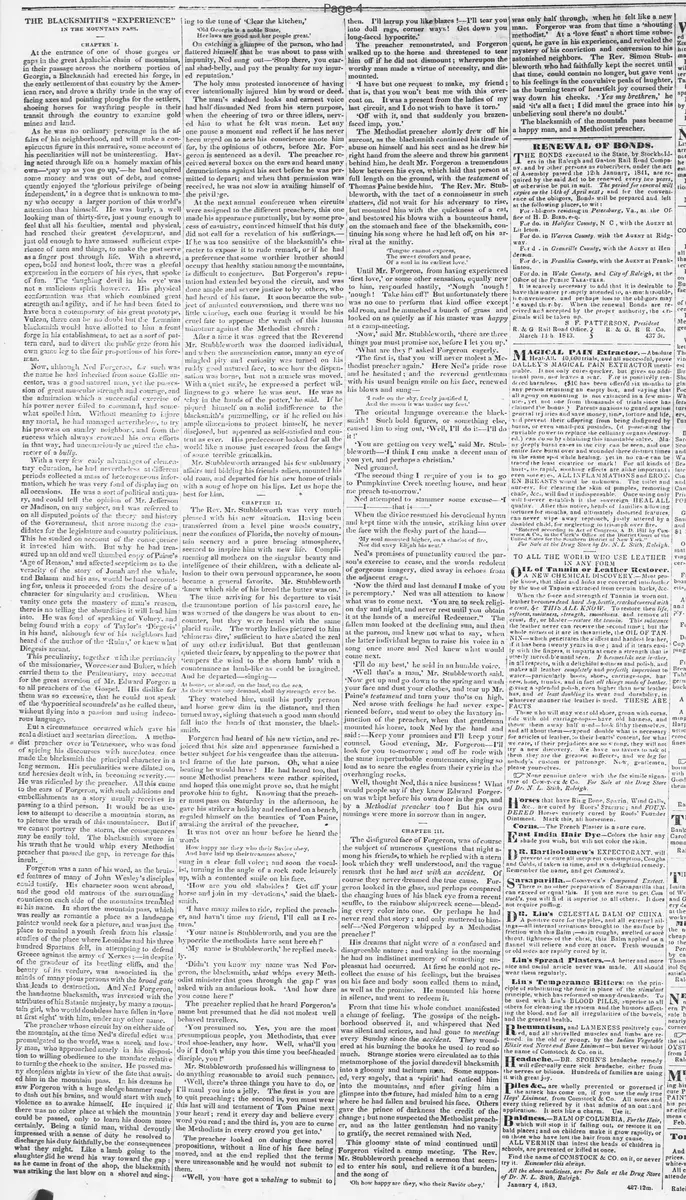
At the entrance of one of those gorges or gaps in the great Appalachian chain of mountains, in their passage across the northern portion of Georgia, a blacksmith had erected his forge, in the early settlement of that country by the American race, and drove a thrifty trade in the way of facing axes and pointing ploughs for the settlers, shoeing horses for wayfaring people in their transit through the country to examine gold mines and land.
As he was no ordinary personage in the affairs of his neighborhood, and will make a conspicuous figure in this narrative, some account of his peculiarities will not be uninteresting. Having acted through life on a homely maxim of his own—'pay up as you go up,'—he had acquired some money and was out of debt, and consequently enjoyed the 'glorious privilege of being independent,' in a degree that is unknown to many who occupy a larger portion of this world's attention than himself. He was burly, a well looking man of thirty-five, just young enough to feel that all his faculties, mental and physical, had reached their greatest development, and just old enough to have amassed sufficient experience of men and things, to make the past serve as a finger post through life. With a shrewd, open, bold and honest look, there was a gleeful expression in the corners of his eyes, that spoke of fun. The laughing devil in his eye was not a malicious spirit however. His physical conformation was that which combined great strength and agility, and if he had been fated to have been a contemporary of his great prototype, Vulcan, there can be no doubt but the Lemnian blacksmith would have allotted to him a front forge in his establishment, to act as a sort of pattern card, and to divert the public gaze from his own game leg to the fair proportions of his foreman.
Now, although Ned Forgeron, for such was the name he had inherited from some Gallic ancestor, was a good natured man, yet the possession of great muscular strength and courage, and the admiration which a successful exercise of his power never failed to command, had somewhat spoiled him. Without meaning to injure any mortal, he had managed nevertheless, to try his prowess on sundry neighbors, and from the success which always crowned his own efforts in that way, had unconsciously acquired the character of a bully.
With a very few early advantages of elementary education, he had nevertheless at different periods collected a mass of heterogeneous information, which he was very fond of displaying on all occasions. He was a sort of political antiquary, and could tell the opinion of Mr. Jefferson or Madison, on any subject, and was referred to on all disputed points of the theory and history of the Government, that arose among the candidates for the legislature and country politicians. This he studied on account of the consequence it invested him with. But why he had treasured up an old and well thumbed copy of Paine's 'Age of Reason,' and affected scepticism as to the veracity of the story of Jonah and the whale, and Balaam and his ass, would be hard accounting for, unless it proceeded from the desire of a character for singularity and erudition. When vanity once gets the mastery of man's reason, there is no telling the absurdities it will lead him into. He was fond of speaking of Volney, and being found with a copy of Taylor's 'Diegesis' in his hand, although few of his neighbors had heard of the author of the 'Ruins,' or knew what Diegesis meant.
This peculiarity, together with the pertinacity of the missionaries, Worcester and Butler, which carried them to the Penitentiary, may account for the great aversion of Mr. Edward Forgeron to all preachers of the Gospel. His dislike for them was so excessive, that he could not speak of the 'hypocritical scoundrels' as he called them, without flying into a passion and using indecorous language.
But a circumstance occurred which gave his zeal a distinct and sectarian direction. A Methodist preacher over in Tennessee, who was fond of spicing his discourses with anecdotes, once made the blacksmith the principal character in a long sermon. His peculiarities were dilated on, and heresies dealt with, in becoming severity. He was ridiculed by the preacher. All this came to the ears of Forgeron, with such additions and embellishments as a story usually receives in passing to a third person. It would be as useless to attempt to describe a mountain storm, as to picture the wrath of this mountaineer.
But if we cannot portray the storm, the consequences may be easily told. The blacksmith swore in his wrath that he would whip every Methodist preacher that passed the gap, in revenge for this insult.
Forgeron was a man of his word, as the bruised features of many of John Wesley's disciples could testify. His character soon went abroad, and the good old matrons of the surrounding counties on each side of the mountains trembled at his name. In short the mountain pass, which was really as romantic a place as a landscape painter would seek for a picture, and was just the place to remind a youth fresh from his classic studies of the place where Leonidas and his three hundred Spartans fell, in attempting to defend Greece against the army of Xerxes;—in despite of the grandeur of its beetling cliffs, and the beauty of its verdure, was associated in the minds of many pious persons with the broad gate that leads to destruction. And Ned Forgeron, the handsome blacksmith, was invested with the attributes of his Satanic majesty, by many a mountain girl, who would doubtless have fallen in 'love at first sight' with him, under any other name.
The preacher whose circuit lay on either side of the mountain, at the time Ned's direful edict was promulgated to the world, was a meek and lowly man, who approached nearly in his disposition to willing obedience to the mandate relative to turning the cheek to the smiter. He passed many sleepless nights in view of the fate that awaited him in the mountain pass. In his dreams he saw Forgeron with a huge sledgehammer ready to dash out his brains, and would start with such violence as to awake himself. He inquired if there was no other place at which the mountain could be passed, only to learn his doom more certainly. Being a timid man, withal devoutly impressed with a sense of duty he resolved to discharge his duty faithfully, be the consequences what they might. Like a lamb going to the slaughter did he wend his way toward the gap: as he came in front of the shop, the blacksmith was striking the last blow on a shovel and singing to the tune of 'Clear the kitchen,'
'Old Georgia is a noble State,
Her laws are good and her people great.'
On catching a glimpse of the parson, who had flattered himself that he was about to pass with impunity, Ned sung out—'Stop there, you eternal shad-belly, and pay the penalty for my injured reputation.'
The holy man protested innocence of having ever intentionally injured him by word or deed. The man's subdued looks and earnest voice had half dissuaded Ned from his stern purpose, when the cheering of two or three idlers, nerved him to what he felt was mean. Let any one pause a moment and reflect if he has never been urged on to acts his conscience smote him for, by the opinions of others, before Mr. Forgeron is sentenced as a devil. The preacher received several boxes on the ears and heard many denunciations against his sect before he was permitted to depart; and when that permission was received, he was not slow in availing himself of the privilege.
At the next annual conference when circuits were assigned to the different preachers, this one made his appearance punctually, but by some process of casuistry, convinced himself that his duty did not call for a revelation of his sufferings. If he was too sensitive of the blacksmith's character to expose it to rude remark, or if he had a preference that some worthier brother should occupy that healthy station among the mountains, is difficult to conjecture. But Forgeron's reputation had extended beyond the circuit, and was done ample and severe justice to by others, who had heard of his fame. It soon became the subject of animated conversation, and there was no little wincing, each one fearing it would be his cruel fate to appease the wrath of this human minotaur against the Methodist church:
After a time it was agreed that the Reverend Mr. Stubbleworth was the doomed individual, and when the annunciation came, many an eye of mingled pity and curiosity was turned on his ruddy good natured face, to see how the dispensation was borne, but not a muscle was moved. With a quiet smile, he expressed a perfect willingness to go where he was sent. He was as 'clay in the hands of the potter,' he said. If he piqued himself on a solid indifference to the blacksmith's pummelling, or if he relied on his ample dimensions to protect himself, he never disclosed, but appeared as self-satisfied and content as ever.
His predecessor looked for all the world like a mouse just escaped from the fangs of some terrible grimalkin.
Mr. Stubbleworth arranged his few sublunary affairs and bidding his friends adieu, mounted his old roan, and departed for his new home of trials with a song of hope on his lips. Let us hope the best for him.
CHAPTER II.
The Rev. Mr. Stubbleworth was very much pleased with his new situation. Having been transferred from a level pine woods country, near the confines of Florida, the novelty of mountain scenery and a pure bracing atmosphere, seemed to inspire him with new life. Complimenting all mothers on the singular beauty and intelligence of their children, with a delicate allusion to their own personal appearance, he soon became a general favorite. Mr. Stubbleworth 'knew which side of his bread the butter was on.'
The time arriving for his departure to visit the tramontane portion of his pastoral care, he was warned of the dangers he was about to encounter, but they were heard with the same placid smile. The worthy ladies pictured to him 'chimeras dire,' sufficient to have abated the zeal of any other individual. But that gentleman quieted their fears, by appealing to the power that 'tempers the wind to the shorn lamb' with a countenance as lamb-like as could be imagined. And he departed—singing
At home, or abroad, on the land, on the sea,
As their wants may demand, shall thy strength ever be.
They watched him, until his portly person and horse grew dim in the distance, and then turned away, sighing that such a good man should fall into the hands of that monster, the blacksmith.
CHAPTER III.
Forgeron had heard of his new victim, and rejoiced that his size and appearance furnished a better subject for his vengeance than the attenuated frame of the late parson. Oh, what a nice beating he would have! He had heard too, that some Methodist preachers were rather spirited, and hoped this one might prove so, that he might provoke him to fight. Knowing that the preacher must pass on Saturday in the afternoon, he gave his striker a holiday and reclined on a bench, regaled himself on the beauties of Tom Paine, awaiting the arrival of the preacher.
It was not over an hour before he heard the words
How happy are they who their Savior obey,
And have laid up their treasures above,'
sung in a clear full voice; and soon the vocalist, turning in the angle of a rock rode leisurely up, with a contented smile on his face.
'How are you old slabsides? Get off your horse and join in my devotions,' said the blacksmith.
'I have many miles to ride, replied the preacher, and haven't time my friend, I'll call as I return.'
'Your name is Stubbleworth, and you are the hypocrite the Methodists have sent here eh?'
'My name is Stubbleworth,' he replied meekly.
'Didn't you know my name was Ned Forgeron, the blacksmith, what whips every Methodist minister that goes through the gap?' was asked with an audacious look. 'And how dare you come here?'
The preacher replied that he heard Forgeron's name but presumed that he did not molest well behaved travellers.
'You presumed so. Yes, you are the most presumptuous people, you Methodists, that ever trod shoe-leather, anyhow. Well, what'll you do if I don't whip you this time you beef-headed disciple, you?'
Mr. Stubbleworth professed his willingness to do anything reasonable to avoid such penance.
'Well, there's three things you have to do, or I'll maul you into a jelly. The first is you are to quit preaching; the second is, you must wear this last will and testament of Tom Paine next your heart; read it every day and believe every word you read; and the third is, you are to curse the Methodists in every crowd you get into.'
The preacher looked on during these novel propositions, without a line of his face being moved, and at the end replied that the terms were unreasonable and he would not submit to them.
'Well, you have got a whaling to submit to then. I'll larrup you like blazes!—I'll tear you into doll rags, corner ways! Get down you long-faced hypocrite.'
The preacher remonstrated, and Forgeron walked up to the horse and threatened to tear him off if he did not dismount; whereupon the worthy man made a virtue of necessity, and dismounted.
'I have but one request to make, my friend; that is, that you won't beat me with this overcoat on. It was a present from the ladies of my last circuit, and I do not wish to have it torn.'
'Off with it, and that suddenly you brazen-faced imp, you.'
The Methodist preacher slowly drew off his surcoat, as the blacksmith continued his tirade of abuse on himself and his sect and as he drew his right hand from the sleeve and threw his garment behind him, he dealt Mr. Forgeron a tremendous blow between his eyes, which laid that person at full length on the ground, with the testament of Thomas Paine beside him. The Rev. Mr. Stubbleworth, with the tact of a connoisseur in such matters, did not wait for his adversary to rise, but mounted him with the quickness of a cat, and bestowed his blows with a bounteous hand, on the stomach and face of the blacksmith, continuing his song where he had left off, on his arrival at the smithy.
'Tongue cannot express,
The sweet comfort and peace,
Of a soul in its earliest love.'
Until Mr. Forgeron, from having experienced 'first love,' or some other sensation, equally new to him, responded hastily,
'Nough! 'Nough! Take him off!' But unfortunately there was no one to perform that kind office except old roan, and he munched a bunch of grass and looked on as quietly as if his master was happy at a camp-meeting.
'Now,' said Mr. Stubbleworth, 'there are three things you must promise me, before I let you up.'
'What are they?' asked Forgeron eagerly.
The first is, that you will never molest a Methodist preacher again.' Here Ned's pride rose and he hesitated; and the reverend gentleman with his usual benign smile on his face, renewed his blows and sung
I rode on the sky, freely justified I,
And the moon it was under my feet.'
The oriental language overcame the blacksmith! Such bold figures, or something else, caused him to sing out, 'Well, I'll do it—I'll do it!'
'You are getting on very well,' said Mr. Stubbleworth—'I think I can make a decent man of you yet, and perhaps a Christian.'
Ned groaned.
'The second thing I require of you is to go to Pumpkinvine Creek meeting house, and hear me preach to-morrow.'
Ned attempted to stammer some excuse—
'I—that is—'
When the divine resumed his devotional hymn and kept time with the music, striking him over the face with the fleshy part of the hand—
'My soul mounted higher, on a chariot of fire,
Nor did envy Elijah his seat.'
Ned's promises of punctuality caused the parson's exercise to cease, and the words redolent of gorgeous imagery, died away in echoes from the adjacent crags.
'Now the third and last demand I make of you is peremptory.'
Ned was all attention to know what was to come next.
'You are to seek religion day and night, and never rest until you obtain it at the hands of a merciful Redeemer.'
The fallen man looked at the declining sun, and then at the parson, and knew not what to say, when the latter individual began to raise his voice in a song once more and Ned knew what would come next.
'I'll do my best,' he said in a humble voice.
'Well that's a man,' Mr. Stubbleworth said. 'Now get up and go down to the spring and wash your face and dust your clothes, and tear up Mr. Paine's testament and turn your thoughts on high.'
Ned arose with feelings he had never experienced before, and went to obey the lavatory injunction of the preacher, when that gentleman mounted his horse, took Ned by the hand and said:—Keep your promises and I'll keep your counsel.
Good evening, Mr. Forgeron—I'll look for you to-morrow; and off he rode with the same imperturbable countenance, singing so loud as to scare the eagles from their eyrie in the overhanging rocks.
Well, thought Ned, this a nice business! What would people say if they knew Edward Forgeron was whipt before his own door in the gap, and by a Methodist preacher too? But his own musings were more in sorrow than in anger.
The disfigured face of Forgeron, was of course the subject of numerous questions that night among his friends, to which he replied with a stern look which they well understood, and the vague remark that he had met with an accident. Of course they never dreamed the true cause. Forgeron looked in the glass, and perhaps compared the changing hues of his black eye from a recent scuffle, to the rainbow shipwreck scene—blending every color into one. Or perhaps he had never read that story; and only muttered to himself—'Ned Forgeron whipped by a Methodist preacher?'
His dreams that night were of a confused and disagreeable nature; and waking in the morning he had an indistinct memory of something unpleasant had occurred. At first he could not recollect the cause of his feelings, but the bruises on his face and body soon called them to mind, as well as the promise. He mounted his horse in silence, and went to redeem it.
From that time his whole conduct manifested a change of feeling. The gossips of the neighborhood observed it, and whispered that Ned was silent and serious, and had gone to meeting every Sunday since the accident. They wondered at his burning the books he used to read so much. Strange stories were circulated as to this metamorphose of the jovial daredevil blacksmith into a gloomy and taciturn man. Some supposed, very sagely, that a spirit had enticed him into the mountains, and after giving him a glimpse into the future, had misled him to a crag where he had fallen and bruised his face. Others gave the prince of darkness the credit of the change; but none suspected the Methodist preacher, and as the latter gentleman had no vanity to gratify, the secret remained with Ned.
This gloomy state of mind continued until Forgeron visited a camp meeting. The Rev. Mr. Stubbleworth preached a sermon that seemed to enter his soul, and relieve it of a burden, and the song of
'Oh how happy are they, who their Savior obey,'
was only half through, when he felt like a new man. Forgeron was from that time a 'shouting Methodist.' At a love feast a short time subsequent, he gave in his experience, and revealed the mystery of his conviction and conversion to his astonished neighbors. The Rev. Simon Stubbleworth who had faithfully kept the secret until that time, could contain no longer, but gave vent to his feelings in the convulsive peals of laughter, as the burning tears of heartfelt joy coursed their way down his cheeks. 'Yes my brethren,' he said it's all a fact; I did maul the grace into his unbelieving soul there's no doubt.'
The blacksmith of the mountain pass became a happy man, and a Methodist preacher.
As he was no ordinary personage in the affairs of his neighborhood, and will make a conspicuous figure in this narrative, some account of his peculiarities will not be uninteresting. Having acted through life on a homely maxim of his own—'pay up as you go up,'—he had acquired some money and was out of debt, and consequently enjoyed the 'glorious privilege of being independent,' in a degree that is unknown to many who occupy a larger portion of this world's attention than himself. He was burly, a well looking man of thirty-five, just young enough to feel that all his faculties, mental and physical, had reached their greatest development, and just old enough to have amassed sufficient experience of men and things, to make the past serve as a finger post through life. With a shrewd, open, bold and honest look, there was a gleeful expression in the corners of his eyes, that spoke of fun. The laughing devil in his eye was not a malicious spirit however. His physical conformation was that which combined great strength and agility, and if he had been fated to have been a contemporary of his great prototype, Vulcan, there can be no doubt but the Lemnian blacksmith would have allotted to him a front forge in his establishment, to act as a sort of pattern card, and to divert the public gaze from his own game leg to the fair proportions of his foreman.
Now, although Ned Forgeron, for such was the name he had inherited from some Gallic ancestor, was a good natured man, yet the possession of great muscular strength and courage, and the admiration which a successful exercise of his power never failed to command, had somewhat spoiled him. Without meaning to injure any mortal, he had managed nevertheless, to try his prowess on sundry neighbors, and from the success which always crowned his own efforts in that way, had unconsciously acquired the character of a bully.
With a very few early advantages of elementary education, he had nevertheless at different periods collected a mass of heterogeneous information, which he was very fond of displaying on all occasions. He was a sort of political antiquary, and could tell the opinion of Mr. Jefferson or Madison, on any subject, and was referred to on all disputed points of the theory and history of the Government, that arose among the candidates for the legislature and country politicians. This he studied on account of the consequence it invested him with. But why he had treasured up an old and well thumbed copy of Paine's 'Age of Reason,' and affected scepticism as to the veracity of the story of Jonah and the whale, and Balaam and his ass, would be hard accounting for, unless it proceeded from the desire of a character for singularity and erudition. When vanity once gets the mastery of man's reason, there is no telling the absurdities it will lead him into. He was fond of speaking of Volney, and being found with a copy of Taylor's 'Diegesis' in his hand, although few of his neighbors had heard of the author of the 'Ruins,' or knew what Diegesis meant.
This peculiarity, together with the pertinacity of the missionaries, Worcester and Butler, which carried them to the Penitentiary, may account for the great aversion of Mr. Edward Forgeron to all preachers of the Gospel. His dislike for them was so excessive, that he could not speak of the 'hypocritical scoundrels' as he called them, without flying into a passion and using indecorous language.
But a circumstance occurred which gave his zeal a distinct and sectarian direction. A Methodist preacher over in Tennessee, who was fond of spicing his discourses with anecdotes, once made the blacksmith the principal character in a long sermon. His peculiarities were dilated on, and heresies dealt with, in becoming severity. He was ridiculed by the preacher. All this came to the ears of Forgeron, with such additions and embellishments as a story usually receives in passing to a third person. It would be as useless to attempt to describe a mountain storm, as to picture the wrath of this mountaineer.
But if we cannot portray the storm, the consequences may be easily told. The blacksmith swore in his wrath that he would whip every Methodist preacher that passed the gap, in revenge for this insult.
Forgeron was a man of his word, as the bruised features of many of John Wesley's disciples could testify. His character soon went abroad, and the good old matrons of the surrounding counties on each side of the mountains trembled at his name. In short the mountain pass, which was really as romantic a place as a landscape painter would seek for a picture, and was just the place to remind a youth fresh from his classic studies of the place where Leonidas and his three hundred Spartans fell, in attempting to defend Greece against the army of Xerxes;—in despite of the grandeur of its beetling cliffs, and the beauty of its verdure, was associated in the minds of many pious persons with the broad gate that leads to destruction. And Ned Forgeron, the handsome blacksmith, was invested with the attributes of his Satanic majesty, by many a mountain girl, who would doubtless have fallen in 'love at first sight' with him, under any other name.
The preacher whose circuit lay on either side of the mountain, at the time Ned's direful edict was promulgated to the world, was a meek and lowly man, who approached nearly in his disposition to willing obedience to the mandate relative to turning the cheek to the smiter. He passed many sleepless nights in view of the fate that awaited him in the mountain pass. In his dreams he saw Forgeron with a huge sledgehammer ready to dash out his brains, and would start with such violence as to awake himself. He inquired if there was no other place at which the mountain could be passed, only to learn his doom more certainly. Being a timid man, withal devoutly impressed with a sense of duty he resolved to discharge his duty faithfully, be the consequences what they might. Like a lamb going to the slaughter did he wend his way toward the gap: as he came in front of the shop, the blacksmith was striking the last blow on a shovel and singing to the tune of 'Clear the kitchen,'
'Old Georgia is a noble State,
Her laws are good and her people great.'
On catching a glimpse of the parson, who had flattered himself that he was about to pass with impunity, Ned sung out—'Stop there, you eternal shad-belly, and pay the penalty for my injured reputation.'
The holy man protested innocence of having ever intentionally injured him by word or deed. The man's subdued looks and earnest voice had half dissuaded Ned from his stern purpose, when the cheering of two or three idlers, nerved him to what he felt was mean. Let any one pause a moment and reflect if he has never been urged on to acts his conscience smote him for, by the opinions of others, before Mr. Forgeron is sentenced as a devil. The preacher received several boxes on the ears and heard many denunciations against his sect before he was permitted to depart; and when that permission was received, he was not slow in availing himself of the privilege.
At the next annual conference when circuits were assigned to the different preachers, this one made his appearance punctually, but by some process of casuistry, convinced himself that his duty did not call for a revelation of his sufferings. If he was too sensitive of the blacksmith's character to expose it to rude remark, or if he had a preference that some worthier brother should occupy that healthy station among the mountains, is difficult to conjecture. But Forgeron's reputation had extended beyond the circuit, and was done ample and severe justice to by others, who had heard of his fame. It soon became the subject of animated conversation, and there was no little wincing, each one fearing it would be his cruel fate to appease the wrath of this human minotaur against the Methodist church:
After a time it was agreed that the Reverend Mr. Stubbleworth was the doomed individual, and when the annunciation came, many an eye of mingled pity and curiosity was turned on his ruddy good natured face, to see how the dispensation was borne, but not a muscle was moved. With a quiet smile, he expressed a perfect willingness to go where he was sent. He was as 'clay in the hands of the potter,' he said. If he piqued himself on a solid indifference to the blacksmith's pummelling, or if he relied on his ample dimensions to protect himself, he never disclosed, but appeared as self-satisfied and content as ever.
His predecessor looked for all the world like a mouse just escaped from the fangs of some terrible grimalkin.
Mr. Stubbleworth arranged his few sublunary affairs and bidding his friends adieu, mounted his old roan, and departed for his new home of trials with a song of hope on his lips. Let us hope the best for him.
CHAPTER II.
The Rev. Mr. Stubbleworth was very much pleased with his new situation. Having been transferred from a level pine woods country, near the confines of Florida, the novelty of mountain scenery and a pure bracing atmosphere, seemed to inspire him with new life. Complimenting all mothers on the singular beauty and intelligence of their children, with a delicate allusion to their own personal appearance, he soon became a general favorite. Mr. Stubbleworth 'knew which side of his bread the butter was on.'
The time arriving for his departure to visit the tramontane portion of his pastoral care, he was warned of the dangers he was about to encounter, but they were heard with the same placid smile. The worthy ladies pictured to him 'chimeras dire,' sufficient to have abated the zeal of any other individual. But that gentleman quieted their fears, by appealing to the power that 'tempers the wind to the shorn lamb' with a countenance as lamb-like as could be imagined. And he departed—singing
At home, or abroad, on the land, on the sea,
As their wants may demand, shall thy strength ever be.
They watched him, until his portly person and horse grew dim in the distance, and then turned away, sighing that such a good man should fall into the hands of that monster, the blacksmith.
CHAPTER III.
Forgeron had heard of his new victim, and rejoiced that his size and appearance furnished a better subject for his vengeance than the attenuated frame of the late parson. Oh, what a nice beating he would have! He had heard too, that some Methodist preachers were rather spirited, and hoped this one might prove so, that he might provoke him to fight. Knowing that the preacher must pass on Saturday in the afternoon, he gave his striker a holiday and reclined on a bench, regaled himself on the beauties of Tom Paine, awaiting the arrival of the preacher.
It was not over an hour before he heard the words
How happy are they who their Savior obey,
And have laid up their treasures above,'
sung in a clear full voice; and soon the vocalist, turning in the angle of a rock rode leisurely up, with a contented smile on his face.
'How are you old slabsides? Get off your horse and join in my devotions,' said the blacksmith.
'I have many miles to ride, replied the preacher, and haven't time my friend, I'll call as I return.'
'Your name is Stubbleworth, and you are the hypocrite the Methodists have sent here eh?'
'My name is Stubbleworth,' he replied meekly.
'Didn't you know my name was Ned Forgeron, the blacksmith, what whips every Methodist minister that goes through the gap?' was asked with an audacious look. 'And how dare you come here?'
The preacher replied that he heard Forgeron's name but presumed that he did not molest well behaved travellers.
'You presumed so. Yes, you are the most presumptuous people, you Methodists, that ever trod shoe-leather, anyhow. Well, what'll you do if I don't whip you this time you beef-headed disciple, you?'
Mr. Stubbleworth professed his willingness to do anything reasonable to avoid such penance.
'Well, there's three things you have to do, or I'll maul you into a jelly. The first is you are to quit preaching; the second is, you must wear this last will and testament of Tom Paine next your heart; read it every day and believe every word you read; and the third is, you are to curse the Methodists in every crowd you get into.'
The preacher looked on during these novel propositions, without a line of his face being moved, and at the end replied that the terms were unreasonable and he would not submit to them.
'Well, you have got a whaling to submit to then. I'll larrup you like blazes!—I'll tear you into doll rags, corner ways! Get down you long-faced hypocrite.'
The preacher remonstrated, and Forgeron walked up to the horse and threatened to tear him off if he did not dismount; whereupon the worthy man made a virtue of necessity, and dismounted.
'I have but one request to make, my friend; that is, that you won't beat me with this overcoat on. It was a present from the ladies of my last circuit, and I do not wish to have it torn.'
'Off with it, and that suddenly you brazen-faced imp, you.'
The Methodist preacher slowly drew off his surcoat, as the blacksmith continued his tirade of abuse on himself and his sect and as he drew his right hand from the sleeve and threw his garment behind him, he dealt Mr. Forgeron a tremendous blow between his eyes, which laid that person at full length on the ground, with the testament of Thomas Paine beside him. The Rev. Mr. Stubbleworth, with the tact of a connoisseur in such matters, did not wait for his adversary to rise, but mounted him with the quickness of a cat, and bestowed his blows with a bounteous hand, on the stomach and face of the blacksmith, continuing his song where he had left off, on his arrival at the smithy.
'Tongue cannot express,
The sweet comfort and peace,
Of a soul in its earliest love.'
Until Mr. Forgeron, from having experienced 'first love,' or some other sensation, equally new to him, responded hastily,
'Nough! 'Nough! Take him off!' But unfortunately there was no one to perform that kind office except old roan, and he munched a bunch of grass and looked on as quietly as if his master was happy at a camp-meeting.
'Now,' said Mr. Stubbleworth, 'there are three things you must promise me, before I let you up.'
'What are they?' asked Forgeron eagerly.
The first is, that you will never molest a Methodist preacher again.' Here Ned's pride rose and he hesitated; and the reverend gentleman with his usual benign smile on his face, renewed his blows and sung
I rode on the sky, freely justified I,
And the moon it was under my feet.'
The oriental language overcame the blacksmith! Such bold figures, or something else, caused him to sing out, 'Well, I'll do it—I'll do it!'
'You are getting on very well,' said Mr. Stubbleworth—'I think I can make a decent man of you yet, and perhaps a Christian.'
Ned groaned.
'The second thing I require of you is to go to Pumpkinvine Creek meeting house, and hear me preach to-morrow.'
Ned attempted to stammer some excuse—
'I—that is—'
When the divine resumed his devotional hymn and kept time with the music, striking him over the face with the fleshy part of the hand—
'My soul mounted higher, on a chariot of fire,
Nor did envy Elijah his seat.'
Ned's promises of punctuality caused the parson's exercise to cease, and the words redolent of gorgeous imagery, died away in echoes from the adjacent crags.
'Now the third and last demand I make of you is peremptory.'
Ned was all attention to know what was to come next.
'You are to seek religion day and night, and never rest until you obtain it at the hands of a merciful Redeemer.'
The fallen man looked at the declining sun, and then at the parson, and knew not what to say, when the latter individual began to raise his voice in a song once more and Ned knew what would come next.
'I'll do my best,' he said in a humble voice.
'Well that's a man,' Mr. Stubbleworth said. 'Now get up and go down to the spring and wash your face and dust your clothes, and tear up Mr. Paine's testament and turn your thoughts on high.'
Ned arose with feelings he had never experienced before, and went to obey the lavatory injunction of the preacher, when that gentleman mounted his horse, took Ned by the hand and said:—Keep your promises and I'll keep your counsel.
Good evening, Mr. Forgeron—I'll look for you to-morrow; and off he rode with the same imperturbable countenance, singing so loud as to scare the eagles from their eyrie in the overhanging rocks.
Well, thought Ned, this a nice business! What would people say if they knew Edward Forgeron was whipt before his own door in the gap, and by a Methodist preacher too? But his own musings were more in sorrow than in anger.
The disfigured face of Forgeron, was of course the subject of numerous questions that night among his friends, to which he replied with a stern look which they well understood, and the vague remark that he had met with an accident. Of course they never dreamed the true cause. Forgeron looked in the glass, and perhaps compared the changing hues of his black eye from a recent scuffle, to the rainbow shipwreck scene—blending every color into one. Or perhaps he had never read that story; and only muttered to himself—'Ned Forgeron whipped by a Methodist preacher?'
His dreams that night were of a confused and disagreeable nature; and waking in the morning he had an indistinct memory of something unpleasant had occurred. At first he could not recollect the cause of his feelings, but the bruises on his face and body soon called them to mind, as well as the promise. He mounted his horse in silence, and went to redeem it.
From that time his whole conduct manifested a change of feeling. The gossips of the neighborhood observed it, and whispered that Ned was silent and serious, and had gone to meeting every Sunday since the accident. They wondered at his burning the books he used to read so much. Strange stories were circulated as to this metamorphose of the jovial daredevil blacksmith into a gloomy and taciturn man. Some supposed, very sagely, that a spirit had enticed him into the mountains, and after giving him a glimpse into the future, had misled him to a crag where he had fallen and bruised his face. Others gave the prince of darkness the credit of the change; but none suspected the Methodist preacher, and as the latter gentleman had no vanity to gratify, the secret remained with Ned.
This gloomy state of mind continued until Forgeron visited a camp meeting. The Rev. Mr. Stubbleworth preached a sermon that seemed to enter his soul, and relieve it of a burden, and the song of
'Oh how happy are they, who their Savior obey,'
was only half through, when he felt like a new man. Forgeron was from that time a 'shouting Methodist.' At a love feast a short time subsequent, he gave in his experience, and revealed the mystery of his conviction and conversion to his astonished neighbors. The Rev. Simon Stubbleworth who had faithfully kept the secret until that time, could contain no longer, but gave vent to his feelings in the convulsive peals of laughter, as the burning tears of heartfelt joy coursed their way down his cheeks. 'Yes my brethren,' he said it's all a fact; I did maul the grace into his unbelieving soul there's no doubt.'
The blacksmith of the mountain pass became a happy man, and a Methodist preacher.
What sub-type of article is it?
Prose Fiction
Satire
What themes does it cover?
Religious
Moral Virtue
What keywords are associated?
Blacksmith
Methodist Preacher
Conversion
Mountain Pass
Reformation
Bully
Religious Awakening
Georgia Appalachians
Literary Details
Key Lines
'Old Georgia Is A Noble State,
Her Laws Are Good And Her People Great.'
'How Happy Are They Who Their Savior Obey,
And Have Laid Up Their Treasures Above,'
'Tongue Cannot Express,
The Sweet Comfort And Peace,
Of A Soul In Its Earliest Love.'
'I Rode On The Sky, Freely Justified I,
And The Moon It Was Under My Feet.'
'My Soul Mounted Higher, On A Chariot Of Fire,
Nor Did Envy Elijah His Seat.'