Thank you for visiting SNEWPapers!
Sign up free
The New Hampshire Gazette
Portsmouth, Rockingham County, New Hampshire
What is this article about?
On April 11, in the House of Representatives, Mr. D. R. Williams debated petitions from Massachusetts inhabitants complaining about the embargo preventing fish exports. He argued against claims of peculiar hardships on fishermen, referenced past motions, and suggested amending the resolution to state 'inconvenience' instead.
Clipping
OCR Quality
Full Text
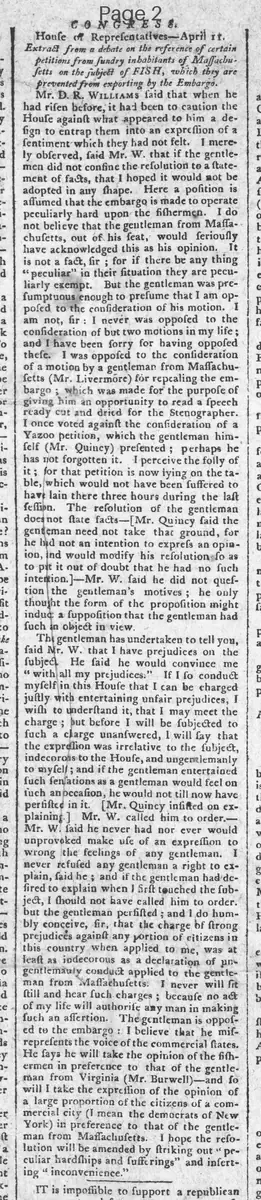
Extract from a debate on the reference of certain petitions from sundry inhabitants of Massachusetts on the subject of FISH, which they are prevented from exporting by the Embargo.
Mr. D. R. Williams said that when he had risen before, it had been to caution the House against what appeared to him a design to entrap them into an expression of a sentiment which they had not felt. I merely observed, said Mr. W. that if the gentlemen did not confine the resolution to a statement of facts, that I hoped it would not be adopted in any shape. Here a position is assumed that the embargo is made to operate peculiarly hard upon the fishermen. I do not believe that the gentleman from Massachusetts, out of his seat, would seriously have acknowledged this as his opinion. It is not a fact, sir; for if there be any thing "peculiar" in their situation they are peculiarly exempt. But the gentleman was presumptuous enough to presume that I am opposed to the consideration of his motion. I am not, sir: I never was opposed to the consideration of but two motions in my life and I have been sorry for having opposed these. I was opposed to the consideration of a motion by a gentleman from Massachusetts (Mr. Livermore) for repealing the embargo; which was made for the purpose of giving him an opportunity to read a speech ready cut and dried for the Stenographer. I once voted against the consideration of a Yazoo petition, which the gentleman himself (Mr. Quincy) presented; perhaps he has not forgotten it. I perceive the folly of it: for that petition is now lying on the table, which would not have been suffered to have lain there three hours during the last session. The resolution of the gentleman does not state facts--[Mr. Quincy said the gentleman need not take that ground, for he had not an intention to express an opinion, and would modify his resolution so as to put it out of doubt that he had no such intention.--Mr. W. said he did not question the gentleman's motives; he only thought the form of the proposition might induce a supposition that the gentleman had such an object in view.]
The gentleman has undertaken to tell you, said Mr. W. that I have prejudices on the subject He said he would convince me "with all my prejudices." If I so conduct myself in this House that I can be charged justly with entertaining unfair prejudices, I wish to understand it, that I may meet the charge; but before I will be subjected to such a charge unanswered, I will say that the expression was irrelevant to the subject indecorous to the House, and ungentlemanly to myself; and if the gentleman entertained such sensations as a gentleman would feel on such an accusation, he would not till now have persisted in it. [Mr. Quincy insisted on explaining.] Mr. W. called him to order. Mr. W. said he never had nor ever would unprovoked make use of an expression to wrong the feelings of any gentleman. I never refused any gentleman a right to explain, said he; and if the gentleman had desired to explain when I first touched the subject, I should not have called him to order. but the gentleman persisted; and I do humbly conceive, sir, that the charge of strong prejudices against any portion of citizens in this country when applied to me, was at least as indecorous as a declaration of ungentlemanly conduct applied to the gentleman from Massachusetts. I never will sit still and hear such charges; because no act of my life will authorize any man in making such an assertion. The gentleman is opposed to the embargo: I believe that he misrepresents the voice of the commercial states. He says he will take the opinion of the fishermen in preference to that of the gentleman from Virginia (Mr. Burwell)--and so will I take the expression of the opinion of a large proportion of the citizens of a commercial city (I mean the democrats of New York) in preference to that of the gentleman from Massachusetts. I hope the resolution will be amended by striking out "peculiar hardships and sufferings" and inserting "inconvenience."
What sub-type of article is it?
What keywords are associated?
What entities or persons were involved?
Where did it happen?
Domestic News Details
Primary Location
House Of Representatives
Event Date
April 11
Key Persons
Outcome
debate on amending resolution to reference 'inconvenience' instead of 'peculiar hardships and sufferings'; no final outcome stated.
Event Details
Mr. D. R. Williams addressed the House on petitions from Massachusetts inhabitants regarding the embargo's impact on fish exports, cautioning against non-factual statements, denying peculiar hardships on fishermen, referencing past opposed motions, defending against charges of prejudice, and suggesting amendment of Mr. Quincy's resolution.