Thank you for visiting SNEWPapers!
Sign up free
Arizona Citizen
Tucson, Florence, Pima County, Pinal County, Arizona
What is this article about?
Report from Pueblo Viejo on January 20, 1875, detailing good health, grain sowing, influx of settlers, cold weather, ongoing valley surveying by T. F. White, availability of cheap water via ditches, need for a blacksmith and mail service, and potential for cotton production in Gila valley, signed by W. A. Holmes. Editor notes efforts to establish postal route.
Clipping
OCR Quality
Full Text
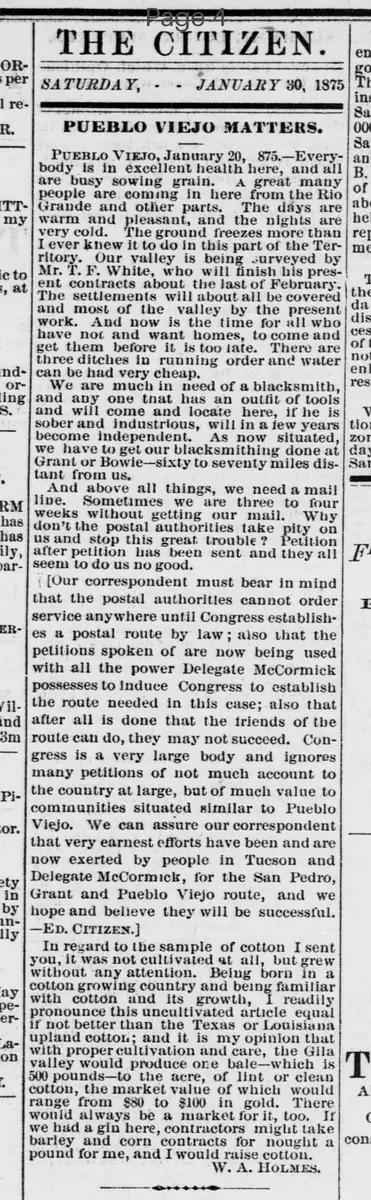
SATURDAY, JANUARY 30, 1875
PUEBLO VIEJO MATTERS.
Pueblo Viejo, January 20, 1875.—Everybody is in excellent health here, and all are busy sowing grain. A great many people are coming in here from the Rio Grande and other parts. The days are warm and pleasant, and the nights are very cold. The ground freezes more than I ever knew it to do in this part of the Territory. Our valley is being surveyed by Mr. T. F. White, who will finish his present contracts about the last of February. The settlements will about all be covered and most of the valley by the present work. And now is the time for all who have not and want homes, to come and get them before it is too late. There are three ditches in running order and water can be had very cheap.
We are much in need of a blacksmith, and any one that has an outfit of tools and will come and locate here, if he is sober and industrious, will in a few years become independent. As now situated, we have to get our blacksmithing done at Grant or Bowie—sixty to seventy miles distant from us.
And above all things, we need a mail line. Sometimes we are three to four weeks without getting our mail. Why don't the postal authorities take pity on us and stop this great trouble? Petition after petition has been sent and they all seem to do us no good.
[Our correspondent must bear in mind that the postal authorities cannot order service anywhere until Congress establishes a postal route by law; also that the petitions spoken of are now being used with all the power Delegate McCormick possesses to induce Congress to establish the route needed in this case; also that after all is done that the friends of the route can do, they may not succeed. Congress is a very large body and ignores many petitions of not much account to the country at large, but of much value to communities situated similar to Pueblo Viejo. We can assure our correspondent that very earnest efforts have been and are now exerted by people in Tucson and Delegate McCormick, for the San Pedro, Grant and Pueblo Viejo route, and we hope and believe they will be successful. —Ed. CITIZEN.]
In regard to the sample of cotton I sent you, it was not cultivated at all, but grew without any attention. Being born in a cotton growing country and being familiar with cotton and its growth, I readily pronounce this uncultivated article equal if not better than the Texas or Louisiana upland cotton; and it is my opinion that with proper cultivation and care, the Gila valley would produce one bale—which is 500 pounds—to the acre, of lint or clean cotton, the market value of which would range from $80 to $100 in gold. There would always be a market for it, too. If we had a gin here, contractors might take barley and corn contracts for nought a pound for me, and I would raise cotton.
W. A. HOLMES.
What sub-type of article is it?
What keywords are associated?
What entities or persons were involved?
Where did it happen?
Domestic News Details
Primary Location
Pueblo Viejo
Event Date
January 20, 1875
Key Persons
Event Details
Local report on health, grain sowing, settler influx from Rio Grande, warm days and cold nights with ground freezing, valley surveying by T. F. White to finish by late February covering settlements, call for people to claim homes with cheap water from three ditches, need for blacksmith due to distance to Grant or Bowie, urgent need for mail line as delays up to four weeks, editor notes congressional efforts via Delegate McCormick for San Pedro-Grant-Pueblo Viejo route, and assessment of wild cotton sample as superior to Texas/Louisiana upland, potential for 500-pound bales per acre worth $80-100 gold with cultivation in Gila valley.