Thank you for visiting SNEWPapers!
Sign up free
Story
March 19, 1897
Griggs Courier
Cooperstown, Griggs County, North Dakota
What is this article about?
Ancient Roman water heaters from 2,000 years ago in Naples museums demonstrate advanced water tube boiler principles similar to modern designs, investigated by Mr. W. T. Bonner of Cincinnati.
Clipping
OCR Quality
98%
Excellent
Full Text
ANCIENT WATER HEATERS.
Two Thousand Years Ago.
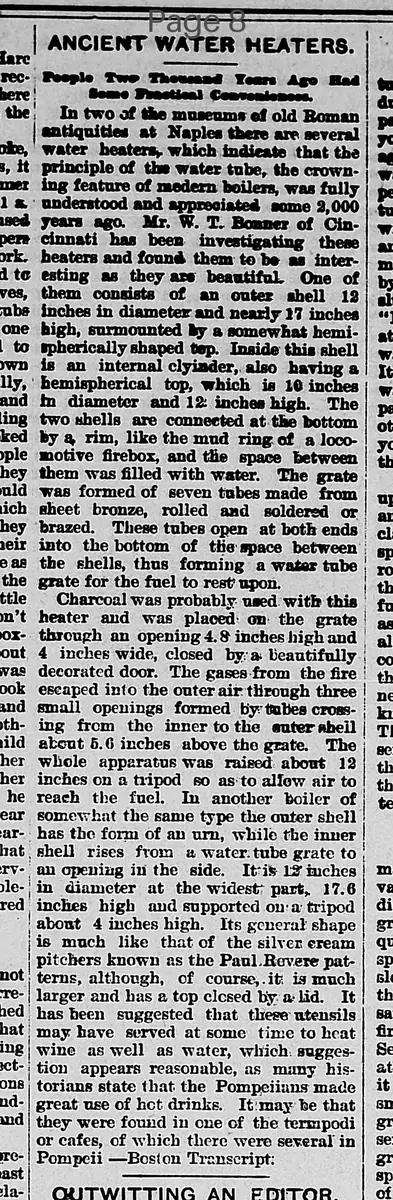
In two of the museums of old Roman antiquities at Naples there are several water heaters, which indicate that the principle of the water tube, the crowning feature of modern boilers, was fully understood and appreciated some 2,000 years ago. Mr. W. T. Bonner's of Cincinnati has been investigating these heaters and found them to be as interesting as they are beautiful. One of them consists of an outer shell 12 inches in diameter and nearly 17 inches high, surmounted by a somewhat hemispherically shaped top. Inside this shell is an internal cylinder, also having a hemispherical top, which is 10 inches in diameter and 12 inches high. The two shells are connected at the bottom by a rim, like the mud ring of a locomotive firebox, and the space between them was filled with water. The grate was formed of seven tubes made from sheet bronze, rolled and soldered or brazed. These tubes open at both ends into the bottom of the space between the shells, thus forming a water tube grate for the fuel to rest upon.
Charcoal was probably used with this heater and was placed on the grate through an opening 4.8 inches high and 4 inches wide, closed by a beautifully decorated door. The gases from the fire escaped into the outer air through three small openings formed by tubes crossing from the inner to the outer shell about 5.6 inches above the grate. The whole apparatus was raised about 12 inches on a tripod so as to allow air to reach the fuel. In another boiler of somewhat the same type the outer shell has the form of an urn, while the inner shell rises from a water tube grate to an opening in the side. It is 15 inches in diameter at the widest part, 17.6 inches high and supported on a tripod about 4 inches high. Its general shape is much like that of the silver cream pitchers known as the Paul Revere patterns, although, of course, it is much larger and has a top closed by a lid. It has been suggested that these utensils may have served at some time to heat wine as well as water, which suggestion appears reasonable, as many historians state that the Pompeiians made great use of hot drinks. It may be that they were found in one of the thermopoli or cafes, of which there were several in Pompeii.
—Boston Transcript.
Two Thousand Years Ago.
In two of the museums of old Roman antiquities at Naples there are several water heaters, which indicate that the principle of the water tube, the crowning feature of modern boilers, was fully understood and appreciated some 2,000 years ago. Mr. W. T. Bonner's of Cincinnati has been investigating these heaters and found them to be as interesting as they are beautiful. One of them consists of an outer shell 12 inches in diameter and nearly 17 inches high, surmounted by a somewhat hemispherically shaped top. Inside this shell is an internal cylinder, also having a hemispherical top, which is 10 inches in diameter and 12 inches high. The two shells are connected at the bottom by a rim, like the mud ring of a locomotive firebox, and the space between them was filled with water. The grate was formed of seven tubes made from sheet bronze, rolled and soldered or brazed. These tubes open at both ends into the bottom of the space between the shells, thus forming a water tube grate for the fuel to rest upon.
Charcoal was probably used with this heater and was placed on the grate through an opening 4.8 inches high and 4 inches wide, closed by a beautifully decorated door. The gases from the fire escaped into the outer air through three small openings formed by tubes crossing from the inner to the outer shell about 5.6 inches above the grate. The whole apparatus was raised about 12 inches on a tripod so as to allow air to reach the fuel. In another boiler of somewhat the same type the outer shell has the form of an urn, while the inner shell rises from a water tube grate to an opening in the side. It is 15 inches in diameter at the widest part, 17.6 inches high and supported on a tripod about 4 inches high. Its general shape is much like that of the silver cream pitchers known as the Paul Revere patterns, although, of course, it is much larger and has a top closed by a lid. It has been suggested that these utensils may have served at some time to heat wine as well as water, which suggestion appears reasonable, as many historians state that the Pompeiians made great use of hot drinks. It may be that they were found in one of the thermopoli or cafes, of which there were several in Pompeii.
—Boston Transcript.
What sub-type of article is it?
Curiosity
Historical Event
What themes does it cover?
Triumph
What keywords are associated?
Ancient Water Heaters
Roman Boiler
Water Tube Principle
Naples Museums
Pompeii Artifacts
What entities or persons were involved?
Mr. W. T. Bonner
Pompeiians
Where did it happen?
Museums Of Old Roman Antiquities At Naples, Pompeii
Story Details
Key Persons
Mr. W. T. Bonner
Pompeiians
Location
Museums Of Old Roman Antiquities At Naples, Pompeii
Event Date
Two Thousand Years Ago
Story Details
Description of two ancient Roman water heaters featuring water tube technology, used possibly for heating water or wine in Pompeii, investigated by Mr. Bonner.