Thank you for visiting SNEWPapers!
Sign up free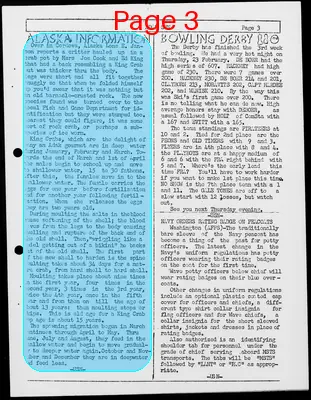
The Adak Sun
Adak, Alaska
What is this article about?
In Cordova, Alaska, Lone E. Jansen reports a strange critter caught in a crab pot by Joe Cook and Ed King, resembling a thicker King Crab with short legs that folds like a rock. Fish and Game Department couldn't identify it, suggesting rock crab or ice worm subspecies. Article includes details on King Crab biology, migration, moulting, and lifespan.
Clipping
OCR Quality
Full Text
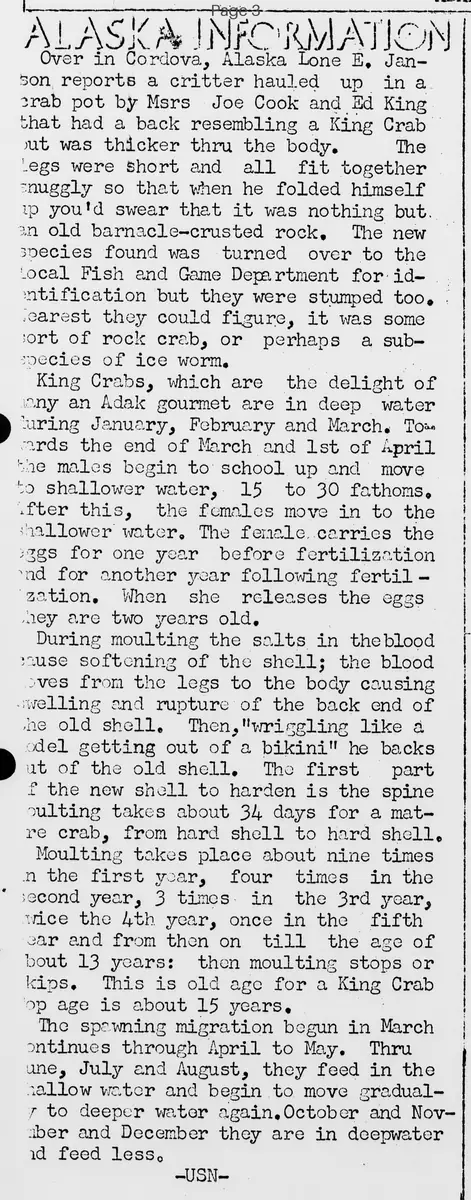
Over in Cordova, Alaska Lone E. Jansen reports a critter hauled up in a crab pot by Messrs Joe Cook and Ed King that had a back resembling a King Crab but was thicker thru the body. The legs were short and all fit together snuggly so that when he folded himself up you'd swear that it was nothing but an old barnacle-crusted rock. The new species found was turned over to the local Fish and Game Department for identification but they were stumped too. Nearest they could figure, it was some sort of rock crab, or perhaps a sub-species of ice worm.
King Crabs, which are the delight of many an Adak gourmet are in deep water during January, February and March. Towards the end of March and 1st of April the males begin to school up and move to shallower water, 15 to 30 fathoms. After this, the females move in to the shallower water. The female carries the eggs for one year before fertilization and for another year following fertilization. When she releases the eggs they are two years old.
During moulting the salts in the blood cause softening of the shell; the blood moves from the legs to the body causing swelling and rupture of the back end of the old shell. Then, "wriggling like a model getting out of a bikini" he backs out of the old shell. The first part of the new shell to harden is the spine. Moulting takes about 3 to 4 days for a mature crab, from hard shell to hard shell. Moulting takes place about nine times in the first year, four times in the second year, 3 times in the 3rd year, twice in the 4th year, once in the fifth year and from then on till the age of about 13 years: then moulting stops or skips. This is old age for a King Crab. Top age is about 15 years.
The spawning migration begun in March continues through April to May. Through June, July and August, they feed in the shallow water and begin to move gradually to deeper water again. October and November and December they are in deep water and feed less.
-USN-
What sub-type of article is it?
What keywords are associated?
What entities or persons were involved?
Where did it happen?
Domestic News Details
Primary Location
Cordova, Alaska
Key Persons
Outcome
the creature was turned over to the local fish and game department for identification but they were stumped; nearest figure was some sort of rock crab or sub-species of ice worm.
Event Details
A critter hauled up in a crab pot by Messrs Joe Cook and Ed King had a back resembling a King Crab but thicker thru the body. The legs were short and fit together snuggly so that when folded up it resembled an old barnacle-crusted rock. The new species found was turned over to the local Fish and Game Department. Additional details on King Crabs include their deep water habits in winter, spawning migration starting end of March, egg carrying for two years, moulting process, frequency over lifespan up to 15 years, and seasonal movements.