Thank you for visiting SNEWPapers!
Sign up free
Daily National Intelligencer
Washington, District Of Columbia
What is this article about?
A letter from Fort Stoddert dated Jan. 8, 1816, discusses rumors of Spain ceding the Floridas to Britain, raising US concerns over slavery, smuggling, revenue, and potential British strategies to divide American territories in a future war. It urges building roads for logistics and retaining settlers on public lands.
Clipping
OCR Quality
Full Text
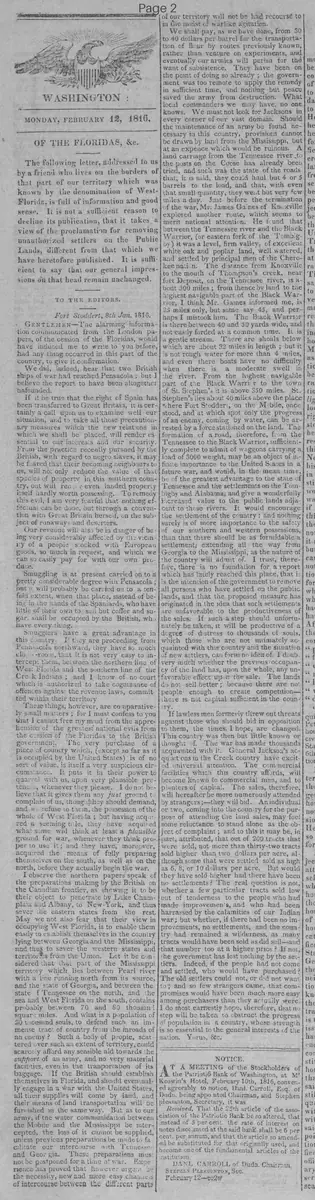
MONDAY, FEBRUARY 12, 1816.
OF THE FLORIDAS, &c.
The following letter, addressed to us by a friend who lives on the borders of that part of our territory which was known by the denomination of West Florida, is full of information and good sense. It is not a sufficient reason to decline its publication, that it takes a view of the proclamation for removing unauthorized settlers on the Public Lands, different from that which we have heretofore published. It is sufficient to say that our general impressions on that head remain unchanged.
TO THE EDITORS.
Fort Stoddert, 8th Jan. 1816.
GENTLEMEN—The alarming information communicated from the London papers, of the cession of the Floridas, would have induced me to write to you before, had any thing occurred in this part of the country, to give it confirmation.
We did, indeed, hear that two British ships of war had reached Pensacola: but I believe the report to have been altogether unfounded.
If it be true that the right of Spain has been transferred to Great Britain, it is certainly a call upon us to examine well our situation, and to take all those precautionary measures which the new relations in which we shall be placed, will render essential to our interests and our security.
From the practice recently pursued by the British, with regard to negro slaves, it may be feared that their becoming neighbours to us, will not only reduce the value of that species of property in this southern country, but will render even landed property itself hardly worth possessing. To remedy this evil, I am very fearful that nothing effectual can be done, but through a convention with Great Britain herself, on the subject of runaways and deserters.
Our revenue will also be in danger of being very considerably affected by the vicinity of a people stocked with European goods, so much in request, and which we can so easily pay for with our own produce.
Smuggling is at present carried on to a pretty considerable degree with Pensacola; but it will probably be carried on to a tenfold extent, when that place, instead of being in the hands of the Spaniards, who have little of their own to sell but coffee and sugar, shall be occupied by the British, who have every thing.
Smugglers have a great advantage in this Country. If they are proceeding from Pensacola northward, they have so much elbow-room, that it is not very easy to intercept them, between the northern line of West Florida and the southern line of the Creek Indians; and I know of no court which is authorized to take cognizance of offences against the revenue laws, committed within their territory.
These things, however, are comparatively small matters; for I must confess to you that I cannot free my mind from the apprehension of the greatest national evils from the cession of the Floridas to the British government. The very purchase of a piece of country which, (except so far as it is occupied by the United States) is of no sort of value, is itself a very suspicious circumstance. It puts it in their power to quarrel with us, upon very plausible pretences, whenever they please. I do not believe that it gives them any just ground to complain of us, though if they should demand, and we refuse to them, the possession of the whole of West Florida; But having acquired a seeming title, they have acquired what some will think at least a plausible ground for war, whenever they think proper to use it; and they have, moreover, acquired the means of fully preparing themselves on the south, as well as on the north, before they actually begin the war.
I observe the northern papers speak of the preparations making by the British on the Canadian frontier, as shewing it to be their object to penetrate by Lake Champlain and Albany, to New-York, and thus sever the eastern states from the rest.
May we not also fear that their view in occupying West Florida, is to enable them easily to establish themselves in the country lying between Georgia and the Mississippi, and thus to sever the western states and territories from the Union. Let it be considered that that part of the Mississippi territory which lies between Pearl river with a line running north from its source, and the state of Georgia, and between the state of Tennessee on the north, and the sea and West Florida on the south, contains probably between 70 and 80 thousand square miles. And what is a population of 30 thousand souls, to defend such an immense tract of country from the inroads of an enemy? Such a body of people, scattered over such an extent of territory, could scarcely afford any sensible aid towards the support of an army, and no very material facilities, even in the transportation of its baggage. If the British should establish themselves in Florida, and should eventually engage in a war with the United States, all their supplies will come by land, and their means of land transportation will be furnished in the same way. But as to our army, if the water communication between the Mobile and the Mississippi be intercepted, the loss of it cannot be supplied, unless previous preparations be made to facilitate our intercourse with Tennessee and Georgia. These preparations must not be postponed for a time of war. Experience has proved that however urgent the necessity, new and more easy channels of intercourse between the different parts of our territory will not be had recourse to in the midst of warlike agitation.
We shall pay, as we have done, from 30 to 40 dollars per barrel for the transportation of flour by routes previously known, rather than venture on experiments, and eventually our armies will perish for the want of subsistence. They have been on the point of doing so already; the government was too remote to apply the remedy in sufficient time, and nothing but peace saved the army from destruction. What local commanders we may have, no one knows. We must not look for Jacksons in every corner of our vast domain. Should the maintenance of an army be found necessary in this country, provisions cannot be drawn by land from the Mississippi, but at an expence which would be ruinous. A land carriage from the Tennessee river to the posts on the Coosa has already been tried, and such was the state of the roads that, it is said, they could haul but 4 or 5 barrels to the load, and that, with even that small quantity, they went but very few miles a day. Just before the termination of the war, Mr. James Gaines of Knoxville explored another route, which seems to merit national attention. He found that between the Tennessee river and the Black Warrior (or eastern fork of the Tombigby) it was a level, firm valley, of excellent white oak and poplar land, well watered, and settled by principal men of the Cherokee nation. The distance from Knoxville to the mouth of Thompson's creek, near fort Deposit, on the Tennessee river, is about 300 miles: from thence by land to the highest navigable part of the Black Warrior, I think Mr. Gaines informed me, is 25 miles only, but some say 45, and perhaps I mistook him. The Black Warrior is there between 40 and 50 yards wide, and not easily forded at a common time. It is a gentle stream. There are shoals below which are about 32 miles in length; but it is not rough water for more than 4 miles, and even there boats have no difficulty when there is a moderate swell in the river. From the highest navigable part of the Black Warrior to the town of St. Stephen's it is above 350 miles. St. Stephen's lies about 40 miles above the place where Fort Stoddert, on the Mobile, once stood, and at which spot only the progress of an enemy, coming by water, can be arrested by a force stationed on the land. The formation of a road, therefore, from the Tennessee to the Black Warrior, sufficiently complete to admit of waggons carrying a load of 3000 weight, may be an object of infinite importance to the United States in a future war, and would, in the mean time, be of the greatest advantage to the state of Tennessee and the settlements on the Tombigby and Alabama, and give a wonderfully increased value to the public lands adjacent to those rivers. It would encourage the settlement of the country: and nothing surely is of more importance to the safety of our southern and western possessions, than that there should be as formidable a settlement, extending all the way from Georgia to the Mississippi, as the nature of the country will admit of. I trust, therefore, there is no foundation for a report which has lately reached this place, that it is the intention of the government to remove all persons who have settled on the public lands, and that the proposed measure has originated in the idea that such settlements are unfavorable to the productiveness of the sales. If such a step should unfortunately be taken, it will be productive of a degree of distress to thousands of souls, which those who are not intimately acquainted with this country and the situation of new settlers, can form no idea of. I doubt very much whether the previous occupancy of the land has, upon the whole, any unfavorable effect upon the sale. The lands do not sell better; because there are not people enough to create competition—there is not capital sufficient in the country.
If lawless men formerly threw out threats against those who should bid in opposition to them, the times, I hope, are changed. This country was then but little known or thought of. The war has made thousands acquainted with it. General Jackson's acquisitions in the Creek country have excited universal attention. The commercial facilities which this country affords, will become known to commercial men, and to planters of capital. The sales, therefore, will hereafter be more numerously attended by strangers;—they will bid. An individual or two, coming into the country for the purpose of attending the land sales, may feel some reluctance to stand alone as the object of complaint; and to this it may be, in part, attributed, that out of 200 tracts that were sold, not more than thirty-two tracts sold higher than two dollars per acre, although some that were settled sold as high as 6, 8, or 10 dollars per acre. But would they have sold higher had there have been no settlements? The real question is not, whether a few particular tracts sold low out of tenderness to the people who had made improvements, and who had been harrassed by the calamities of our Indian war: but whether, if there had been no improvements, no settlements, and the country had remained a wilderness, as many tracts would have been sold as did sell—and that number too at a higher price? If not, the government has lost nothing by the settlers. Indeed, if the people had not come and settled, who would have purchased: The old settlers could not, or did not want to; and so few strangers came, that compromises would have been much more easy among purchasers than they actually were.
I do most earnestly hope, therefore, that no step will be taken to obstruct the progress of population in a country, whose strength is so essential to the general interests of the nation. Yours, &c.
What sub-type of article is it?
What keywords are associated?
What entities or persons were involved?
Where did it happen?
Foreign News Details
Primary Location
Floridas
Event Date
8th Jan. 1816
Key Persons
Outcome
rumored cession of floridas from spain to britain; potential reduction in slave and land values, increased smuggling, strategic threats to us unity and military supply lines.
Event Details
Letter warns of British acquisition of Floridas via cession from Spain, based on London papers; fears impacts on slaves, economy, smuggling from Pensacola; anticipates British use for war to sever US states; proposes road from Tennessee River to Black Warrior for supplies; opposes removing public land settlers.