Thank you for visiting SNEWPapers!
Sign up free
Thomas's Massachusetts Spy, Or, Worcester Gazette
Worcester, Worcester County, Massachusetts
What is this article about?
Extract from the Fourth Annual Report of the Society for the Prevention of Pauperism in New-York details Mr. J. P. Allaire's experiment at his Corlaer's Hook foundry, showing that prohibiting ardent spirits during work improved workers' finances, steadiness, and family happiness, countering the belief that laborers need alcohol to endure harsh conditions.
Clipping
OCR Quality
Full Text
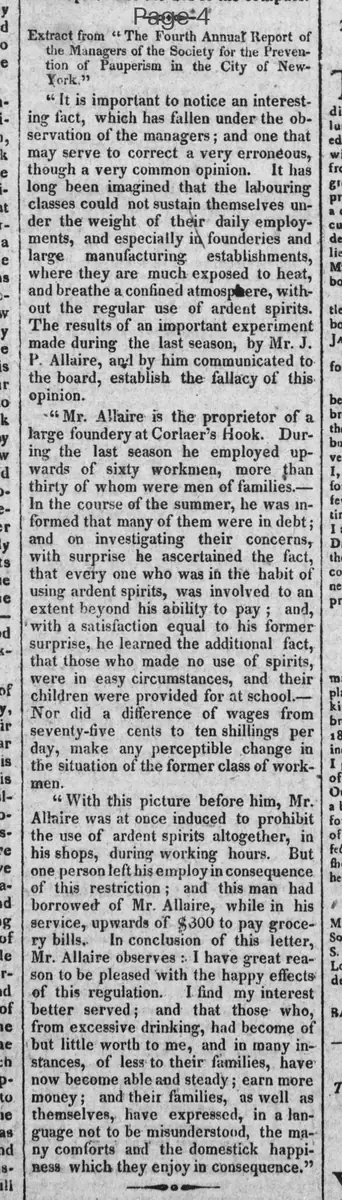
"It is important to notice an interesting fact, which has fallen under the observation of the managers; and one that may serve to correct a very erroneous, though a very common opinion. It has long been imagined that the labouring classes could not sustain themselves under the weight of their daily employments, and especially in founderies and large manufacturing establishments, where they are much exposed to heat, and breathe a confined atmosphere, without the regular use of ardent spirits. The results of an important experiment made during the last season, by Mr. J. P. Allaire, and by him communicated to the board, establish the fallacy of this opinion.
"Mr. Allaire is the proprietor of a large foundery at Corlaer's Hook. During the last season he employed upwards of sixty workmen, more than thirty of whom were men of families.— In the course of the summer, he was informed that many of them were in debt; and on investigating their concerns, with surprise he ascertained the fact, that every one who was in the habit of using ardent spirits, was involved to an extent beyond his ability to pay; and, with a satisfaction equal to his former surprise, he learned the additional fact, that those who made no use of spirits, were in easy circumstances, and their children were provided for at school.— Nor did a difference of wages from seventy-five cents to ten shillings per day, make any perceptible change in the situation of the former class of workmen.
"With this picture before him, Mr. Allaire was at once induced to prohibit the use of ardent spirits altogether, in his shops, during working hours. But one person left his employ in consequence of this restriction; and this man had borrowed of Mr. Allaire, while in his service, upwards of $300 to pay grocery bills. In conclusion of this letter, Mr. Allaire observes: I have great reason to be pleased with the happy effects of this regulation. I find my interest better served; and that those who, from excessive drinking, had become of but little worth to me, and in many instances, of less to their families, have now become able and steady; earn more money; and their families, as well as themselves, have expressed, in a language not to be misunderstood, the many comforts and the domestick happiness which they enjoy in consequence."
What sub-type of article is it?
What keywords are associated?
What entities or persons were involved?
Where did it happen?
Domestic News Details
Primary Location
Corlaer's Hook, City Of New York
Event Date
During The Last Season, In The Course Of The Summer
Key Persons
Outcome
workers abstaining from spirits were in easy circumstances with children at school; prohibition led to improved steadiness, earnings, family comforts, and happiness; only one worker left due to restriction, who had borrowed over $300 for grocery bills.
Event Details
Mr. Allaire, proprietor of a large foundry employing over 60 workmen, observed that spirit users were in debt beyond ability to pay, while abstainers were financially stable. He prohibited spirits during working hours, resulting in positive effects on workers and families.