Thank you for visiting SNEWPapers!
Sign up free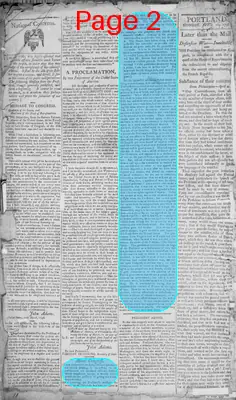
Domestic News
April 16, 1798
The Gazette
Portland, Cumberland County, Maine
What is this article about?
Congressional debates focus on U.S. defensive measures against French depredations on American commerce following the President's message. An embargo is rejected; arming ships is proposed. Mr. Sewall opposes a resolution against resorting to war, arguing French actions constitute undeclared war.
Clipping
OCR Quality
95%
Excellent
Full Text
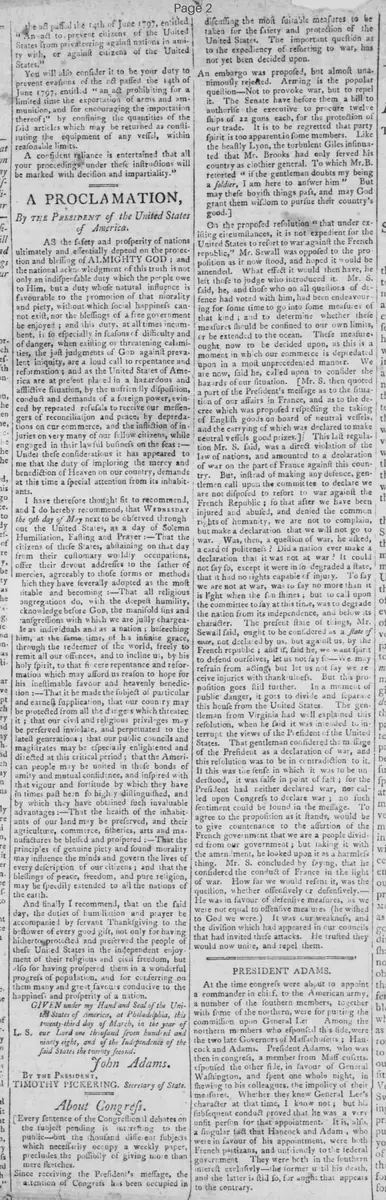
About Congress.
[Every sentence of the Congressional debates on the subject pending is interesting to the public-but the thousand different subjects which necessarily occupy a weekly paper, precludes the possibility of giving more than mere sketches.
Since receiving the President's message, the attention of Congress has been occupied in discussing the most suitable measures to be taken for the safety and protection of the United States.
The important question as to the expediency of resorting to war, has not yet been decided upon.
An embargo was proposed, but almost unanimously rejected.
Arming is the popular question-Not to provoke war, but to repel it.
The Senate have before them a bill to authorize the executive to procure twelve ships of 22 guns each, for the protection of our trade.
It is to be regretted that party spirit is too apparent in some members.
Like the beastly Lyon, the turbulent Giles insinuated that Mr. Brooks had only served his country as clothier general.
To which Mr. B. retorted "if the gentleman doubts my being a soldier, I am here to answer him"
But may these boyish things pass, and may God grant them wisdom to pursue their country's good.]
On the proposed resolution "that under existing circumstances, it is not expedient for the United States to resort to war against the French republic," Mr. Sewall was opposed to the proposition as it now stood, and hoped it would be amended.
What effect it would then have, he left those to judge who introduced it.
Mr. S. said, he, and those who on all questions of defence had voted with him, had been endeavouring for some time to go into some measures of that kind; and to determine whether these measures should be confined to our own limits, or be extended to the ocean.
These measures ought now to be decided upon, as this is a moment in which our commerce is depredated upon in a most unprecedented manner.
We are now, said he, called upon to consider the hazards of our situation.
[Mr. S. then quoted a part of the President's message as to the situation of our affairs in France, and as to the decree which was proposed respecting the taking of English goods on board of neutral vessels, and the carrying of which was declared to make neutral vessels good prizes.]
This last regulation Mr. S. said, was a direct violation of the law of nations, and amounted to a declaration of war on the part of France against this country.
But, instead of making any defence, gentlemen call upon the committee to declare we are not disposed to resort to war against the French Republic; so that after we have been injured and abused, and denied the common rights of humanity, we are not to complain, but make a declaration that we will not go to war.
Was, then, a question of war, he asked, a card of politeness?
Did a nation ever make a declaration that it was not at war?
It could not say so, except it were in so degraded a state, that it had no rights capable of injury.
To say we are not at war, was to say no more than it is light when the sun shines; but to call upon the committee to say at this time, was to degrade the nation from its independence, and below its character.
The present state of things, Mr. Sewall said, ought to be considered as a state of war, not declared by us, but against us, by the French republic; and if, said he, we want spirit to defend ourselves, let us not say so-We may refrain from acting, but let us not say we receive injuries with thankfulness.
But this proposition goes still further.
In a moment of public danger, it goes to divide and separate this house from the United States.
The gentleman from Virginia had well explained this resolution, when he said it was intended to interrupt the views of the President of the United States.
That gentleman considered the message of the President as a declaration of war, and this resolution was to be in contradiction to it.
If this was the sense in which it was to be understood, it was false in point of fact; for the President had neither declared war, nor called upon Congress to declare war; no such sentiment could be found in the message.
To agree to the proposition as it stands, would be to give countenance to the assertion of the French government that we are a people divided from our government; but taking it with the amendment, he looked upon it as a harmless thing.
Mr. S. concluded by saying, that he considered the conduct of France in the light of war.
How far we would resent it, was the question, whether offensively or defensively.-
He was in favour of defensive measures, as we were not equal to offensive measures (he wished to God we were.)
It was our weakness, and the division which had appeared in our councils that had invited these attacks.
He trusted they would now unite, and repel them.
[Every sentence of the Congressional debates on the subject pending is interesting to the public-but the thousand different subjects which necessarily occupy a weekly paper, precludes the possibility of giving more than mere sketches.
Since receiving the President's message, the attention of Congress has been occupied in discussing the most suitable measures to be taken for the safety and protection of the United States.
The important question as to the expediency of resorting to war, has not yet been decided upon.
An embargo was proposed, but almost unanimously rejected.
Arming is the popular question-Not to provoke war, but to repel it.
The Senate have before them a bill to authorize the executive to procure twelve ships of 22 guns each, for the protection of our trade.
It is to be regretted that party spirit is too apparent in some members.
Like the beastly Lyon, the turbulent Giles insinuated that Mr. Brooks had only served his country as clothier general.
To which Mr. B. retorted "if the gentleman doubts my being a soldier, I am here to answer him"
But may these boyish things pass, and may God grant them wisdom to pursue their country's good.]
On the proposed resolution "that under existing circumstances, it is not expedient for the United States to resort to war against the French republic," Mr. Sewall was opposed to the proposition as it now stood, and hoped it would be amended.
What effect it would then have, he left those to judge who introduced it.
Mr. S. said, he, and those who on all questions of defence had voted with him, had been endeavouring for some time to go into some measures of that kind; and to determine whether these measures should be confined to our own limits, or be extended to the ocean.
These measures ought now to be decided upon, as this is a moment in which our commerce is depredated upon in a most unprecedented manner.
We are now, said he, called upon to consider the hazards of our situation.
[Mr. S. then quoted a part of the President's message as to the situation of our affairs in France, and as to the decree which was proposed respecting the taking of English goods on board of neutral vessels, and the carrying of which was declared to make neutral vessels good prizes.]
This last regulation Mr. S. said, was a direct violation of the law of nations, and amounted to a declaration of war on the part of France against this country.
But, instead of making any defence, gentlemen call upon the committee to declare we are not disposed to resort to war against the French Republic; so that after we have been injured and abused, and denied the common rights of humanity, we are not to complain, but make a declaration that we will not go to war.
Was, then, a question of war, he asked, a card of politeness?
Did a nation ever make a declaration that it was not at war?
It could not say so, except it were in so degraded a state, that it had no rights capable of injury.
To say we are not at war, was to say no more than it is light when the sun shines; but to call upon the committee to say at this time, was to degrade the nation from its independence, and below its character.
The present state of things, Mr. Sewall said, ought to be considered as a state of war, not declared by us, but against us, by the French republic; and if, said he, we want spirit to defend ourselves, let us not say so-We may refrain from acting, but let us not say we receive injuries with thankfulness.
But this proposition goes still further.
In a moment of public danger, it goes to divide and separate this house from the United States.
The gentleman from Virginia had well explained this resolution, when he said it was intended to interrupt the views of the President of the United States.
That gentleman considered the message of the President as a declaration of war, and this resolution was to be in contradiction to it.
If this was the sense in which it was to be understood, it was false in point of fact; for the President had neither declared war, nor called upon Congress to declare war; no such sentiment could be found in the message.
To agree to the proposition as it stands, would be to give countenance to the assertion of the French government that we are a people divided from our government; but taking it with the amendment, he looked upon it as a harmless thing.
Mr. S. concluded by saying, that he considered the conduct of France in the light of war.
How far we would resent it, was the question, whether offensively or defensively.-
He was in favour of defensive measures, as we were not equal to offensive measures (he wished to God we were.)
It was our weakness, and the division which had appeared in our councils that had invited these attacks.
He trusted they would now unite, and repel them.
What sub-type of article is it?
Politics
Military
What keywords are associated?
Congressional Debate
French Relations
Defensive Measures
War Resolution
Arming Ships
What entities or persons were involved?
Mr. Sewall
Mr. Brooks
Lyon
Giles
President
Where did it happen?
United States
Domestic News Details
Primary Location
United States
Key Persons
Mr. Sewall
Mr. Brooks
Lyon
Giles
President
Event Details
Congress debates measures for U.S. protection against French threats, including rejection of embargo, proposal to arm ships, and opposition to a resolution against war with France. Mr. Sewall argues French actions amount to undeclared war and advocates defensive measures.