Thank you for visiting SNEWPapers!
Sign up free
The Lansing State Republican
Lansing, Ingham County, Michigan
What is this article about?
In Virginia, slave Amy was tried for stealing a letter with money from the post office. Her master invoked the Dred Scott decision, arguing slaves are mere property without responsibility. The court overruled this; Chief Justice Taney, despite authoring Dred Scott, affirmed slaves as persons accountable under law, signaling a reversal of the infamous ruling.
Merged-components note: Continuation of the article on the Dred Scott decision, with sequential reading order and coherent topic flow.
Clipping
OCR Quality
Full Text
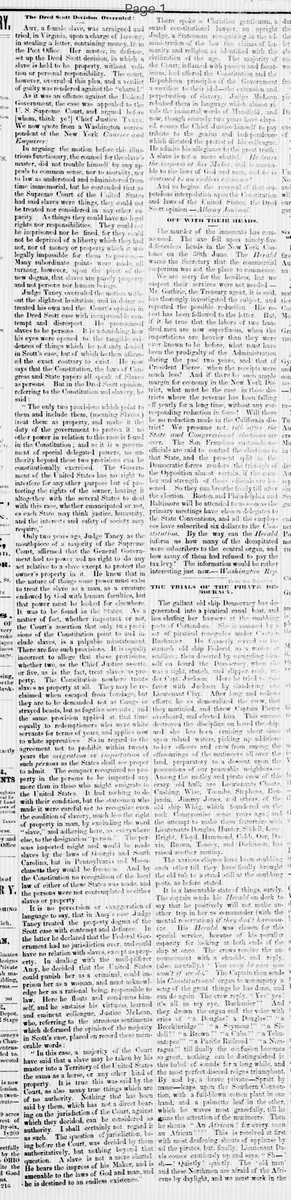
Amy, a female slave, was arraigned and tried, in Virginia, upon a charge of larceny, in stealing a letter, containing money, from the Post Office. Her master, in defence, set up the Dred Scott decision, in which a slave is held to be property, without volition or personal responsibility. The court, however, overruled this plea, and a verdict of guilty was rendered against the "chattel."
As it was an offence against the Federal Government, the case was appealed to the U. S. Supreme Court, and argued before [whom, think ye?] Chief Justice Taney.
We now quote from a Washington correspondent of the New York Courier and Enquirer:
In arguing the motion before this illustrious functionary, the counsel for the slave's master, did not trouble himself by any appeals to common sense, nor to morality, nor to law as understood and administered from time immemorial, but he contended that as the Supreme Court of the United States had said slaves were things, they could not be treated nor considered in any other capacity. As things they could have no legal rights nor responsibilities. They could be imprisoned nor be fined, for they could not be deprived of a liberty which they had not, nor of money or property which it was legally impossible for them to possess.
Many subordinate points were made, all turning, however, upon the pivot of the new dogma, that slaves are purely property and not persons nor human beings.
Judge Taney overruled the motion without the slightest hesitation, and in doing so treated his own and the Court's opinion in the Dred Scott case with inexpressible contempt and disrespect. He pronounced slaves to be persons. It is astonishing how his eyes were opened to the tangible evidences of things which he not only denied in Scott's case, but of which he then affirmed the exact contrary to exist. He now says that the Constitution, the laws of Congress and State papers all speak of Slaves as persons. But in the Dred Scott opinion, referring to the Constitution and slavery, he said:
"The only two provisions which point to them and include them, (meaning Slaves,) treat them as property, and make it the duty of the government to protect it. No other power in relation to this race is found in the Constitution; and as it is a government of special delegated powers, no authority beyond these two provisions can be constitutionally exercised. The Government of the United States has no right to interfere for any other purpose but of protecting the rights of the owner, leaving it altogether with the several States to deal with this race, whether emancipated or not, as each State may think justice, humanity and the interests and safety of society may require."
Only two years ago, Judge Taney as the mouthpiece of a majority of the Supreme Court, affirmed that the General Government had no power and no right to do any act relative to a slave except to protect the owner's property in it. He knew that in the nature of things some power must exist to treat the slave as a man, as a creature endowed by God with human faculties, but that power must be looked for elsewhere. It was to be found in the States. As a matter of fact, whether important or not, the Court's assertion that only two provisions of the Constitution point to and include slaves, is a palpable misstatement. There are five such provisions. It is equally incorrect to allege that these provisions whether two, as the Chief Justice asserts or five, as is the fact, treat slaves as property. The Constitution nowhere treats slaves as property at all. They may be reclaimed when escaped from bondage, but they are to be demanded not as things or strayed beasts, but as fugitive servants, and the same provision applied at that time equally to redemptioners who were white servants for terms of years, and applies now to white apprentices. "So in regard to the agreement not to prohibit within twenty years the migration or importation of such persons as the States shall see proper to admit. The compact recognized no property in the persons to be imported any more than in those who might emigrate to the United States. It had nothing to do with their condition, but the statesmen who made it were careful not to recognize even the condition of slavery, much less the right of property in man, by excluding the word "slave," and adhering here, as everywhere else, to the designation "person." The persons imported might and would be made slaves by the laws of Georgia and South Carolina, but in Pennsylvania and Massachusetts they would be free. And by the Constitution no recognition of the local law of either of these States was made, and the persons were not contemplated as either slaves or property.
It is no perversion or exaggeration of language to say, that in Amy's case Judge Taney treated the property dogma of the Scott case with contempt and defiance. In the latter he declared that the Federal Government had no jurisdiction over, and could have no relation with slaves, except as property. In dealing with the mail-pilferer Amy, he decided that the United States could punish her as a criminal, could imprison her as a woman, and must acknowledge her as a rational being, responsible to law. Here he flouts and condemns himself, and he sustains his virtuous, learned and eminent colleague, Justice McLean, who, referring to the atrocious sentiments which deformed the opinion of the majority in Scott's case, placed on record these memorable words:
"In this case, a majority of the Court have said that a slave may be taken by his master into a Territory of the United States the same as a horse, or any other kind of property. It is true this was said by the Court, as also many true things which are of no authority. Nothing that has been said by them, which has not a direct bearing on the question of jurisdiction, against which they decided, can be considered as authority. I shall certainly not regard it as such. The question of jurisdiction, being before the Court, was decided by them authoritatively, but nothing beyond that question. A slave is not a mere chattel. He bears the impress of his Maker, and is amenable to the laws of God and man, and he is destined to an endless existence."
There spoke a Christian gentleman, a sound constitutional lawyer, an upright Judge, a Statesman recognizing in the administration of the law the claims of humanity and religion as identified with the civilization of the age. The majority of the Court, inflamed with passion and fanaticism, had offered the Constitution and the Republican principles of the Government a sacrifice to their idol—the extension and perpetuation of slavery. Judge McLean rebuked them in language which almost rivals the immortal words of Mansfield, and now, though scarcely two years have elapsed, comes the Chief Justice himself to pay tribute to the genius and independence which dictated the protest of his colleague. He admits his allegiance to the great truth: A slave is not a mere chattel. He bears the impress of his Maker, and is amenable to the laws of God and man, and he is destined to an endless existence.
And so begins the reversal of that stupendous interpolation upon the Constitution and laws of the United States, the Dred Scott opinion.—Albany Journal.
What sub-type of article is it?
What themes does it cover?
What keywords are associated?
What entities or persons were involved?
Where did it happen?
Story Details
Key Persons
Location
Virginia And U.S. Supreme Court
Story Details
Female slave Amy tried in Virginia for larceny by stealing a letter with money from the post office; her master defends using Dred Scott decision claiming slaves are property without responsibility; court overrules, finding her guilty; appealed to U.S. Supreme Court where Taney rules slaves are persons accountable to law, contradicting Dred Scott and praising Justice McLean's dissent.