Thank you for visiting SNEWPapers!
Sign up free
Editorial
June 27, 1834
Alexandria Gazette
Alexandria, Alexandria County, District Of Columbia
What is this article about?
The editorial examines the Senate's rejection of Andrew Stevenson's nomination as U.S. Minister to Britain, citing a secret 1833 assurance from Secretary Livingston on behalf of President Jackson, concealed from Congress while Stevenson sought re-election and the Speakership, raising concerns of executive influence and constitutional impropriety.
Clipping
OCR Quality
95%
Excellent
Full Text
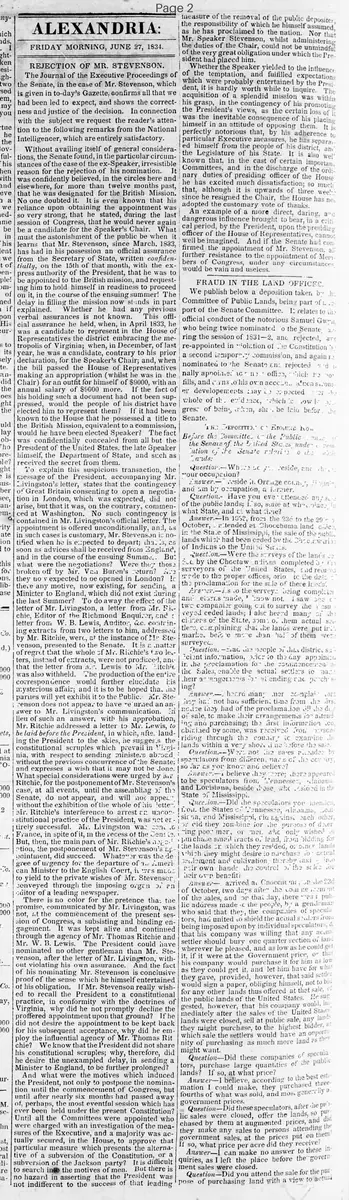
ALEXANDRIA:
FRIDAY MORNING, JUNE 27, 1834.
REJECTION OF MR. STEVENSON.
The Journal of the Executive Proceedings of the Senate, in the case of Mr. Stevenson, which is given in to-day's Gazette, confirms all that we had been led to expect, and shows the correctness and justice of the decision. In connection with the subject we request the reader's attention to the following remarks from the National Intelligencer, which are entirely satisfactory.
Without availing itself of general considerations, the Senate found, in the particular circumstances of the case of the ex-Speaker, irresistible reason for the rejection of his nomination. It was confidently believed, in the circles here and elsewhere, for more than twelve months past that he was designated for the British Mission. No one doubted it. It is even known that his reliance upon obtaining the appointment was so very strong, that he stated, during the last session of Congress, that he would never again be a candidate for the Speaker's Chair. What must the astonishment of the public be when it learns that Mr. Stevenson, since March, 1833, has had in his possession an official assurance from the Secretary of State, written confidentially, on the 15th of that month, with the express authority of the President, that he was to be appointed to the British mission, and requesting him to hold himself in readiness to proceed on it, in the course of the ensuing summer! The delay in filling the mission now stands in part explained.
Whether he had any previous verbal assurances is not known. This official assurance he held, when, in April 1833, he was a candidate to represent in the House of Representatives the district embracing the metropolis of Virginia; when, in December, of last year, he was a candidate, contrary to his prior declaration, for the Speaker's Chair; and, when the bill passed the House of Representatives making an appropriation (whilst he was in the Chair) for an outfit for himself of $9000, with an annual salary of $9000 more. If the fact of his holding such a document had not been suppressed, would the people of his district have elected him to represent them? If it had been known to the House that he possessed a title to the British Mission, equivalent to a commission, would he have been elected Speaker? The fact was confidentially concealed from all but the President of the United States. the late Speaker himself. the Department of State, and such as received the secret from them.
To explain this suspicious transaction, the message of the President, accompanying Mr. Livingston's letter, states that the contingency of Great Britain consenting to open a negotiation in London, which was expected, did not arise, but that it was, on the contrary, commenced at Washington. No such contingency is contained in Mr. Livingston's official letter. The appointment is offered unconditionally, and, as in such cases is customary, Mr. Stevenson is notified when he is expected to depart; that is, as soon as advices shall be received from England, and in the course of the ensuing Summer. But what were the negotiations? Were they those broken off by Mr. Van Buren's return? And are they now expected to be opened in London? Is there any motive, now existing, for sending a Minister to England, which did not exist during the last Summer? To do away the effect of the letter of Mr. Livingston, a letter from Mr. Ritchie, Editor of the Richmond Enquirer, and a letter from W. B. Lewis, Auditor, &c. containing extracts from two letters to him. addressed by Mr. Ritchie, were, at the instance of Mr Stevenson, presented to the Senate. It is a matter of regret that the whole of Mr. Ritchie's two letters, instead of extracts, were not produced, and that the letter from Mr. Lewis to Mr. Ritchie was also withheld. The production of the entire correspondence would further elucidate this mysterious affair; and it is to be hoped that the parties will yet exhibit it to the Public. Mr. Stevenson does not appear to have returned an answer to Mr. Livingston's communication. in lieu of such an answer, with his approbation, Mr. Ritchie addressed a letter to Mr. Lewis, to be laid before the President, in which, after lauding the President to the skies, he suggests the constitutional scruples which prevail in Virginia. with respect to sending ministers abroad without the previous concurrence of the Senate; and expresses a wish that it may not be done
What special considerations were urged by Mr Ritchie, for the postponement of Mr. Stevenson's case, at all events, until the assembling of the Senate, do not appear, and will not appear without the exhibition of the whole of his letter
Mr. Ritchie's interference to arrest an unconstitutional practice of the President, was not entirely successful. Mr. Livingston was sent to France. in spite of it, in the recess of the Senate. But, then, the main part of Mr. Ritchie's negotiation, the postponement of Mr. Stevenson's appointment, did succeed. Whatever was the degree of urgency for the departure of an American Minister to the English Court, it was made to yield to the private wishes of Mr. Stevenson. conveyed through the imposing organ of an editor of a leading newspaper.
There is no color for the pretence that the promise, communicated by Mr. Livingston, was not, at the commencement of the present session of Congress, a subsisting and binding engagement. It was kept alive and continued through the agency of Mr. Thomas Ritchie and Mr. W. B. Lewis. The President could have nominated no other gentleman than Mr. Stevenson, after the letter of Mr. Livingston, without violating his own assurance. And the fact of his nominating Mr. Stevenson is conclusive proof of the sense which he himself entertained of his obligation. If Mr. Stevenson really wished to recall the President to a constitutional practice, in conformity with the doctrines of Virginia, why did he not promptly decline the proffered appointment upon that ground? If he did not desire the appointment to be kept back for his subsequent acceptance, why did he employ the influential agency of Mr. Thomas Ritchie? We know that the President did not share his constitutional scruples; why, therefore, did he desire the unexampled delay, in sending a Minister to England, to be further prolonged?
And what were the motives which induced the President, not only to postpone the nomination until the commencement of Congress, but until after nearly six months had passed away of. perhaps, the most eventful session which has ever been held under the present Constitution? Until all the Committees were appointed who were charged with an investigation of the measures of the Executive, and a majority was actually secured, in the House, to approve that particular measure which presents the alternative of a subversion of the Constitution, or a subversion of the Jackson party? It is difficult to search into the motives of men. But there is no hazard in asserting that the President was not indifferent to the success of that leading measure of the removal of the public deposits: the responsibility of which he himself assumed, as he has proclaimed to the nation. Nor that Mr. Speaker Stevenson, whilst administering the duties of the Chair, could not be unmindful of the very great obligation under which the President had placed him.
Whether the Speaker yielded to the influence of the temptation, and fulfilled expectations which were probably entertained by the President, it is hardly worth while to inquire. The acquisition of a splendid mission was within his grasp, in the contingency of his promoting the President's views, as the certain loss of it was the inevitable consequence of his placing himself in an attitude of opposing them. It is perfectly notorious that, by his adherence to particular Executive measures, he has separated himself from the people of his district, and the Legislature of his State. It is also well known that, in the cast of certain important Committees, and in the discharge of the ordinary duties of presiding officer of the House he has excited much dissatisfaction; so much that. although it is upwards of three weeks since he resigned the Chair, the House has not adopted the customary vote of thanks.
An example of a more direct, daring, and dangerous influence brought to bear, in a critical period, by the President, upon the presiding officer of the House of Representatives, cannot well be imagined. And if the Senate had confirmed the appointment of Mr. Stevenson. all further resistance to the appointment of Members of Congress, under any circumstances would be vain and useless.
FRIDAY MORNING, JUNE 27, 1834.
REJECTION OF MR. STEVENSON.
The Journal of the Executive Proceedings of the Senate, in the case of Mr. Stevenson, which is given in to-day's Gazette, confirms all that we had been led to expect, and shows the correctness and justice of the decision. In connection with the subject we request the reader's attention to the following remarks from the National Intelligencer, which are entirely satisfactory.
Without availing itself of general considerations, the Senate found, in the particular circumstances of the case of the ex-Speaker, irresistible reason for the rejection of his nomination. It was confidently believed, in the circles here and elsewhere, for more than twelve months past that he was designated for the British Mission. No one doubted it. It is even known that his reliance upon obtaining the appointment was so very strong, that he stated, during the last session of Congress, that he would never again be a candidate for the Speaker's Chair. What must the astonishment of the public be when it learns that Mr. Stevenson, since March, 1833, has had in his possession an official assurance from the Secretary of State, written confidentially, on the 15th of that month, with the express authority of the President, that he was to be appointed to the British mission, and requesting him to hold himself in readiness to proceed on it, in the course of the ensuing summer! The delay in filling the mission now stands in part explained.
Whether he had any previous verbal assurances is not known. This official assurance he held, when, in April 1833, he was a candidate to represent in the House of Representatives the district embracing the metropolis of Virginia; when, in December, of last year, he was a candidate, contrary to his prior declaration, for the Speaker's Chair; and, when the bill passed the House of Representatives making an appropriation (whilst he was in the Chair) for an outfit for himself of $9000, with an annual salary of $9000 more. If the fact of his holding such a document had not been suppressed, would the people of his district have elected him to represent them? If it had been known to the House that he possessed a title to the British Mission, equivalent to a commission, would he have been elected Speaker? The fact was confidentially concealed from all but the President of the United States. the late Speaker himself. the Department of State, and such as received the secret from them.
To explain this suspicious transaction, the message of the President, accompanying Mr. Livingston's letter, states that the contingency of Great Britain consenting to open a negotiation in London, which was expected, did not arise, but that it was, on the contrary, commenced at Washington. No such contingency is contained in Mr. Livingston's official letter. The appointment is offered unconditionally, and, as in such cases is customary, Mr. Stevenson is notified when he is expected to depart; that is, as soon as advices shall be received from England, and in the course of the ensuing Summer. But what were the negotiations? Were they those broken off by Mr. Van Buren's return? And are they now expected to be opened in London? Is there any motive, now existing, for sending a Minister to England, which did not exist during the last Summer? To do away the effect of the letter of Mr. Livingston, a letter from Mr. Ritchie, Editor of the Richmond Enquirer, and a letter from W. B. Lewis, Auditor, &c. containing extracts from two letters to him. addressed by Mr. Ritchie, were, at the instance of Mr Stevenson, presented to the Senate. It is a matter of regret that the whole of Mr. Ritchie's two letters, instead of extracts, were not produced, and that the letter from Mr. Lewis to Mr. Ritchie was also withheld. The production of the entire correspondence would further elucidate this mysterious affair; and it is to be hoped that the parties will yet exhibit it to the Public. Mr. Stevenson does not appear to have returned an answer to Mr. Livingston's communication. in lieu of such an answer, with his approbation, Mr. Ritchie addressed a letter to Mr. Lewis, to be laid before the President, in which, after lauding the President to the skies, he suggests the constitutional scruples which prevail in Virginia. with respect to sending ministers abroad without the previous concurrence of the Senate; and expresses a wish that it may not be done
What special considerations were urged by Mr Ritchie, for the postponement of Mr. Stevenson's case, at all events, until the assembling of the Senate, do not appear, and will not appear without the exhibition of the whole of his letter
Mr. Ritchie's interference to arrest an unconstitutional practice of the President, was not entirely successful. Mr. Livingston was sent to France. in spite of it, in the recess of the Senate. But, then, the main part of Mr. Ritchie's negotiation, the postponement of Mr. Stevenson's appointment, did succeed. Whatever was the degree of urgency for the departure of an American Minister to the English Court, it was made to yield to the private wishes of Mr. Stevenson. conveyed through the imposing organ of an editor of a leading newspaper.
There is no color for the pretence that the promise, communicated by Mr. Livingston, was not, at the commencement of the present session of Congress, a subsisting and binding engagement. It was kept alive and continued through the agency of Mr. Thomas Ritchie and Mr. W. B. Lewis. The President could have nominated no other gentleman than Mr. Stevenson, after the letter of Mr. Livingston, without violating his own assurance. And the fact of his nominating Mr. Stevenson is conclusive proof of the sense which he himself entertained of his obligation. If Mr. Stevenson really wished to recall the President to a constitutional practice, in conformity with the doctrines of Virginia, why did he not promptly decline the proffered appointment upon that ground? If he did not desire the appointment to be kept back for his subsequent acceptance, why did he employ the influential agency of Mr. Thomas Ritchie? We know that the President did not share his constitutional scruples; why, therefore, did he desire the unexampled delay, in sending a Minister to England, to be further prolonged?
And what were the motives which induced the President, not only to postpone the nomination until the commencement of Congress, but until after nearly six months had passed away of. perhaps, the most eventful session which has ever been held under the present Constitution? Until all the Committees were appointed who were charged with an investigation of the measures of the Executive, and a majority was actually secured, in the House, to approve that particular measure which presents the alternative of a subversion of the Constitution, or a subversion of the Jackson party? It is difficult to search into the motives of men. But there is no hazard in asserting that the President was not indifferent to the success of that leading measure of the removal of the public deposits: the responsibility of which he himself assumed, as he has proclaimed to the nation. Nor that Mr. Speaker Stevenson, whilst administering the duties of the Chair, could not be unmindful of the very great obligation under which the President had placed him.
Whether the Speaker yielded to the influence of the temptation, and fulfilled expectations which were probably entertained by the President, it is hardly worth while to inquire. The acquisition of a splendid mission was within his grasp, in the contingency of his promoting the President's views, as the certain loss of it was the inevitable consequence of his placing himself in an attitude of opposing them. It is perfectly notorious that, by his adherence to particular Executive measures, he has separated himself from the people of his district, and the Legislature of his State. It is also well known that, in the cast of certain important Committees, and in the discharge of the ordinary duties of presiding officer of the House he has excited much dissatisfaction; so much that. although it is upwards of three weeks since he resigned the Chair, the House has not adopted the customary vote of thanks.
An example of a more direct, daring, and dangerous influence brought to bear, in a critical period, by the President, upon the presiding officer of the House of Representatives, cannot well be imagined. And if the Senate had confirmed the appointment of Mr. Stevenson. all further resistance to the appointment of Members of Congress, under any circumstances would be vain and useless.
What sub-type of article is it?
Partisan Politics
Constitutional
Foreign Affairs
What keywords are associated?
Stevenson Nomination
British Mission
Senate Rejection
Executive Influence
Constitutional Scruples
Jackson Administration
Speaker Of The House
What entities or persons were involved?
Mr. Stevenson
President Jackson
Secretary Livingston
Mr. Ritchie
W. B. Lewis
Senate
National Intelligencer
Editorial Details
Primary Topic
Senate Rejection Of Andrew Stevenson's Nomination For British Minister
Stance / Tone
Critical Of Executive Influence And Supportive Of Senate's Decision
Key Figures
Mr. Stevenson
President Jackson
Secretary Livingston
Mr. Ritchie
W. B. Lewis
Senate
National Intelligencer
Key Arguments
Secret Official Assurance To Stevenson In March 1833 For British Mission
Concealment Of Assurance During Stevenson's Elections And Speakership Bid
No Contingency In Livingston's Letter Justifying Delay
Ritchie's Letters Urged Postponement Due To Constitutional Scruples
Presidential Nomination Confirms Binding Obligation
Delay Allowed Stevenson To Influence House In Favor Of Executive Measures
Stevenson's Actions Separated Him From Constituents
Example Of Dangerous Executive Influence On Legislature