Thank you for visiting SNEWPapers!
Sign up free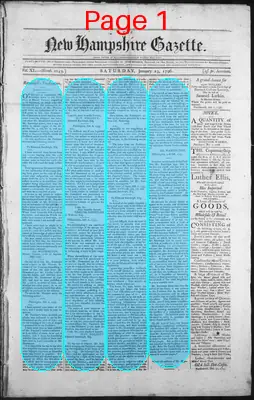
The New Hampshire Gazette
Portsmouth, Rockingham County, New Hampshire
What is this article about?
In 1795, former Secretary of State Edmund Randolph corresponds with President Washington and Treasury Secretary Wolcott, seeking details and documents related to an intercepted letter from French minister Fauchet that led to suspicions of his misconduct and resignation. Washington grants permission to publish private letters for his defense, amid political tensions over the Jay Treaty ratification.
Merged-components note: These two components form a single continued story about Randolph's Vindication, spanning multiple columns on page 1 with sequential reading order and direct text continuation.
Clipping
OCR Quality
Full Text
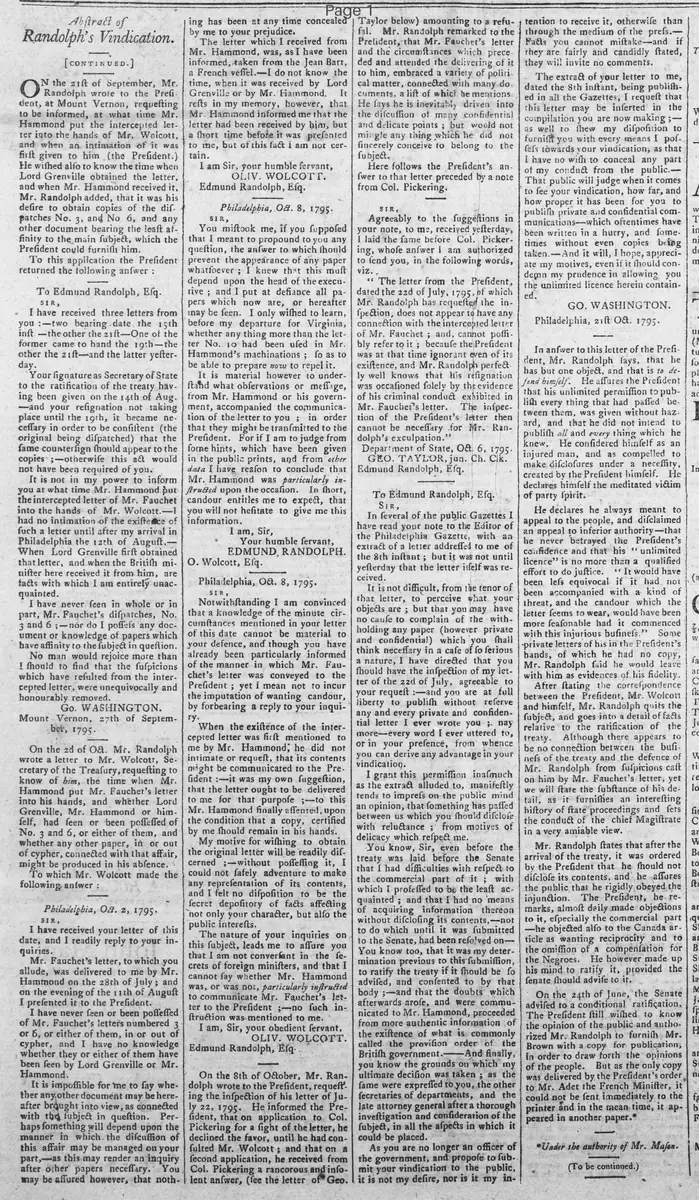
[Continued.]
On the 21st of September, Mr. Randolph wrote to the President, at Mount Vernon, requesting to be informed, at what time Mr. Hammond put the intercepted letter into the hands of Mr. Wolcott, and when an intimation of it was first given to him (the President.) He wished also to know the time when Lord Grenville obtained the letter, and when Mr. Hammond received it. Mr. Randolph added, that it was his desire to obtain copies of the dispatches No. 3, and No. 6, and any other document bearing the least affinity to the main subject, which the President could furnish him.
To this application the President returned the following answer:
To Edmund Randolph, Esq.
SIR,
I have received three letters from you: two bearing date the 15th inst. the other the 21st. One of the former came to hand the 19th. the other the 21st. and the latter yesterday.
Your signature as Secretary of State to the ratification of the treaty having been given on the 14th of Aug. and your resignation not taking place until the 19th, it became necessary in order to be consistent (the original being dispatched) that the same countersign should appear to the copies; otherwise this act would not have been required of you.
It is not in my power to inform you at what time Mr. Hammond put the intercepted letter of Mr. Fauchet into the hands of Mr. Wolcott. I had no intimation of the existence of such a letter until after my arrival in Philadelphia the 12th of August. When Lord Grenville first obtained that letter, and when the British minister here received it from him, are facts with which I am entirely unacquainted.
I have never seen in whole or in part, Mr. Fauchet's dispatches, No. 3 and 6; nor do I possess any document or knowledge of papers which have affinity to the subject in question.
No man would rejoice more than I should to find that the suspicions which have resulted from the intercepted letter, were unequivocally and honourably removed.
GO. WASHINGTON.
Mount Vernon, 27th of September, 1795.
On the 2d of Oct. Mr. Randolph wrote a letter to Mr. Wolcott, Secretary of the Treasury, requesting to know of him, the time when Mr. Hammond put Mr. Fauchet's letter into his hands, and whether Lord Grenville, Mr. Hammond or himself, had seen or been possessed of No. 3 and 6. or either of them. and whether any other paper, in or out of cypher, connected with that affair, might be produced in his absence.
To which Mr. Wolcott made the following answer:
Philadelphia, Oct. 2, 1795.
SIR,
I have received your letter of this date, and I readily reply to your inquiries.
Mr. Fauchet's letter, to which you allude, was delivered to me by Mr. Hammond on the 28th of July; and on the evening of the 11th of August I presented it to the President.
I have never seen or been possessed of Mr. Fauchet's letters numbered 3 or 6, or either of them, in or out of cypher, and I have no knowledge whether they or either of them have been seen by Lord Grenville or Mr. Hammond.
It is impossible for me to say whether any other document may be hereafter brought into view, as connected with the subject in question. Perhaps something will depend upon the manner in which the discussion of this affair may be managed on your part, as this may render an inquiry after other papers necessary. You may be assured however, that nothing has been at any time concealed by me to your prejudice.
The letter which I received from Mr. Hammond, was, as I have been informed, taken from the Jean Bart, a French vessel. I do not know the time when it was received by Lord Grenville or by Mr. Hammond. It rests in my memory, however, that Mr. Hammond informed me that the letter had been received by him, but a short time before it was presented to me, but of this fact I am not certain.
I am Sir, your humble servant,
OLIV. WOLCOTT.
Edmund Randolph, Esq.
Philadelphia, Oct. 8, 1795.
SIR,
You mistook me, if you supposed that I meant to propound to you any question, the answer to which should prevent the appearance of any paper whatsoever: I knew that this must depend upon the head of the executive; and I put at defiance all papers which now are, or hereafter may be seen. I only wished to learn, before my departure for Virginia, whether any thing more than the letter No. 10 had been used in Mr. Hammond's machinations; so as to be able to prepare now to repel it.
It is material however to understand what observations or message, from Mr. Hammond or his government, accompanied the communication of the letter to you: in order that they might be transmitted to the President. For if I am to judge from some hints, which have been given in the public prints, and from other data I have reason to conclude that Mr. Hammond was particularly instructed upon the occasion. In short, candour entitles me to expect, that you will not hesitate to give me this information.
I am, Sir,
Your humble servant,
EDMUND RANDOLPH.
O. Wolcott, Esq.
Philadelphia, Oct. 8, 1795.
SIR,
Notwithstanding I am convinced that a knowledge of the minute circumstances mentioned in your letter of this date cannot be material to your defence, and though you have already been particularly informed of the manner in which Mr. Fauchet's letter was conveyed to the President; yet I mean not to incur the imputation of wanting candour, by forbearing a reply to your inquiry.
When the existence of the intercepted letter was first mentioned to me by Mr. Hammond; he did not intimate or request, that its contents might be communicated to the President: it was my own suggestion, that the letter ought to be delivered to me for that purpose; to this Mr. Hammond finally assented, upon the condition that a copy, certified by me should remain in his hands.
My motive for wishing to obtain the original letter will be readily discerned; without possessing it, I could not safely adventure to make any representation of its contents, and I felt no disposition to be the secret depository of facts affecting not only your character, but also the public interests.
The nature of your inquiries on this subject, leads me to assure you that I am not conversant in the secrets of foreign ministers, and that I cannot say whether Mr. Hammond was, or was not, particularly instructed to communicate Mr. Fauchet's letter to the President; no such instruction was mentioned to me.
I am, Sir, your obedient servant,
OLIV. WOLCOTT.
Edmund Randolph, Esq.
On the 8th of October, Mr. Randolph wrote to the President, requesting the inspection of his letter of July 22, 1795. He informed the President, that on application to Col. Pickering for a sight of the letter, he declined the favor, until he had consulted Mr. Wolcott: and that on a second application, he received from Col. Pickering a rancorous and insolent answer, (see the letter of Geo.
Taylor below) amounting to a refusal. Mr. Randolph remarked to the President, that Mr. Fauchet's letter and the circumstances which preceded and attended the delivering of it to him, embraced a variety of political matter, connected with many documents, a list of which he mentions. He says he is inevitably driven into the discussion of many confidential and delicate points; but would not mingle any thing which he did not sincerely conceive to belong to the subject.
Here follows the President's answer to that letter preceded by a note from Col. Pickering
SIR,
Agreeably to the suggestions in your note, to me, received yesterday, I laid the same before Col. Pickering, whose answer I am authorized to send you, in the following words, viz.
"The letter from the President, dated the 22d of July, 1795, of which Mr. Randolph has requested the inspection, does not appear to have any connection with the intercepted letter of Mr. Fauchet: and cannot possibly refer to it: because the President was at that time ignorant even of its existence. and Mr. Randolph perfectly well knows that his resignation was occasioned solely by the evidence of his criminal conduct exhibited in Mr. Fauchet's letter. The inspection of the President's letter then cannot be necessary for Mr. Randolph's exculpation."
Department of State, Oct 6, 1795.
GEO. TAYLOR, jun. Ch. Clk.
Edmund Randolph, Esq.
To Edmund Randolph, Esq.
SIR,
In several of the public Gazettes I have read your note to the Editor of the Philadelphia Gazette, with an extract of a letter addressed to me of the 8th instant; but it was not until yesterday that the letter itself was received.
It is not difficult, from the tenor of that letter, to perceive what your objects are; but that you may have no cause to complain of the withholding any paper (however private and confidential) which you shall think necessary in a case of so serious a nature, I have directed that you should have the inspection of my letter of the 22d of July, agreeable to your request: and you are at full liberty to publish without reserve any and every private and confidential letter I ever wrote you; nay more. every word I ever uttered to, or in your presence, from whence you can derive any advantage in your vindication.
I grant this permission inasmuch as the extract alluded to, manifestly tends to impress on the public mind an opinion, that something has passed between us which you should disclose with reluctance; from motives of delicacy which respect me.
You know, Sir, even before the treaty was laid before the Senate that I had difficulties with respect to the commercial part of it; with which I profess to be the least acquainted; and that I had no means of acquiring information thereon without disclosing its contents, not to do which until it was submitted to the Senate, had been resolved on.
You know too, that it was my determination previous to this submission, to ratify the treaty if it should be so advised, and consented to by that body; and that the doubts which afterwards arose, and were communicated to Mr. Hammond, proceeded from more authentic information of the existence of what is commonly called the provision order of the British government. And finally, you know the grounds on which my ultimate decision was taken; as the same were expressed to you, the other secretaries of departments, and the late attorney general after a thorough investigation and consideration of the subject, in all the aspects in which it could be placed.
As you are no longer an officer of the government, and propose to submit your vindication to the public, it is not my desire, nor is it my intention to receive it, otherwise than through the medium of the pres. Facts you cannot mistake. and if they are fairly and candidly stated, they will invite no comments.
The extract of your letter to me, dated the 8th instant, being published in all the Gazettes, I request that this letter may be inserted in the compilation you are now making; as well to show my disposition to furnish you with every means I possess towards your vindication; as that I have no wish to conceal any part of my conduct from the public.
That public will judge when it comes to see your vindication, how far, and how proper it has been for you to publish private and confidential communications. which oftentimes have been written in a hurry, and sometimes without even copies being taken. And it will, I hope, appreciate my motives, even if it should condemn my prudence in allowing you the unlimited licence herein contained.
GO. WASHINGTON.
Philadelphia, 21st Oct. 1795.
In answer to this letter of the President, Mr. Randolph says, that he has but one object, and that is to defend himself. He assures the President that his unlimited permission to publish every thing that had passed between them, was given without hazard. and that he did not intend to publish all and every thing which he knew. He considered himself as an injured man, and as compelled to make disclosures under a necessity, created by the President himself. He declares himself the meditated victim of party spirit.
He declares he always meant to appeal to the people, and disclaimed an appeal to inferior authority. that he never betrayed the President's confidence and that his "unlimited licence" is no more than a qualified effort to do justice. "It would have been less equivocal if it had not been accompanied with a kind of threat, and the candour which the letter seems to wear, would have been more reasonable had it commenced with this injurious business." Some private letters of his in the President's hands, of which he had no copy, Mr. Randolph said he would leave with him as evidences of his fidelity.
After stating the correspondence between the President, Mr. Wolcott and himself, Mr. Randolph quits the subject, and goes into a detail of facts relative to the ratification of the treaty. Although there appears to be no connection between the business of the treaty and the defence of Mr. Randolph from suspicions cast on him by Mr. Fauchet's letter, yet we will state the substance of his detail, as it furnishes an interesting history of state proceedings and sets the conduct of the chief Magistrate in a very amiable view.
Mr. Randolph states that after the arrival of the treaty, it was ordered by the President that he should not disclose its contents, and he assures the public that he rigidly obeyed the injunction. The President, he remarks, almost daily made objections to it, especially the commercial part. he objected also to the Canada article as wanting reciprocity and to the omission of a compensation for the Negroes. He however made up his mind to ratify it, provided the Senate should advise to it.
On the 24th of June, the Senate advised to a conditional ratification. The President still wished to know the opinion of the public and authorized Mr. Randolph to furnish Mr. Brown with a copy for publication; in order to draw forth the opinions of the people. But as the only copy was delivered by the President's order to Mr. Adet the French Minister, it could not be sent immediately to the printer and in the mean time, it appeared in another paper.*
*Under the authority of Mr. Mason.
(To be continued.)
What sub-type of article is it?
What themes does it cover?
What keywords are associated?
What entities or persons were involved?
Where did it happen?
Story Details
Key Persons
Location
Philadelphia, Mount Vernon
Event Date
1795
Story Details
Edmund Randolph seeks information and documents from Washington and Wolcott to vindicate himself against suspicions from an intercepted Fauchet letter that prompted his resignation. Washington permits publication of private correspondence for his defense, while detailing treaty ratification context amid political intrigue.