Thank you for visiting SNEWPapers!
Sign up free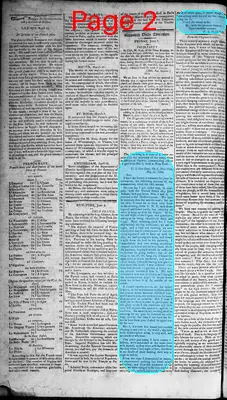
Alexandria Daily Advertiser
Alexandria, Virginia
What is this article about?
Midshipman P. S. Ogilvie reports from U.S. Gun Boat No. 7 in New York that, while en route to the Mediterranean with the USS John Adams and other gunboats starting May 14, 1805, severe weather on May 16 caused the vessel to lose sight of the convoy in fog and spring its mast, leading to a decision on May 21 to return for repairs at latitude 37°17' N, longitude 65° W.
Clipping
OCR Quality
Full Text
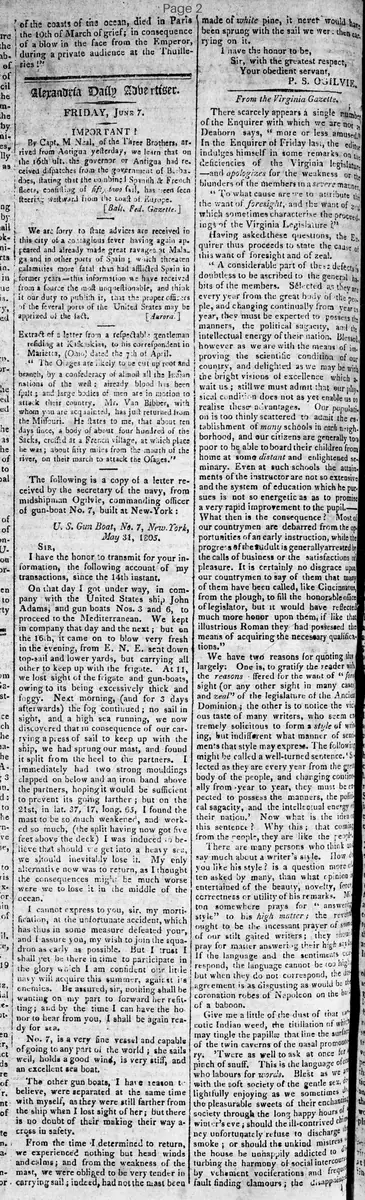
U. S. Gun Boat, No. 7, New-York,
May 31, 1805.
SIR,
I have the honor to transmit for your information, the following account of my transactions, since the 14th instant.
On that day I got under way, in company with the United States ship John Adams, and gun boats Nos. 3 and 6, to proceed to the Mediterranean. We kept in company that day and the next; but on the 16th, it came on to blow very fresh in the evening, from E. N. E. sent down top-sail and lower yards, but carrying all other to keep up with the frigate. At 11, we lost sight of the frigate and gun-boats, owing to its being excessively thick and foggy. Next morning, (and for 3 days afterwards) the fog continued; no sail in sight, and a high sea running, we now discovered that in consequence of our carrying a press of sail to keep up with the ship, we had sprung our mast, and found it split from the heel to the partners. I immediately had two strong mouldings clapped on below and an iron band above the partners, hoping it would be sufficient to prevent its going farther; but on the 21st, in lat. 37, 17, long. 65, I found the mast to be so much weakened, and worked so much, (the split having now got five feet above the deck) I was induced to believe that should we get into a heavy sea, we should inevitably lose it. My only alternative now was to return, as I thought the consequences might be much worse were we to lose it in the middle of the ocean.
I cannot express to you, sir, my mortification, at the unfortunate accident, which has thus in some measure defeated your, and I assure you, my wish to join the squadron as early as possible. But I trust I shall yet be there in time to participate in the glory which I am confident our little navy will acquire this summer, against its enemies. Be assured, sir, nothing shall be wanting on my part to forward her refitting; and by the time I can have the honor to hear from you, I shall be again ready for sea.
No. 7, is a very fine vessel and capable of going to any part of the world; she sails well, holds a good wind, is very stiff, and an excellent sea boat.
The other gun boats, I have reason to believe, were separated at the same time with myself, as they were still farther from the ship when I lost sight of her; but there is no doubt of their making their way across in safety.
From the time I determined to return, we experienced nothing but head winds and calms; and from the weakness of the mast, we were obliged to be very tender in carrying sail; indeed, had not the mast been made of white pine, it never would have been sprung with the sail we were then carrying on it.
I have the honor to be,
Sir, with the greatest respect,
Your obedient servant,
P. S. OGILVIE.
What sub-type of article is it?
What keywords are associated?
What entities or persons were involved?
Where did it happen?
Domestic News Details
Primary Location
New York
Event Date
May 14 31, 1805
Key Persons
Outcome
sprung mast requiring repairs; vessel returning to new york; no casualties reported.
Event Details
U.S. Gun Boat No. 7 departed New York on May 14, 1805, with USS John Adams and gunboats Nos. 3 and 6 for the Mediterranean. On May 16, heavy winds and fog caused separation from the convoy. Mast sprung from excessive sail; temporary repairs made, but on May 21 at lat. 37, 17, long. 65, decided to return due to worsening damage. Other gunboats believed separated but safe.