Thank you for visiting SNEWPapers!
Sign up free
Editorial
August 11, 1957
Atlanta Daily World
Atlanta, Fulton County, Georgia
What is this article about?
William Gordon critiques Louisiana Catholic churchmen's opposition to Archbishop Rummel's integration stance, citing biblical precedent of Philip converting an Ethiopian and the Vatican's affirmation that all souls are equal, condemning segregation as un-Christian and politically motivated.
Clipping
OCR Quality
98%
Excellent
Full Text
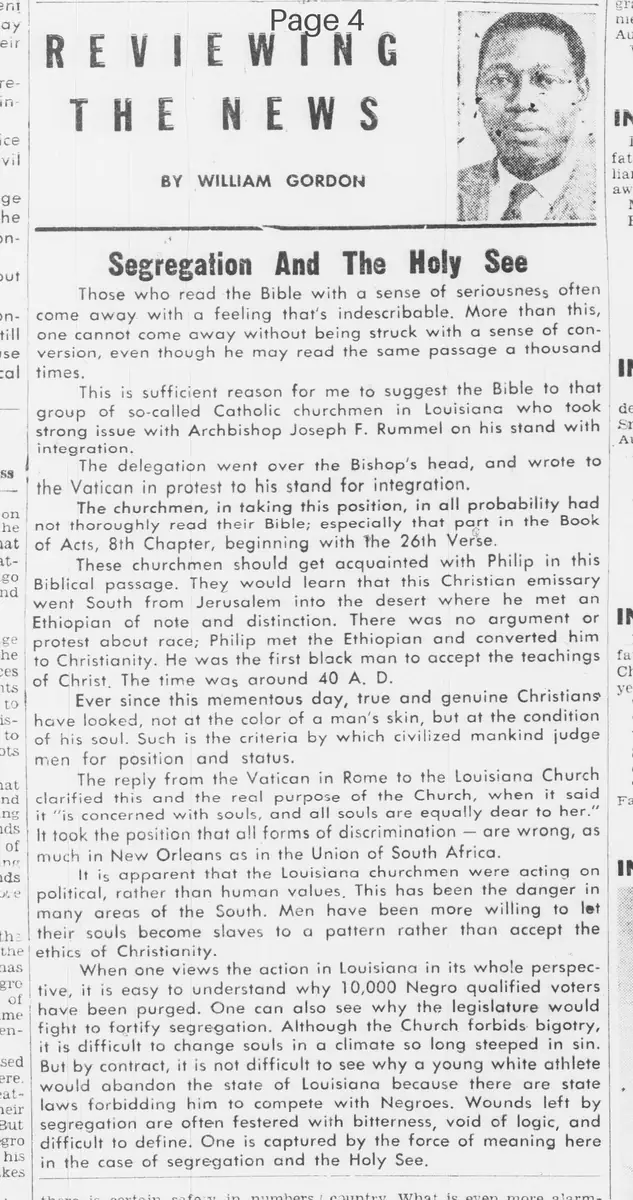
REVIEWING THE NEWS
BY WILLIAM GORDON
Segregation And The Holy See
Those who read the Bible with a sense of seriousness often come away with a feeling that's indescribable. More than this, one cannot come away without being struck with a sense of conversion, even though he may read the same passage a thousand times.
This is sufficient reason for me to suggest the Bible to that group of so-called Catholic churchmen in Louisiana who took strong issue with Archbishop Joseph F. Rummel on his stand with integration.
The delegation went over the Bishop's head, and wrote to the Vatican in protest to his stand for integration.
The churchmen, in taking this position, in all probability had not thoroughly read their Bible; especially that part in the Book of Acts, 8th Chapter, beginning with The 26th Verse.
These churchmen should get acquainted with Philip in this Biblical passage. They would learn that this Christian emissary went South from Jerusalem into the desert where he met an Ethiopian of note and distinction. There was no argument or protest about race; Philip met the Ethiopian and converted him to Christianity. He was the first black man to accept the teachings of Christ. The time was around 40 A. D.
Ever since this momentous day, true and genuine Christians have looked, not at the color of a man's skin, but at the condition of his soul. Such is the criteria by which civilized mankind judge men for position and status.
The reply from the Vatican in Rome to the Louisiana Church clarified this and the real purpose of the Church, when it said it "is concerned with souls, and all souls are equally dear to her."
It took the position that all forms of discrimination - are wrong, as much in New Orleans as in the Union of South Africa.
It is apparent that the Louisiana churchmen were acting on political, rather than human values. This has been the danger in many areas of the South. Men have been more willing to let their souls become slaves to a pattern rather than accept the ethics of Christianity
When one views the action in Louisiana in its whole perspective, it is easy to understand why 10,000 Negro qualified voters have been purged. One can also see why the legislature would fight to fortify segregation. Although the Church forbids bigotry, it is difficult to change souls in a climate so long steeped in sin.
But by contrast, it is not difficult to see why a young white athlete would abandon the state of Louisiana because there are state laws forbidding him to compete with Negroes. Wounds left by segregation are often festered with bitterness, void of logic, and difficult to define. One is captured by the force of meaning here in the case of segregation and the Holy See.
BY WILLIAM GORDON
Segregation And The Holy See
Those who read the Bible with a sense of seriousness often come away with a feeling that's indescribable. More than this, one cannot come away without being struck with a sense of conversion, even though he may read the same passage a thousand times.
This is sufficient reason for me to suggest the Bible to that group of so-called Catholic churchmen in Louisiana who took strong issue with Archbishop Joseph F. Rummel on his stand with integration.
The delegation went over the Bishop's head, and wrote to the Vatican in protest to his stand for integration.
The churchmen, in taking this position, in all probability had not thoroughly read their Bible; especially that part in the Book of Acts, 8th Chapter, beginning with The 26th Verse.
These churchmen should get acquainted with Philip in this Biblical passage. They would learn that this Christian emissary went South from Jerusalem into the desert where he met an Ethiopian of note and distinction. There was no argument or protest about race; Philip met the Ethiopian and converted him to Christianity. He was the first black man to accept the teachings of Christ. The time was around 40 A. D.
Ever since this momentous day, true and genuine Christians have looked, not at the color of a man's skin, but at the condition of his soul. Such is the criteria by which civilized mankind judge men for position and status.
The reply from the Vatican in Rome to the Louisiana Church clarified this and the real purpose of the Church, when it said it "is concerned with souls, and all souls are equally dear to her."
It took the position that all forms of discrimination - are wrong, as much in New Orleans as in the Union of South Africa.
It is apparent that the Louisiana churchmen were acting on political, rather than human values. This has been the danger in many areas of the South. Men have been more willing to let their souls become slaves to a pattern rather than accept the ethics of Christianity
When one views the action in Louisiana in its whole perspective, it is easy to understand why 10,000 Negro qualified voters have been purged. One can also see why the legislature would fight to fortify segregation. Although the Church forbids bigotry, it is difficult to change souls in a climate so long steeped in sin.
But by contrast, it is not difficult to see why a young white athlete would abandon the state of Louisiana because there are state laws forbidding him to compete with Negroes. Wounds left by segregation are often festered with bitterness, void of logic, and difficult to define. One is captured by the force of meaning here in the case of segregation and the Holy See.
What sub-type of article is it?
Moral Or Religious
Social Reform
What keywords are associated?
Segregation
Integration
Vatican
Bible
Louisiana
Christianity
Discrimination
Racial Equality
What entities or persons were involved?
Archbishop Joseph F. Rummel
Vatican
Louisiana Churchmen
Philip
Ethiopian
Editorial Details
Primary Topic
Vatican Support For Racial Integration Against Segregation In Louisiana
Stance / Tone
Strongly Pro Integration And Anti Segregation Using Christian Ethics
Key Figures
Archbishop Joseph F. Rummel
Vatican
Louisiana Churchmen
Philip
Ethiopian
Key Arguments
Bible Passage In Acts Shows Early Christian Acceptance Of Black Convert Without Racial Protest
True Christians Judge By Soul Condition Not Skin Color
Vatican States All Souls Are Equally Dear And Opposes All Discrimination
Louisiana Churchmen Acted On Political Rather Than Human Values
Segregation Leads To Purging Negro Voters And Legislative Fights
Church Forbids Bigotry But Changing Souls In Sinful Climate Is Difficult