Thank you for visiting SNEWPapers!
Sign up free
The National Republican And Ohio Political Register
Cincinnati, Hamilton County, Ohio
What is this article about?
Oration by John S. Little delivered in Cincinnati on January 8, 1827, commemorating the 12th anniversary of the Battle of New Orleans. It recounts the War of 1812 context, praises Andrew Jackson's leadership and victory over British forces, and exhorts citizens to military readiness, constitutional loyalty, and patriotic virtue.
Merged-components note: Continuation of the oration delivered on the 8th of January; text flows directly from one to the next.
Clipping
OCR Quality
Full Text
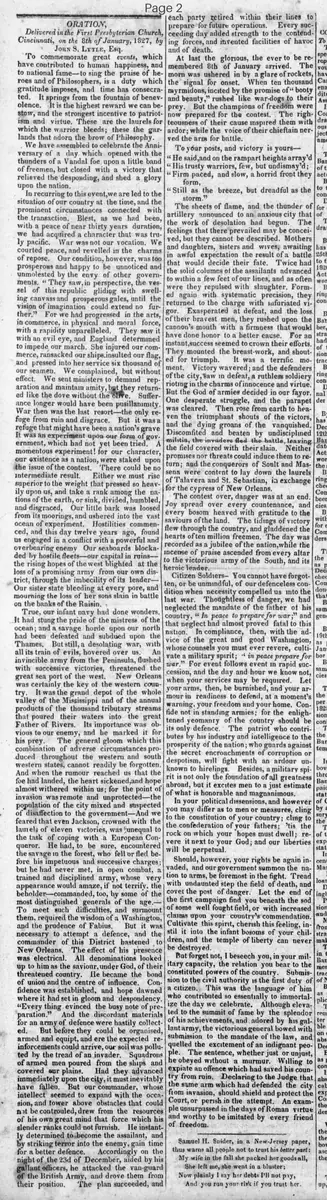
Delivered in the First Presbyterian Church.
Cincinnati, on the 8th of January, 1827, by
John S. Little, Esq.
To commemorate great events, which
have contributed to human happiness, and
to national fame—to sing the praise of he-
roes and of Philosophers, is a duty which
gratitude imposes, and time has consecra-
ted. It springs from the fountain of benev-
olence. It is the highest reward we can be-
stow, and the strongest incentive to patriot-
ism and virtue. These are the laurels for
which the warrior bleeds; these the gar-
lands that adorn the brow of Philosophy.
We have assembled to celebrate the Anni-
versary of a day which opened with the
thunders of a Vandal foe upon a little band
of freemen, but closed with a victory that
relieved the desponding, and shed a glory
upon the nation.
In recurring to this event, we are led to the
situation of our country at the time, and the
prominent circumstances connected with
the transaction. Blest, as we had been,
with a peace of near thirty years duration,
we had acquired a character that was tru-
ly pacific. War was not our vocation. We
courted peace, and revelled in the charms
of repose. Our condition, however, was too
prosperous and happy to be unnoticed and
unmolested by the envy of other govern-
ments. "They saw, in perspective, the ves-
sel of this republic gliding with swell-
ing canvass and prosperous gales, until the
vision of imagination could extend no fur-
ther." For we had progressed in the arts,
in commerce, in physical and moral force.
with a rapidity unparalleled. They saw it
with an evil eye, and England determined
to impede our march. She injured our com-
merce, ransacked our ships, insulted our flag,
and pressed into her service six thousand of
our seamen. We complained, but without
effect. We sent ministers to demand rep-
aration and maintain amity, but they return-
ed like the dove without the olive. Suffer-
anace longer would have been pusillanimity.
War then was the last resort—the only re-
fuge from ruin and disgrace. But it was a
refuge that might have been a nation's grave
It was an experiment upon our form of gov.
ernment, which had not yet been tried. A
momentous experiment! for our character,
our existence as a nation, were staked upon
the issue of the contest. There could be no
intermediate result. Either we must rise
superior to the weight that pressed so heav-
ily upon us, and take a rank among the na-
tions of the earth, or sink, divided, humbled.
and disgraced. Our little bark was loosed
from its moorings, and ushered into the vast
ocean of experiment. Hostilities commen-
ced, and this day twelve years ago, found
us engaged in a conflict with a powerful and
overbearing enemy Our seaboards blocka-
ded by hostile fleets—our capital in ruins—
the rising hopes of the west blighted at the
loss of a promising army from our own dis-
trict, through the imbecility of its leader—
Our sister state bleeding at every pore, and
mourning the loss of her sons slain in battle
on the banks of the Raisin.
True, our infant navy had done wonders.
It had stung the pride of the mistress of the
ocean; and a savage horde upon our north
had been defeated and subdued upon the
Thames. But still, a desolating war, with
all its train of evils, hovered over us. An
invincible army from the Peninsula, flushed
with successive victories, threatened the
great sea port of the west. New Orleans
was certainly the key of the western coun-
try. It was the grand depot of the whole
valley of the Mississippi and of the annual
products of the thousand tributary streams
that poured their waters into the great
Father of Rivers. Its importance was ob-
vious to our enemy, and he marked it for
his prey. The general gloom which this
combination of adverse circumstances pro-
duced throughout the western and south
western states, cannot readily be forgotten.
And when the rumour reached us that the
foe had landed, the heart sickened, and hope
almost withered within us; for the point of
invasion was remote and unprotected—the
population of the city mixed and suspected
of disaffection to the government—And we
feared that even Jackson, crowned with the
laurels of eleven victories, was unequal to
the task of coping with a European Con-
queror. He had, to be sure, encountered
the savage in the forest, who fell or fled be-
fore his impetuous and successive charges;
but he had never met, in open combat, a
trained and disciplined army, whose very
appearance would amaze, if not terrify, the
beholder—commanded, too, by some of the
most distinguished generals of the age.—
To meet such difficulties, and surmount
them, required the wisdom of a Washington,
and the prudence of Fabius. But it was
necessary to attempt a defence, and the
commander of this District hastened to
New Orleans. The effect of his presence
was electrical. All denominations looked
up to him as the saviour, under God, of their
threatened country. He became the bond
of union and the centre of influence. Con-
fidence was established, and hope dawned
where it had set in gloom and despondency.
"Every thing evinced the busy note of pre-
paration." And the discordant materials
for an army of defence were hastily collect-
ed. But before they could be organised.
armed and equipt, and ere the expected re-
forcements could arrive, our soil was pollu-
ted by the tread of an invader. Squadrons
of armed men poured from the ships and
covered our plains.
Had they advanced
immediately upon the city, it must inevitably
have fallen. But our commander, whose
intellect seemed to expand with the occa-
sion, and tower above obstacles that could
not be controuled, drew from the resources
of his own great mind that force which his
slender ranks could not furnish. He instant.
ly determined to become the assailant, and
by striking terror into the enemy, gain time
for a better defence. Accordingly on the
night of the 23d of December, aided by his
gallant officers, he attacked the van-guard
of the British Army, and drove them from
their position. The plan succeeded, and
each party retired within their lines to
prepare for future operations. Every suc-
ceeding day added strength to the contend-
ing forces, and invented facilities of havoc
and of death.
At last the glorious, the ever to be re-
membered 8th of January arrived. The
morn was ushered in by a glare of rockets.
the signal for onset. When ten thousand
myrmidons, incited by the promise of "booty
and beauty," rushed like war-dogs to their
prey. But the champions of freedom were
now prepared for the contest. The righ-
teousness of their cause inspired them with
ardor; while the voice of their chieftain ner
ved the arm for battle.
To your posts, and victory is yours—
"He said, and on the rampart heights array'd
"His trusty warriors, few, but undismay'd;
"Firm paced, and slow, a horrid front they
form,
"Still as the breeze, but dreadful as the
storm."
The sheets of flame, and the thunder of
artillery announced to an anxious city that
the work of desolation had begun. The
feelings that there prevailed may be concei-
ved, but they cannot be described. Mothers
and daughters, sisters and wives, awaiting
in awful expectation the result of a battle
that would decide their fate. Twice had
the solid columns of the assailants advanced
to within a few feet of our lines, and as often
were they repulsed with slaughter. Form-
ed again with systematic precision, they
returned to the charge with infuriated vi-
gor. Exasperated at defeat, and the loss
of their bravest men, they rushed upon the
cannon's mouth with a firmness that would
have done honor to a better cause. For an
instant, success seemed to crown their efforts.
They mounted the breast-work, and shout-
ed for triumph. It was a terrific mo-
ment. Victory wavered; and the defenders
of the city, Saw in defeat, a ruthless soldiery
rioting in the charms of innocence and virtue.
But the God of armies decided in our favor
One desperate struggle, and the parapet
was cleared. Then rose from earth to hea-
ven the triumphant shouts of the victors,
and the dying groans of the vanquished.
Discomfited and beaten by undisciplined
militia, the invaders slunk the battle, leaving
the field covered with their slain. Neither
promises nor threats could induce them to re
turn; and the conquerors of Soult and Mas-
sena were content to lay down the laurels
of Talavera and St. Sebastian, in exchange
for the cypress of New Orleans.
The contest over, danger was at an end.
Joy spread over every countenance, and
every bosom heaved with gratitude to the
saviours of the land. The tidings of victory
flew through the country, and gladdened the
hearts of ten million freemen. The day was
recorded as a jubilee of the nation, while the
incense of praise ascended from every altar
to the victorious army of the South, and its
heroic leader.
Citizen Soldiers—You cannot have forgot-
ten, or be unmindful, of our defenceless con
dition when necessity compelled us into the
last war. Thoughtless of danger, we had
neglected the mandate of the father of his
country, "In peace to prepare for war;" and
that neglect had almost proved fatal to this
nation. In compliance, then, with the ad-
vice of the great and good Washington,
whose counsels you must ever revere, culti-
vate a military spirit; in peace prepare for
war." For event follows event in rapid suc-
cession, and the day and hour we know not,
when your services may be required. Let
your arms, then, be burnished, and your ar-
mour in readiness to defend, at a moment's
warning, your freedom and your home. Con-
fide not in standing armies; for the enlightened yeomanry of the country should be
its only defence. The patriot who contri-
butes by his industry and intelligence to the
prosperity of the nation; who guards against
the secret encroachments of corruption or
despotism, will fight with an ardour up-
known to hirelings. Besides, a military spi
rit is not only the foundation of all greatness
abroad, but it excites men to a just estimate
of what is honorable and magnanimous.
In your political dissensions, and however
you may differ as to men or measures, cling
to the constitution of your country; cling to
the confederation of your fathers; 'tis the
rock on which your hopes must dwell; re-
vere it next to your God; and our liberties
will be perpetual.
Should, however, your rights be again in-
vaded, and our government summon the na-
tion to arms, be foremost in the fight. Tread
with undaunted step the field of death, and
covet the post of danger. Let the end of
the first campaign find you beneath the sod
of some well fought field, or with increased
claims upon your country's commendation.
Cultivate this spirit, cherish this feeling, in-
stil it into the infant bosoms of your chil-
dren, and the temple of liberty can never
be destroyed.
But forget not, I beseech you, in your mil-
itary capacity, the relation you bear to the
constituted powers of the country. Submis-
sion to the civil authority is the first duty of
a citizen. This was the language of him
who contributed so essentially to immortal-
ize the day we celebrate. Although eleva-
ted to the summit of fame by the splendor
of his achievements, and, adored by his gal-
lant army, the victorious general bowed with
submission to the mandate of the law, and
quelled the excitement of an indignant peo-
ple. The sentence, whether just or unjust,
he obeyed without a murmur. Willing to
expiate an offence which had saved his coun-
try from ruin. Declaring to the Judge that
the same arm which had defended the city
from invasion, should shield and protect the
Court, or perish in the attempt. An exam-
ple unsurpassed in the days of Roman virtue
and worthy to be imitated by every friend
of freedom.
What sub-type of article is it?
What themes does it cover?
What keywords are associated?
What entities or persons were involved?
Literary Details
Title
Oration, Delivered In The First Presbyterian Church, Cincinnati, On The 8th Of January, 1827
Author
John S. Little, Esq.
Subject
Commemorating The Anniversary Of The Battle Of New Orleans
Form / Style
Commemorative Prose Oration
Key Lines