Thank you for visiting SNEWPapers!
Sign up free
Editorial
July 9, 1899
Daily American Citizen
Kansas City, Wyandotte County, Kansas
What is this article about?
An editorial reflecting on the challenges of forgiveness and sincere apologies, noting human tendencies toward vindictiveness and self-righteousness, and emphasizing the moral courage required for both giving and receiving pardon.
Clipping
OCR Quality
98%
Excellent
Full Text
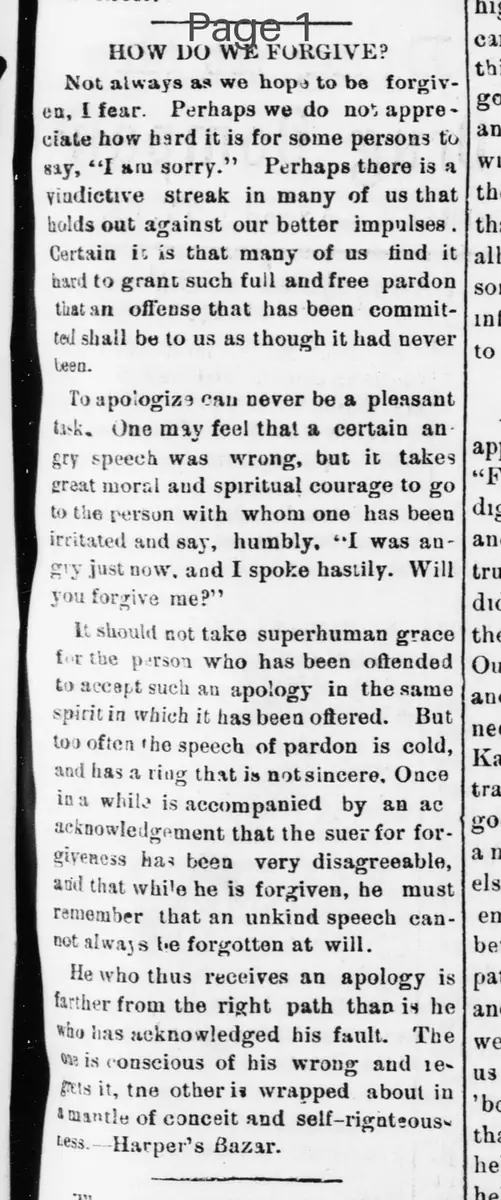
HOW DO WE FORGIVE?
Not always as we hope to be forgiven, I fear. Perhaps we do not appreciate how hard it is for some persons to say, "I am sorry." Perhaps there is a vindictive streak in many of us that holds out against our better impulses. Certain it is that many of us find it hard to grant such full and free pardon that an offense that has been committed shall be to us as though it had never been.
To apologize can never be a pleasant task. One may feel that a certain angry speech was wrong, but it takes great moral and spiritual courage to go to the person with whom one has been irritated and say, humbly, "I was angry just now, and I spoke hastily. Will you forgive me?"
It should not take superhuman grace for the person who has been offended to accept such an apology in the same spirit in which it has been offered. But too often the speech of pardon is cold, and has a ring that is not sincere. Once in a while it is accompanied by an acknowledgement that the suer for forgiveness has been very disagreeable, and that while he is forgiven, he must remember that an unkind speech cannot always be forgotten at will.
He who thus receives an apology is farther from the right path than is he who has acknowledged his fault. The one is conscious of his wrong and regrets it, the other is wrapped about in a mantle of conceit and self-righteousness.-Harper's Bazar.
Not always as we hope to be forgiven, I fear. Perhaps we do not appreciate how hard it is for some persons to say, "I am sorry." Perhaps there is a vindictive streak in many of us that holds out against our better impulses. Certain it is that many of us find it hard to grant such full and free pardon that an offense that has been committed shall be to us as though it had never been.
To apologize can never be a pleasant task. One may feel that a certain angry speech was wrong, but it takes great moral and spiritual courage to go to the person with whom one has been irritated and say, humbly, "I was angry just now, and I spoke hastily. Will you forgive me?"
It should not take superhuman grace for the person who has been offended to accept such an apology in the same spirit in which it has been offered. But too often the speech of pardon is cold, and has a ring that is not sincere. Once in a while it is accompanied by an acknowledgement that the suer for forgiveness has been very disagreeable, and that while he is forgiven, he must remember that an unkind speech cannot always be forgotten at will.
He who thus receives an apology is farther from the right path than is he who has acknowledged his fault. The one is conscious of his wrong and regrets it, the other is wrapped about in a mantle of conceit and self-righteousness.-Harper's Bazar.
What sub-type of article is it?
Moral Or Religious
What keywords are associated?
Forgiveness
Apology
Moral Courage
Self Righteousness
Vindictiveness
What entities or persons were involved?
Harper's Bazar
Editorial Details
Primary Topic
The Challenges Of Forgiveness And Sincere Apology
Stance / Tone
Reflective Exhortation Toward True Forgiveness
Key Figures
Harper's Bazar
Key Arguments
Forgiveness Is Often Incomplete Due To Vindictive Impulses
Apologizing Requires Moral And Spiritual Courage
Sincere Acceptance Of Apologies Is Essential And Should Not Be Cold Or Insincere
Self Righteousness Hinders Proper Forgiveness More Than Acknowledging Fault