Thank you for visiting SNEWPapers!
Sign up free
The New Hampshire Gazette And Historical Chronicle
Portsmouth, Greenland, Rockingham County, New Hampshire
What is this article about?
Lord Chatham's speech in the House of Lords on January 20, 1775, urging withdrawal of British troops from Boston to foster reconciliation with America, followed by supportive speeches from Lords Shelburne, Camden, Richmond, and Rockingham. Motion defeated 18-77.
Merged-components note: Merged as the second component contains the vote tally concluding the parliamentary debate on Lord Chatham's speech in the first component; sequential reading order and adjacent spatial positioning indicate they form a single logical foreign news article.
Clipping
OCR Quality
Full Text
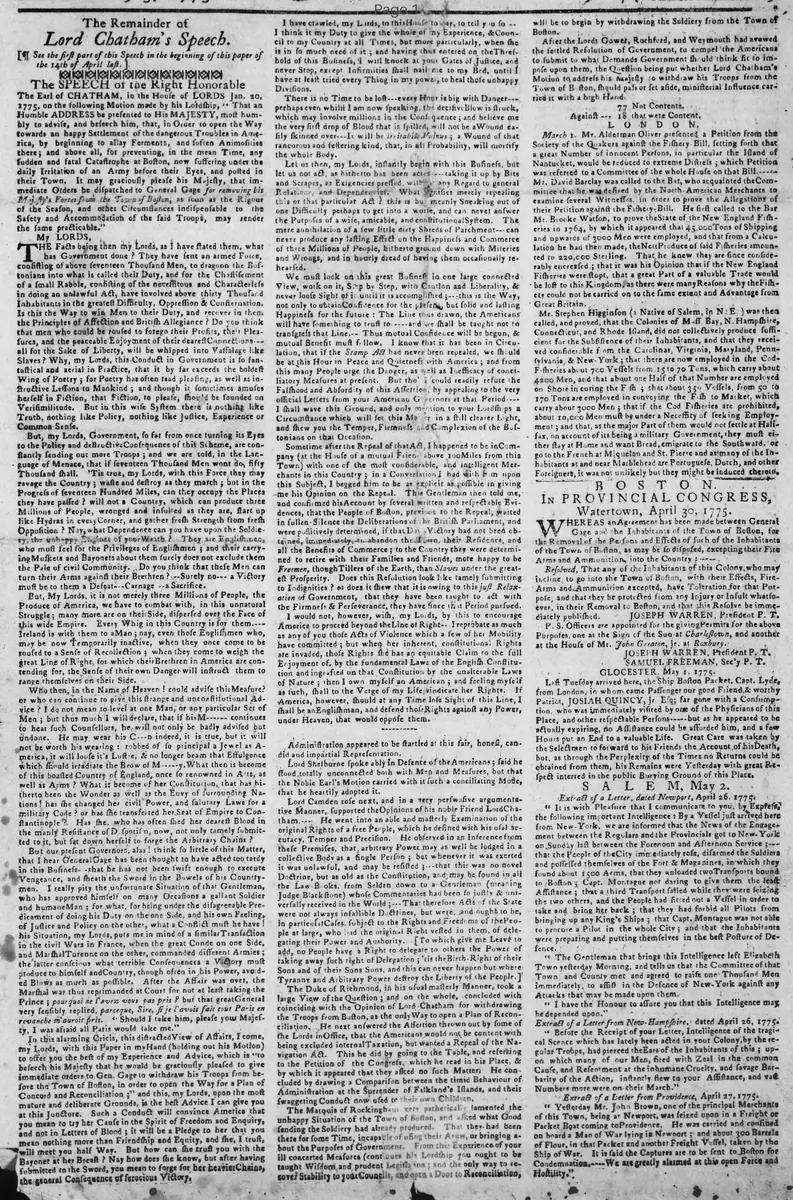
Lord Chatham's Speech.
[See the first part of this Speech in the beginning of this paper the 14th of April last.]
The SPEECH of the Right Honorable
The Earl of CHATHAM, in the House of LORDS Jan. 20,
1775, on the following Motion made by his Lordship, "That an
Humble ADDRESS be presented to His MAJESTY, most humbly to advise, and beseech him, that, in Order to open the Way
towards an happy Settlement of the dangerous Troubles in America, by beginning to allay Ferments, and soften Animosities
there; and above all, for preventing, in the mean Time, any
sudden and fatal Catastrophe at Boston, now suffering under the
daily Irritation of an Army before their Eyes, and posted in
their Town. It may graciously please his Majesty, that immediate
Orders be dispatched to General Gage for removing his
Majesty's Forces from the Town of Boston, as soon as the Rigour
of the Season, and other Circumstances indispensable to the
Safety and Accommodation of the said Troops, may render
the same practicable.
My LORDS,
The Facts being then my Lords, as I have stated them, what
has Government done? They have sent an armed Force,
consisting of above seventeen Thousand Men, to dragoon the Bostonians into what is called their Duty, and for the Chastisement
of a small Rabble, consisting of the necessitous and Characterless
in doing an unlawful Act, have involved above thirty Thousand
Inhabitants in the greatest Difficulty, Oppression & Consternation.
Is this the Way to win Men to their Duty, and recover in them
the Principles of Affection and British Allegiance? Do you think
that men who could be roused to forego their Profits, their Pleasures, and the peaceable Enjoyment of their dearest Connections---
all for the Sake of Liberty, will be whipped into Vassalage like
Slaves? Why, my Lords, this Conduct in Government is so fantastical and aerial in Practice, that it by far exceeds the boldest
Wing of Poetry; for Poetry has often taught pleasing, as well as instructive Lessons to Mankind; and though it sometimes amuses
herself in Fiction, that Fiction, to please, should be founded on
Verisimilitude. But in this wise System there is nothing like
Truth, nothing like Policy, nothing like Justice, Experience or
Common Sense.
But, my Lords, Government, so far from once turning its Eyes
to the Policy and destructive Consequence of this Scheme, are constantly sending out more Troops; and we are told, in the Language
of Menace, that if seventeen Thousand Men won't do, fifty
Thousand shall. 'Tis true, my Lords, with this Force they may
ravage the Country; waste and destroy as they march; but in the
Progress of seventeen Hundred Miles, can they occupy the Places
they have passed? will not a Country, which can produce three
Millions of People, wronged and insulted as they are, start up
like Hydras in every Corner, and gather fresh Strength from fresh
Opposition? Nay, what Dependence can you have upon the Soldiery, the unhappy Slaves of your Will? They are Englishmen,
who must feel for the Privileges of Englishmen; and their carrying Muskets and Bayonets about them surely does not exclude them
the Pale of civil Community. Do you think that these Men can
turn their Arms against their Brethren?--Surely no--- a Victory
must be to them a Defeat.--Carnage --a Sacrifice.
But, My Lords, it is not merely three Millions of People, the
Produce of America, we have to combat with, in this unnatural
Struggle; many more are on their Side, dispersed over the Face of
this wide Empire. Every Whig in this Country is for them.--.
Ireland is with them to a Man; nay, even those Englishmen who,
may be now Temporarily inactive, when they once come to be
roused to a Sense of Recollection; when they come to weigh the
great Line of Right, for which their Brethren in America are contending for, the Sense of their own Danger will instruct them to
range themselves on their Side. :
Who then, in the Name of Heaven! could advise this Measure?
or who can continue to give this strange and unconstitutional Advice? I do not mean to level at one Man, or any particular Set of
Men; but thus much I will declare, that if his Majesty continues
to hear such Counsellors, he will not only be badly advised but
undone. He may, wear his Crown indeed, it is true, but it will
not be worth his wearing: robbed of so principal a Jewel as America, it will lose it's Lustre, & no longer beam that Effulgence
which should irradiate the Brow of Majesty. What then is become
of this boasted Country of England, once so renowned in Arts. as
well as Arms? What is become of her Constitution, that has hitherto been the Wonder as well as the Envy of surrounding Nations! has she changed her civil Power, and salutary Laws for a
military Code? or has she transferred her Seat of Empire to Constantinople?. Has she, who has often shed her dearest Blood in
the manly Resistance of Despotism, now, not only tamely submitted to it, but sat down herself to forge the Arbitrary Chains?
But our present Governors, alas! think so little of this Matter,
that I hear General Gage has been thought to have acted too tardy
in this Business--that he has not been swift enough to execute
Vengeance, and sheath the Sword in the Bowels of his Countrymen. I really pity the unfortunate Situation of that Gentleman,
who has approved himself on many Occasions a gallant Soldier
and humane Man; for what, for being under the disagreeable Predicament of doing his Duty on the one Side, and his own Feeling,
of Justice and Policy on the other, what a Conflict must he have!
His Situation, my Lords, puts me in mind of a similar Transaction
in the civil Wars in France, when the great Conde on one Side,
and Marshal Turenne on the other, commanded different Armies;
the latter conscious what terrible Consequences a Victory must
produce to himself and Country, though often in his Power, avoided Blows as much as possible. After the Affair was over, the
Marshal was thus reprimanded at Court for not at least taking the
Prince; pourquoi ne l'avez vous pas pris? but that great General
very sensibly replied, parce que, Sire, si je l'avois fait tout Paris en
revanche m'auroit pris. "Should I take him, please your Majesty, I was afraid all Paris would take me."
In, this alarming Crisis, this distracted View of Affairs, I come,
my Lords, with this Paper in my Hand (holding out his Motion)
to offer you the best of my Experience and Advice, which is "to
beseech his Majesty that he would be graciously pleased to give
immediate orders to Gen. Gage to withdraw his Troops from before the Town of Boston, in order to open the Way for a Plan of
Concord and Reconciliation;" and this, my Lords, upon the most
mature and deliberate Grounds, is the best Advice I can give you
at this Juncture. Such a Conduct will convince America that
you mean to try her Cause in the Spirit of Freedom and Enquiry,
and not in Letters of Blood; it will be a Pledge to her that you
mean nothing more than Friendship and Equity, and she, I trust,
will meet you half Way. But how can she trust you with the
Bayonet at her Breast? Nay how does she know, but after having
submitted to the Sword, you mean to forge for her heavier Chains,
the general Consequence of ferocious Victory.
I have crawled, my Lords, to this House to say, to tell you o-
I think it my Duty to give the whole of my Experience, & Council to my Country at all Times, but more particularly, when she
is in so much need of it; and having thus entered on the Thread.
hold of this Business, I will knock at your Gates of Justice, and
never Stop, except Infirmities shall nail me to my Bed. until
you have at least tried every Thing in my power, to heal those unhappy
Divisions.
There is no Time to be lost.--every Hour is big with Danger---
perhaps even whilst I am now speaking, the decisive Blow is struck,
which may involve millions in the Consequence; and believe me
the very first drop of Blood that is spilled, will not be a Wound easily skinned over---It will be irritabile Vulgus; a Wound of that
rancorous and festering kind, that, in all Probability, will mortify
the whole Body.
Let us then, my Lords, instantly begin with this Business, but
let us not act, as hitherto has been acted.---taking it up by Bits
and Scraps, as Exigencies pressed, with any Regard to general
Relations, and Dependencies. What Signifies merely repealing
this or that particular Act? this is but meanly Sneaking out of
one Difficulty perhaps to get into a worse, and can never answer
the Purposes of a wise, amicable, and constitutional System. The
mere annihilation of a few little dirty Shreds of Parchment---can
never produce any lasting Effect on the Happiness and Commerce
of three Millions of People, hitherto ground down with Miseries
and Wrongs, and in hourly dread of having them occasionally rehearsed.
We must look on this great Business in one large connected
View, work on it, Step by Step, with Caution and Liberality, &
never lose Sight of it until it is accomplished;---this is the Way,
not only to obtain Confidence for the present, but solid and lasting
Happiness for the future: The Line thus drawn, the Americans
will have something to trust to.---and we shall be taught not to
transgress that Line.---Thus mutual Confidence will be begun, &
mutual Benefit must follow. I know that it has been in Circulation, that if the Stamp Act had never been repealed, we should
be at this Hour in Peace and Quietness with America; and from
this many People urge the Danger, as well as Inefficacy of conciliatory Measures at present. But tho' I could readily refute the
Falsehood and Absurdity of this Assertion, by appealing to the very
official Letters from your American Governors at that Period...
I shall waive this Ground, and only mention to your Lordships a
Circumstance which will set this Matter in a still clearer Light,
and shew you the Temper, Firmness and Complexion of the Bostonians on that Occasion.
Sometime after the Repeal of that Act, I happened to be in Company (at the House of a mutual Friend above 100 Miles from this
Town) with one of the most considerable, and intelligent Merchants in this Country; in a Conversation I had With him upon
this Subject, I begged him to be as explicit as possible in giving
me his Opinion on the Repeal. This Gentleman then told me,
and confirmed his Account by several written and respectable Evidences, that the People of Boston, previous to the Repeal, waited
in sullen Silence the Deliberations of the British Parliament, and
were positively determined, if that decisive Victory had not been obtained, immediately, to abandon the Town, their Residence, and
all the Benefits of Commerce; to the Country they were determined to retire with their Families and Friends, more happy to be
Freemen, though Tillers of the Earth, than Slaves under the greatest Prosperity. Does this Resolution look like tamely submitting
to Indignities? or does it shew that it is owing to this just Relaxation
of Government, that they have been taught to act with
the Firmness & Perseverance, they have since this Period pursued.
I would not, however, wish, my Lords, by this to encourage
America to proceed beyond the Line of Right... I reprobate as much
as any of you those Acts of Violence which a few of her Mobility
have committed; but when her inherent, constitutional Rights
are invaded, those Rights she has an equitable Claim to the full
Enjoyment of, by the fundamental Laws of the English Constitution and insisted on that Constitution by the unalterable Laws
of Nature; then I own myself an American; and feeling myself
as such, shall to the Verge of my Life vindicate her Rights. If
America, however, should at any Time lose Sight of this Line, I
shall be an Englishman, and defend those Rights against any Power,
under Heaven, that would oppose them.
Administration, appeared to be startled at this fair, honest, candid and impartial Representation.
Lord Shelburne spoke ably in Defence of the Americans; said he
stood totally unconnected both with Men and Measures, but that
the Noble Earl's Motion carried with it such a conciliating Mode,
that he heartily adopted it.
Lord Camden rose next, and in a very persuasive argumentative Manner, supported the Opinions of his noble Friend Lord Chatham... He went into an able and masterly Examination of the
original Rights of a free People, which he defined with his usual accuracy, Temper and Precision. He observed in an Inference from
these Premises, that, arbitrary Power may as well be lodged in a
collective Body as a single Person; but whenever it was exerted
it was unlawful, and may be resisted; that this was no novel
Doctrine, but as old as the Constitution, and may be found in all
the Law-Books: from Selden down to a Gentleman (meaning
Judge Blackstone) whose Commentaries had been so justly & universally received in the World... That therefore Acts of the State
were not always infallible Doctrines, but were, and ought to be,
in particular Cases, subject to the Rights and Freedoms of the People at large, who had the original Right vested in them, of delegating their Power and Authority. To which give me Leave to
add, no People have a Right to delegate to others the Power of
taking away such right of Delegation; 'tis the Birth-Right of their
Sons and of their Sons Sons, and this can never happen but where
Tyranny and Arbitrary Power destroy the Liberty of the People.
The Duke of Richmond, in his usual masterly Manner, took a
large View of the Question; and on the whole, concluded with
coinciding with the Opinion of Lord Chatham for withdrawing
the Troops from Boston, as the only Way to open a Plan of Reconciliation. He next answered the Assertion thrown out by some of
the Lords in Office, that the Americans would not be content with
being excluded internal Taxation, but wanted a Repeal of the Navigation Act. This he did by going to the Table, and referring
to the Petition of the Congress, which he read in his Place, &
by which it appeared that they asked no such Matter. He concluded by drawing a Comparison between the timid Behaviour of
Administration at the Surrender of Falkland's Islands, and their
swaggering Conduct now used to their own Children.
The Marquis of Rockingham very pathetically, lamented the
unhappy Situation of the Town of Boston, and asked what Good
sending the Soldiery had already produced. That they had been
there for some Time, incapable of using their Arms, or bringing about the Purposes of Government. From this Experience of your
ill concerted Measures (continues his Lordship) you ought to be
taught Wisdom, and prudent Legislation; and the only way to recover Stability to good Councils, and open a Door to Reconciliation,
77
Not Contents.
Against it 18 that were Content.
LONDON.
What sub-type of article is it?
What keywords are associated?
What entities or persons were involved?
Where did it happen?
Foreign News Details
Primary Location
Boston
Event Date
Jan. 20, 1775
Key Persons
Outcome
motion to withdraw troops from boston defeated, 18 contents against 77 not contents.
Event Details
Earl of Chatham delivered a speech in the House of Lords proposing an address to the King to order General Gage to remove British forces from Boston to facilitate reconciliation with America, criticizing government policy of sending troops and predicting escalation. Supporting speeches by Lords Shelburne, Camden, Richmond, and Rockingham emphasized American rights and need for conciliation. The motion was rejected.