Thank you for visiting SNEWPapers!
Sign up free
Daily National Intelligencer
Washington, District Of Columbia
What is this article about?
Editorial from London Statesman warns of the severe consequences of war with the United States, highlighting a recent state paper from the US Committee of Foreign Relations as an opportunity for renewed diplomacy, criticizing British leadership, and emphasizing America's strategic advantages.
Clipping
OCR Quality
Full Text
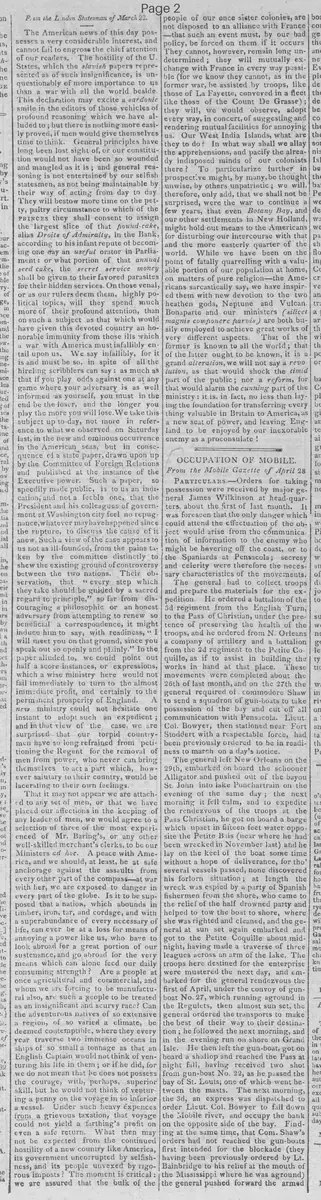
The American news of this day possesses a very considerable interest, and cannot fail to engross the chief attention of our readers. The hostility of the U. States, which the slavish papers represented as of such insignificance, is unquestionably of more importance to us than a war with all the world beside. This declaration may excite a sardonic smile in the editors of those vehicles of profound reasoning which we have alluded to; but there is nothing more easily proved, if men would give themselves time to think. General principles have long been lost sight of, or our constitution would not have been so wounded and mangled as it is; and general reasoning is not entertained by our selfish statesmen, as not being maintainable by their way of acting from day to day. They will bestow more time on the petty, paltry circumstance to which of the PRINCES they shall consent to assign the largest slice of that hound-cake, alias Droits of Admiralty, in the Bank, according to his infant repute of becoming one day a useful orator in Parliament: or what portion of that annual seed cake, the secret service money shall be given to their favored parasites for their hidden services. On those venal, or as our rulers deem them, highly political topics, will they spend much more of their profound attention, than on such a subject as that which would have given this devoted country an honorable immunity from those ills which a war with America must infallibly entail upon us. We say infallibly, or it is and must be so, in spite of all the hireling scribblers can say: as much as that if you play odds against one at any game where your adversary is as well informed as yourself, you must in the end be the loser, and the longer you play the more you will lose. We take this subject up to-day, not more in reference to what we observed on Saturday last, in the new and ominous occurrence in the American seas, but in consequence of a state paper, drawn up by the Committee of Foreign Relations and published at the instance of the Executive power. Such a paper, so speedily made public, is to us an indication, and not a feeble one, that the President and his colleagues of government at Washington city feel no repugnance, whatever may have happened since the rupture, to discuss the cause of it anew. Such a view of the case appears to us not as ill-founded, from the pains taken by the committee distinctly to shew the existing ground of controversy between the two nations. Their observation, that "every step which they take should be guided by a sacred regard to principle," so far from discouraging a philosophic or an honest adversary from attempting to renew so beneficial a correspondence, it might induce him to say, with readiness, "I will meet you on that ground, since you speak out so openly and plainly." In the paper alluded to, we could point out half a score instances, or expressions, which a wise ministry here would not fail immediately to turn to the almost immediate profit, and certainly to the permanent prosperity of England. A new ministry could not hesitate one instant to adopt such an expedient; and in that view of the case, we are surprised that our torpid countrymen have so long refrained from petitioning the Regent for the removal of men from power, who never can bring themselves to act a part which, however salutary to their country, would be lacerating to their own feelings.
That it may not appear we are attached to any set of men, or that we have placed our affections in the keeping of any leader of men, we would agree to a selection of three of the most experienced of Mr. Baring's, or any other well-skilled merchant's clerks, to be our Ministers ad hoc. A peace with America, and we should, at least, be at safe anchorage against the assaults from every other part of the compass--at war with her, we are exposed to danger in every part of the globe. Is it to be supposed that a nation, which abounds in timber, iron, tar, and cordage, and with a superabundance of every necessary of life, can ever be at a loss for means of annoying a power like us, who have to look abroad for a great portion of our sustenance, and go abroad for the very means which can alone feed our daily consuming strength? Are a people at once agricultural and commercial, and whom we are forcing to be manufacturing also, are such a people to be treated as an insignificant and scurvy race? Can the adventurous natives of so extensive a region, of so varied a climate, be deemed contemptible, where they every year traverse two immense oceans in ships of so small a tonnage as that an English Captain would not think of venturing his life in them; or if he did, for we do not mean that he does not possess the courage, with, perhaps, superior skill, but he would not think of venturing a penny on the voyage in so inferior a vessel. Under such heavy expenses from a grievous taxation, that voyage could not yield a farthing's profit on even a safe return. What then may not be expected from the continued hostility of a new country like America, its government uncorrupted by selfishness, and its people unvexed by rigorous imposts? The moment is critical: we are assured that the bulk of the people of our once sister colonies, are not disposed to an alliance with France--that such an event must, by our bad policy, be forced on them if it occurs. They cannot, however, remain long undetermined; they will mutually exchange with France in every way possible (for we know they cannot, as in the former war, be assisted by troops, like those of La Fayette, conveyed in a fleet like those of the Count De Grasse); they will, we would observe, adopt every way, in concert, of suggesting and rendering mutual facilities for annoying us. Our West India Islands, what are they to do? In what way shall we allay the apprehensions, and pacify the already indisposed minds of our colonists there? To particularize further in prospective might, by many, be thought unwise, by others unpatriotic; we will, therefore, only add, that we shall not be surprised, were the war to continue a few years, that even Botany Bay, and our other settlements in New Holland, might hold out means to the Americans for disturbing our intercourse with that and the more easterly quarter of the world. While we have been on the point of fatally quarrelling with a valuable portion of our population at home, on matters of pure religion--the Americans sarcastically say, we have inspired them with new devotion to the two heathen gods, Neptune and Vulcan. Bonaparte and our ministers (silicet magnis componere parvis) are both busily employed to achieve great works of very different aspects. That of the former is known to all the world; that of the latter ought to be known, it is a grand alteration, we will not say a revolution, as that would shock the timid part of the public; nor a reform, for that would alarm the cunning part of the ministry: it is, in fact, no less than laying the foundation for transferring every thing valuable in Britain to America, as a new seat of power, and leaving England to be enjoyed by our inexorable enemy as a proconsulate!
What sub-type of article is it?
What keywords are associated?
What entities or persons were involved?
Where did it happen?
Foreign News Details
Primary Location
Washington City
Event Date
March 22
Key Persons
Outcome
potential war with america would expose britain to global dangers, including threats to west india islands and settlements in new holland; opportunity for peace via us state paper.
Event Details
Editorial discusses US state paper from Committee of Foreign Relations indicating willingness to discuss rupture causes; criticizes British statesmen for ignoring diplomatic opportunities and warns of America's resources enabling prolonged hostility, potential alliance with France, and disruptions to British colonies.