Thank you for visiting SNEWPapers!
Sign up free
Editorial
March 22, 1933
Smyrna Times
Smyrna, Kent County, Delaware
What is this article about?
Editorial critiques the reintroduction of the farm allotment plan under President Roosevelt, highlighting opposition from processors due to proposed taxes that would raise food prices significantly, estimating $800M annual consumer cost, amid doubts from Congress and economists.
Clipping
OCR Quality
98%
Excellent
Full Text
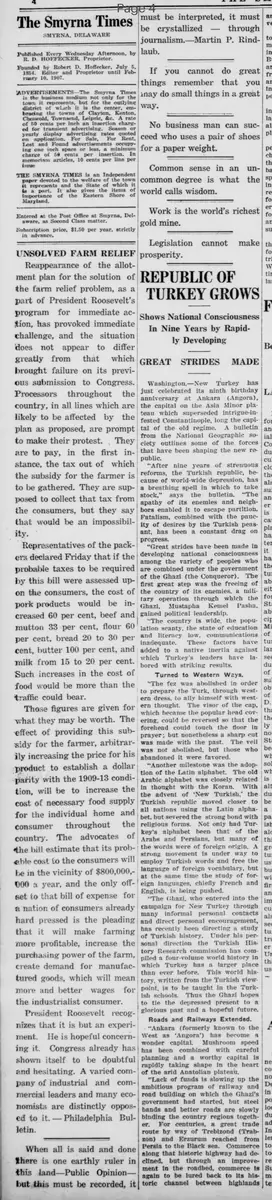
UNSOLVED FARM RELIEF
Reappearance of the allotment plan for the solution of the farm relief problem, as a part of President Roosevelt's program for immediate action, has provoked immediate challenge, and the situation does not appear to differ greatly from that which brought failure on its previous submission to Congress.
Processors throughout the country, in all lines which are likely to be affected by the plan as proposed, are prompt to make their protest. They are to pay, in the first instance, the tax out of which the subsidy for the farmer is to be gathered. They are supposed to collect that tax from the consumers, but they say that would be an impossibility.
Representatives of the packers declared Friday that if the probable taxes to be required by this bill were assessed upon the consumers, the cost of pork products would be increased 60 per cent, beef and mutton 33 per cent, flour 60 per cent, bread 20 to 30 per cent, butter 100 per cent, and milk from 15 to 20 per cent.
Such increases in the cost of food would be more than the traffic could bear.
Those figures are given for what they may be worth. The effect of providing this subsidy for the farmer, arbitrarily increasing the price for his product to establish a dollar parity with the 1909-13 condition, will be to increase the cost of necessary food supply for the individual home and consumer throughout the country. The advocates of the bill estimate that its probable cost to the consumers will be in the vicinity of $800,000,000 a year, and the only offset to that bill of expense for a nation of consumers already hard pressed is the pleading that it will make farming more profitable, increase the purchasing power of the farm, create demand for manufactured goods, which will mean more and better wages for the industrialist consumer.
President Roosevelt recognizes that it is but an experiment. He is hopeful concerning it. Congress already has shown itself to be doubtful and hesitating. A varied company of industrial and commercial leaders and many economists are distinctly opposed to it. — Philadelphia Bulletin.
When all is said and done there is one earthly ruler in this land—Public Opinion—but this must be recorded, it must be interpreted, it must be crystallized through journalism.—Martin P. Rindlaub.
Reappearance of the allotment plan for the solution of the farm relief problem, as a part of President Roosevelt's program for immediate action, has provoked immediate challenge, and the situation does not appear to differ greatly from that which brought failure on its previous submission to Congress.
Processors throughout the country, in all lines which are likely to be affected by the plan as proposed, are prompt to make their protest. They are to pay, in the first instance, the tax out of which the subsidy for the farmer is to be gathered. They are supposed to collect that tax from the consumers, but they say that would be an impossibility.
Representatives of the packers declared Friday that if the probable taxes to be required by this bill were assessed upon the consumers, the cost of pork products would be increased 60 per cent, beef and mutton 33 per cent, flour 60 per cent, bread 20 to 30 per cent, butter 100 per cent, and milk from 15 to 20 per cent.
Such increases in the cost of food would be more than the traffic could bear.
Those figures are given for what they may be worth. The effect of providing this subsidy for the farmer, arbitrarily increasing the price for his product to establish a dollar parity with the 1909-13 condition, will be to increase the cost of necessary food supply for the individual home and consumer throughout the country. The advocates of the bill estimate that its probable cost to the consumers will be in the vicinity of $800,000,000 a year, and the only offset to that bill of expense for a nation of consumers already hard pressed is the pleading that it will make farming more profitable, increase the purchasing power of the farm, create demand for manufactured goods, which will mean more and better wages for the industrialist consumer.
President Roosevelt recognizes that it is but an experiment. He is hopeful concerning it. Congress already has shown itself to be doubtful and hesitating. A varied company of industrial and commercial leaders and many economists are distinctly opposed to it. — Philadelphia Bulletin.
When all is said and done there is one earthly ruler in this land—Public Opinion—but this must be recorded, it must be interpreted, it must be crystallized through journalism.—Martin P. Rindlaub.
What sub-type of article is it?
Agriculture
Economic Policy
What keywords are associated?
Farm Relief
Allotment Plan
Roosevelt Program
Food Price Increases
Processor Protests
Agricultural Subsidies
Consumer Costs
What entities or persons were involved?
President Roosevelt
Congress
Processors
Packers
Philadelphia Bulletin
Editorial Details
Primary Topic
Opposition To Farm Allotment Plan And Subsidies
Stance / Tone
Skeptical And Critical Of The Plan
Key Figures
President Roosevelt
Congress
Processors
Packers
Philadelphia Bulletin
Key Arguments
Processors Protest The Tax They Must Pay To Fund Farmer Subsidies, Claiming Inability To Pass It To Consumers.
Packers Estimate Massive Food Price Increases: Pork 60%, Beef/Mutton 33%, Flour 60%, Bread 20 30%, Butter 100%, Milk 15 20%.
Plan Aims For Dollar Parity With 1909 13 But Would Raise Consumer Food Costs By ~$800m Annually.
Offset Claimed: More Profitable Farming Boosts Purchasing Power, Demand For Goods, And Wages.
Roosevelt Sees It As Experiment And Is Hopeful; Congress Doubtful; Opposed By Industrial Leaders And Economists.