Thank you for visiting SNEWPapers!
Sign up free
Springfield Weekly Republican
Springfield, Hampden County, Massachusetts
What is this article about?
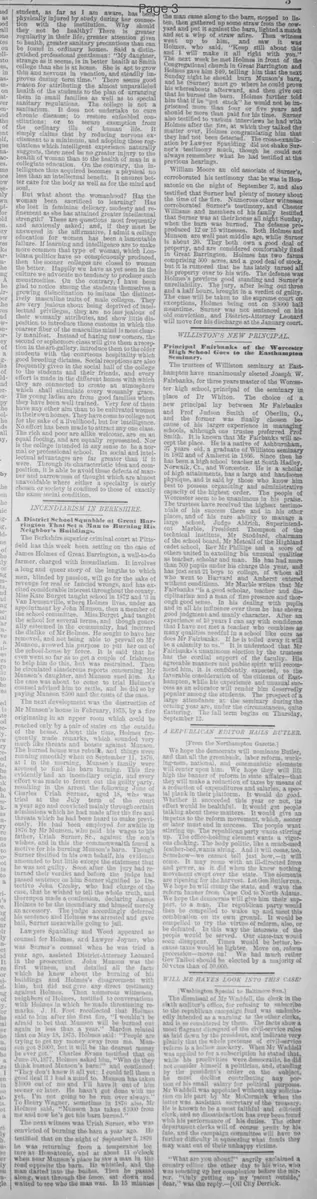
In Great Barrington, Berkshire County, farmer James Holmes was convicted in Pittsfield court this week of incendiarism for burning John Munson's house in 1875 and barn in 1876, stemming from a school teacher dispute and revenge after paying Munson $500 in a slander suit. Accomplice Charles Sumner testified against him.
Clipping
OCR Quality
Full Text
A District School Squabble at Great Barrington That Set a Man to Burning His Neighbor's Buildings.
The Berkshire superior criminal court at Pittsfield has this week been sitting on the case of James Holmes of Great Barrington, a well-to-do farmer, charged with incendiarism. It involves a long and queer story of the lengths to which men, blinded by passion, will go for the sake of revenge for real or fancied wrongs, and has excited considerable interest throughout the county. Miss Kate Burget taught school in 1872 and '73 in Van Deusenville, where Holmes lives, under an appointment by John Munson, then a member of the school committee. Miss Burget had taught the school for several terms, and though generally esteemed in the community, had incurred the dislike of Mr. Holmes. He sought to have her removed, and not being able to prevail on Mr. Munson, avowed his purpose to put her out of the school-house by force. It is said that he even went so far as to get a couple of Irishmen to help him do this, but was restrained. Then he circulated slanderous reports concerning Mr. Munson's daughter, and Munson sued him. As the case was about to come to trial, Holmes's counsel advised him to settle, and he did so by paying Munson $500 and the costs of the case. The next development was the destruction of Mr. Munson's house in February, 1875, by a fire originating in an upper room which could be reached only by a pair of stairs on the outside of the house. About this time, Holmes frequently made remarks, which sounded very much like threats and boasts against Munson. The burned house was rebuilt, and things were running smoothly when on September 11, 1876, at 1 in the morning, Munson's family were aroused to find his barn burning. This fire evidently had an incendiary origin, and every effort was made to ferret out the guilty party, resulting in the arrest the following June of Charles Uriah Sumner, aged 18, who was tried at the July term of the court a year ago and convicted mainly through certain admissions which he had made after the fire and threats which he had been heard to make previously. He had been employed for awhile in 1876 by Mr. Munson, who paid his wages to his father, Uriah Sumner, Sr., against the son's wishes, and in this the commonwealth found a motive for his burning Munson's barn. Though Sumner testified in his own behalf, his evidence amounted to but little except the statement that he was not guilty. Soon after the jury had returned their verdict and before the judge had passed sentence on him, Sumner signified to Detective John Crosby, who had charge of the case, that he wished to tell the whole truth, and thereupon made a confession, declaring James Holmes to be the incendiary and himself merely an accessory. The judge accordingly deferred his sentence and Holmes was arrested and gave bail, Sumner meanwhile going to jail. Lawyers Spaulding and Wood appeared as counsel for Holmes, and Lawyer Joyner, who was Sumner's counsel when he was tried a year ago, assisted District-Attorney Leonard in the prosecution. John Munson was the first witness, and detailed all the facts which he knew about the burning of his buildings and Holmes's disagreement with him, but did not give any direct testimony against Holmes. Then numerous witnesses, neighbors of Holmes, testified to conversations with Holmes in which he made threatening remarks. J.H. Foot recollected that Holmes said to him after the first fire, "I wouldn't be afraid to bet that Munson will be burned out again in less than a year." Marden related that on May 18, 1875, Holmes said: "People are trying to get my money away from me. Munson got $500, but it will be the dearest money he ever got." Charles Evans testified that on June 30, 1877, Holmes asked him, "Who do they think burned Munson's barn?" and continued: "They don't know it all yet; I could tell them a good deal if I had a mind to. Munson has taken $500 out of me and I'll have it out of him sooner or later. He hasn't got done with me yet. I'm not going to be run over always." To Henry Wagner, sometime in 1876 also, Mr. Holmes said, "Munson has taken $1000 from me and now he's got his barn burned." The next witness was Uriah Sumner, who was convicted of burning the barn a year ago. He testified that on the night of September 2, 1876 he was returning from a temperance lecture at Housatonic, and at about 11 o'clock when near Munson's place he saw a man in the road opposite the barn. He whistled, and the man darted into the bushes. Then he passed along, went through the fence, sat down and waited to see who the man was. In 15 minutes the man came along to the barn, stopped to listen, then gathered up some straw from the cow-yard and put it against the barn, lighted a match and set a wisp of straw afire. Then witness went up to him, and saw it was Holmes, who said, "Keep still about this and I will make it all right with you." The next week he met Holmes in front of the Congregational church in Great Barrington and Holmes gave him $40, telling him that the next Sunday night he should burn Munson's barn, and he (Sumner) must go where he could prove his whereabouts afterward, and then give out that he burned the barn. Holmes further told him that if he "got stuck" he would not be imprisoned more than four or five years and should be more than paid for his time. Sumner also testified to various interviews he had with Holmes after the fire, at which they talked the matter over, Holmes congratulating him that they had not been detected. The cross-examination by Lawyer Spaulding did not shake Sumner's testimony much, though he could not always remember what he had testified at the previous hearings. William Moore, an old associate of Sumner's, corroborated his testimony that he was in Housatonic on the night of September 2, and also testified that Sumner had plenty of money about the time of the fire. Numerous other witnesses corroborated Sumner's testimony, and Chester Williams and members of his family testified that Sumner was at their house all night Sunday, when the barn was burned. The defense produced 12 or 15 witnesses. Both Holmes and Munson are well past middle age, while Sumner is about 20. They both own a good deal of property, and are considered comfortably fixed in Great Barrington. Holmes has two farms comprising 300 acres, and a good deal of stock, but it is rumored that he has lately turned all his property over to his wife. The defense was Holmes's previous good standing and Sumner's unreliability. The jury, after being out three and a half hours, brought in a verdict of guilty. The case will be taken to the supreme court on exceptions, Holmes being out on $3000 bail meantime. Sumner was not sentenced on his old conviction, and District-Attorney Leonard will move for his discharge at the January court.
What sub-type of article is it?
What keywords are associated?
What entities or persons were involved?
Where did it happen?
Domestic News Details
Primary Location
Great Barrington, Berkshire County
Event Date
This Week (Ca. 1878); Fires February 1875 And September 11, 1876
Key Persons
Outcome
holmes convicted of incendiarism, out on $3000 bail pending appeal to supreme court; munson's house and barn destroyed by fire; no deaths reported; sumner deferred sentencing, potential discharge
Event Details
James Holmes, motivated by grudge over schoolteacher Miss Kate Burget and a $500 slander settlement to John Munson, orchestrated the arson of Munson's house in February 1875 and barn on September 11, 1876. Holmes paid accomplice Charles Uriah Sumner $40 to take the blame; Sumner confessed, leading to Holmes's arrest and trial where witnesses testified to Holmes's threats; jury found Holmes guilty after three and a half hours.