Thank you for visiting SNEWPapers!
Sign up free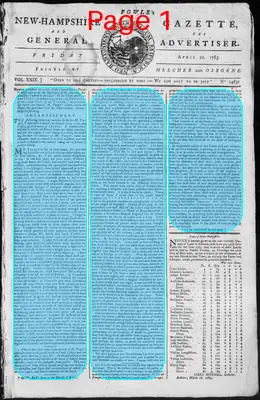
Literary
April 22, 1785
Fowle's New Hampshire Gazette And General Advertiser
Portsmouth, Rockingham County, New Hampshire
What is this article about?
Dr. Price introduces and publishes a letter from M. Turgot, former French Comptroller-General, addressed to Price. Turgot praises Price's work on civil liberty, critiques British misconceptions, and analyzes American state constitutions for flaws in balancing powers, religious tests, commerce regulation, and federal unity, urging a rational, rights-based framework.
Clipping
OCR Quality
92%
Excellent
Full Text
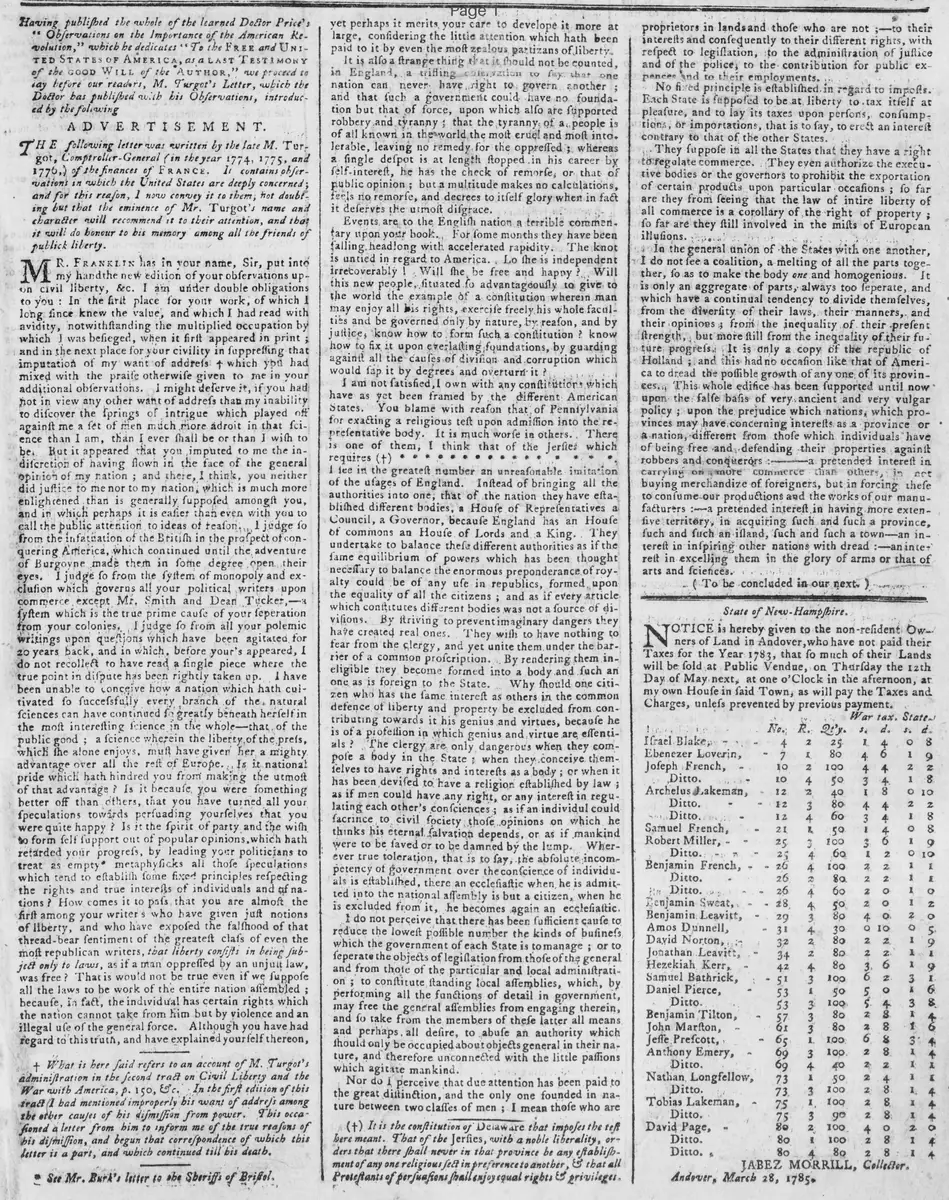
Having published the whole of the learned Doctor Price's
his Observations on the Importance of the American Revolution, which he dedicates "To the FREE and UNITED STATES OF AMERICA, as a LAST TESTIMONY
of the GOOD WILL of the AUTHOR," we proceed to
lay before our readers, M. Turgot's Letter, which the
Doctor has published with his Observations, introduced
by the following
ADVERTISEMENT.
THE following letter was written by the late M. Turgot,
Comptroller-General (in the year 1774, 1775, and
1776,) of the finances of FRANCE. It contains observations in which the United States are deeply concerned:
and for this reason, I now convey it to them; not doubting
but that the eminence of Mr. Turgot's name and
character will recommend it to their attention, and that
it will do honour to his memory among all the friends of
publick liberty.
R. Franklin has in your name, Sir, put into
my hands the new edition of your observations upon
civil liberty, &c. I am under double obligations
to you: In the first place for your work, of which I
long since knew the value, and which I had read with
avidity, notwithstanding the multiplied occupation by
which I was besieged, when it first appeared in print;
and in the next place for your civility in suppressing that
imputation of my want of address to which you had
mixed with the praise otherwise given to me in your
additional observations. I might deserve it, if you had
not in view any other want of address than my inability
to discover the springs of intrigue which played off
against me a set of men much more adroit in that science than I am, than I ever shall be or than I wish to
be. But it appeared that you imputed to me the indiscretion of having flown in the face of the general
opinion of my nation; and there, I think, you neither
did justice to me nor to my nation, which is much more
enlightened than is generally supposed amongst you,
and in which perhaps it is easier than even with you to
call the public attention to ideas of reason.... I judge so
from the infatuation of the British in the prospect of conquering America, which continued until the adventure
of Burgoyne made them in some degree open their
eyes. I judge so from this system of monopoly and exclusion which governs all your political writers upon
commerce, except Mr. Smith and Dean Tucker,--a
system which is the true prime cause of your separation
from your colonies. I judge so from all your polemic
writings upon questions which have been agitated for
twenty years back, and in which, before yours appeared, I
do not recollect to have read a single piece where the
true point in dispute has been rightly taken up. I have
been unable to conceive how a nation which hath cultivated so successfully every branch of the natural
sciences can have continued so greatly beneath herself in
the most interesting science in the whole--that of the
public good; a science wherein the liberty of the press,
which she alone enjoys, must have given her a mighty
advantage over all the rest of Europe... Is it national
pride which hath hindered you from making the utmost
of that advantage? Is it because you were something
better off than others, that you have turned all your
speculations towards persuading yourselves that you
were quite happy? Is it the spirit of party and the wish
to form self support out of popular opinions, which hath
retarded your progress, by leading your politicians to
treat as empty metaphysicks all those speculations
which tend to establish some fixed principles respecting
the rights and true interests of individuals and of nations? How comes it to pass, that you are almost the
first among your writers who have given just notions
of liberty, and who have exposed the falsehood of that
thread-bare sentiment of the greatest class of even the
most republican writers, that liberty consists in being subject only to laws, as if a man oppressed by an unjust law,
was free? That would not be true even if we suppose
all the laws to be work of the entire nation assembled;
because, in fact, the individual has certain rights which
the nation cannot take from him but by violence and an
illegal use of the general force. Although you have had
regard to this truth, and have explained yourself thereon,
+ What is here said refers to an account of M. Turgot's
administration in the second tract on Civil Liberty and the
War with America, p. 150, &c. In the first edition of this
tract I had mentioned improperly his want of address among
the other causes of his dismission from power. This occasioned a letter from him to inform me of the true reasons of
his dismission, and begun that correspondence of which this
letter is a part, and which continued till his death.
See Mr. Burke's letter to the Sheriffs of Bristol.
yet perhaps it merits your care to develope it more at
large, considering the little attention which hath been
paid to it by even the most zealous partizans of liberty.
It is also a strange thing that it should not be counted,
in England, a trifling observation to say, that one
nation can never have right to govern another;
and that such a government could have no foundation
but that of force, upon which also are supported
robbery and tyranny; that the tyranny of a people is
of all known in the world the most cruel and most intolerable, leaving no remedy for the oppressed; whereas
a single despot is at length stopped in his career by
self-interest, he has the check of remorse, or that of
public opinion; but a multitude makes no calculations,
feels no remorse, and decrees to itself glory when in fact
it deserves the utmost disgrace.
Events are to the English nation a terrible commentary upon your book. For some months they have been
falling headlong with accelerated rapidity. The knot
is untied in regard to America. Lo she is independent
irrecoverably! Will she be free and happy? Will
this new people, situated so advantageously to give to
the world the example of a constitution wherein man
may enjoy all his rights, exercise freely his whole faculties and be governed only by nature, by reason, and by
justice, know how to form such a constitution? know
how to fix it upon everlasting foundations, by guarding
against all the causes of division and corruption which
would sap it by degrees and overturn it?
I am not satisfied, I own with any constitutions which
have as yet been framed by the different American
States. You blame with reason that of Pennsylvania
for exacting a religious test upon admission into the representative body. It is much worse in others. There
is one of them, I think that of the Jerseys which
requires (t) * * * e *
9
I see in the greatest number an unreasonable imitation
of the usages of England. Instead of bringing all the
authorities into one; that of the nation they have established different bodies, a House of Representatives a
Council, a Governor, because England has a House
of Commons a House of Lords and a King. They
undertake to balance these different authorities as if the
same equilibrium of powers which has been thought
necessary to balance the enormous preponderance of royalty could be of any use in republics, formed upon
the equality of all the citizens: and as if every article
which constitutes different bodies was not a source of divisions. By striving to prevent imaginary dangers they
have created real ones. They wish to have nothing to
fear from the clergy, and yet unite them under the barrier of a common proscription. By rendering them ineligible they become formed into a body and such an
one as is foreign to the State. Why should one citizen who has the same interest as others in the common
defence of liberty and property be excluded from contributing towards it his genius and virtues, because he
is of a profession in which genius and virtue are essentials? The clergy are only dangerous when they compose a body in the State: when they conceive themselves to have rights and interests as a body; or when it
has been devised to have a religion established by law;
as if men could have any right or any interest in regulating each other's consciences: as if an individual could
sacrifice to civil society those opinions on which he
thinks his eternal salvation depends, or as if mankind
were to be saved or to be damned by the lump. Wherever true toleration, that is to say, the absolute incompetency of government over the conscience of individuals is established, there an ecclesiastic when he is admitted into the national assembly is but a citizen, when he
is excluded from it, he becomes again an ecclesiastic.
I do not perceive that there has been sufficient cause to
reduce to the lowest possible number the kinds of business which the government of each State is to manage; or to
separate the objects of legislation from those of the general and from those of the particular and local administration; to constitute standing local assemblies, which, by
performing all the functions of detail in government,
may free the general assemblies from engaging therein,
and so take from the members of these latter all means
and perhaps, all desire to abuse an authority which
should only be occupied about objects general in their nature, and therefore unconnected with the little passions which agitate mankind.
Nor do I perceive that due attention has been paid to
the great distinction, and the only one founded in nature between two classes of men; I mean those who are
(t) It is the constitution of Delaware that imposes the test
here meant. That of the Jerseys, with a noble liberality, orders that there shall never in that province be any establishment of any one religious sect in preference to another, that all
Protestants of all persuasions shall enjoy equal rights & privileges.
proprietors in lands and those who are not;--to their
interests and consequently to their different rights, with
respect to legislation, to the administration of justice
and of the police, to the contribution for public expenses and to their employments.
No fixed principle is established in regard to imposts.
Each State is supposed to be at liberty to tax itself at
pleasure, and to lay its taxes upon persons, consumptions, or importations, that is to say, to erect an interest
contrary to that of the other States.
f,
They suppose in all the States that they have a right
to regulate commerce. They even authorize the executive bodies or the governors to prohibit the exportation
of certain products upon particular occasions; so far
are they from seeing that the law of entire liberty of
all commerce is a corollary of the right of property;
so far are they still involved in the mists of European
illusions.:.u..
6.7
In the general union of the States with one another,
I do not see a coalition, a melting of all the parts together, so as to make the body one and homogeneous. It
is only an aggregate of parts, always too separate, and
which have a continual tendency to divide themselves,
from the diversity of their laws, their manners, and
their opinions as from the inequality of their present
strength, but more still from the inequality of their future progress. It is only a copy of the republic of
Holland: and this had no occasion like that of America to dread the possible growth of any one of its provinces. This whole edifice has been supported until now
upon the false basis of very ancient and very vulgar
policy; upon the prejudice which nations, which provinces may have concerning interests as a province or
a nation, different from those which individuals have
of being free and defending their properties against
robbers and conquerors:--a pretended interest in
carrying on more commerce than others, in not
buying merchandize of foreigners, but in forcing these
to consume our productions and the works of our manufacturers:--a pretended interest in having more extensive territory, in acquiring such and such a province,
such and such an island, such and such a town--an interest in inspiring other nations with dread:--an interest in excelling them in the glory of arms or that of
arts and sciences.
(To be concluded in our next.)
his Observations on the Importance of the American Revolution, which he dedicates "To the FREE and UNITED STATES OF AMERICA, as a LAST TESTIMONY
of the GOOD WILL of the AUTHOR," we proceed to
lay before our readers, M. Turgot's Letter, which the
Doctor has published with his Observations, introduced
by the following
ADVERTISEMENT.
THE following letter was written by the late M. Turgot,
Comptroller-General (in the year 1774, 1775, and
1776,) of the finances of FRANCE. It contains observations in which the United States are deeply concerned:
and for this reason, I now convey it to them; not doubting
but that the eminence of Mr. Turgot's name and
character will recommend it to their attention, and that
it will do honour to his memory among all the friends of
publick liberty.
R. Franklin has in your name, Sir, put into
my hands the new edition of your observations upon
civil liberty, &c. I am under double obligations
to you: In the first place for your work, of which I
long since knew the value, and which I had read with
avidity, notwithstanding the multiplied occupation by
which I was besieged, when it first appeared in print;
and in the next place for your civility in suppressing that
imputation of my want of address to which you had
mixed with the praise otherwise given to me in your
additional observations. I might deserve it, if you had
not in view any other want of address than my inability
to discover the springs of intrigue which played off
against me a set of men much more adroit in that science than I am, than I ever shall be or than I wish to
be. But it appeared that you imputed to me the indiscretion of having flown in the face of the general
opinion of my nation; and there, I think, you neither
did justice to me nor to my nation, which is much more
enlightened than is generally supposed amongst you,
and in which perhaps it is easier than even with you to
call the public attention to ideas of reason.... I judge so
from the infatuation of the British in the prospect of conquering America, which continued until the adventure
of Burgoyne made them in some degree open their
eyes. I judge so from this system of monopoly and exclusion which governs all your political writers upon
commerce, except Mr. Smith and Dean Tucker,--a
system which is the true prime cause of your separation
from your colonies. I judge so from all your polemic
writings upon questions which have been agitated for
twenty years back, and in which, before yours appeared, I
do not recollect to have read a single piece where the
true point in dispute has been rightly taken up. I have
been unable to conceive how a nation which hath cultivated so successfully every branch of the natural
sciences can have continued so greatly beneath herself in
the most interesting science in the whole--that of the
public good; a science wherein the liberty of the press,
which she alone enjoys, must have given her a mighty
advantage over all the rest of Europe... Is it national
pride which hath hindered you from making the utmost
of that advantage? Is it because you were something
better off than others, that you have turned all your
speculations towards persuading yourselves that you
were quite happy? Is it the spirit of party and the wish
to form self support out of popular opinions, which hath
retarded your progress, by leading your politicians to
treat as empty metaphysicks all those speculations
which tend to establish some fixed principles respecting
the rights and true interests of individuals and of nations? How comes it to pass, that you are almost the
first among your writers who have given just notions
of liberty, and who have exposed the falsehood of that
thread-bare sentiment of the greatest class of even the
most republican writers, that liberty consists in being subject only to laws, as if a man oppressed by an unjust law,
was free? That would not be true even if we suppose
all the laws to be work of the entire nation assembled;
because, in fact, the individual has certain rights which
the nation cannot take from him but by violence and an
illegal use of the general force. Although you have had
regard to this truth, and have explained yourself thereon,
+ What is here said refers to an account of M. Turgot's
administration in the second tract on Civil Liberty and the
War with America, p. 150, &c. In the first edition of this
tract I had mentioned improperly his want of address among
the other causes of his dismission from power. This occasioned a letter from him to inform me of the true reasons of
his dismission, and begun that correspondence of which this
letter is a part, and which continued till his death.
See Mr. Burke's letter to the Sheriffs of Bristol.
yet perhaps it merits your care to develope it more at
large, considering the little attention which hath been
paid to it by even the most zealous partizans of liberty.
It is also a strange thing that it should not be counted,
in England, a trifling observation to say, that one
nation can never have right to govern another;
and that such a government could have no foundation
but that of force, upon which also are supported
robbery and tyranny; that the tyranny of a people is
of all known in the world the most cruel and most intolerable, leaving no remedy for the oppressed; whereas
a single despot is at length stopped in his career by
self-interest, he has the check of remorse, or that of
public opinion; but a multitude makes no calculations,
feels no remorse, and decrees to itself glory when in fact
it deserves the utmost disgrace.
Events are to the English nation a terrible commentary upon your book. For some months they have been
falling headlong with accelerated rapidity. The knot
is untied in regard to America. Lo she is independent
irrecoverably! Will she be free and happy? Will
this new people, situated so advantageously to give to
the world the example of a constitution wherein man
may enjoy all his rights, exercise freely his whole faculties and be governed only by nature, by reason, and by
justice, know how to form such a constitution? know
how to fix it upon everlasting foundations, by guarding
against all the causes of division and corruption which
would sap it by degrees and overturn it?
I am not satisfied, I own with any constitutions which
have as yet been framed by the different American
States. You blame with reason that of Pennsylvania
for exacting a religious test upon admission into the representative body. It is much worse in others. There
is one of them, I think that of the Jerseys which
requires (t) * * * e *
9
I see in the greatest number an unreasonable imitation
of the usages of England. Instead of bringing all the
authorities into one; that of the nation they have established different bodies, a House of Representatives a
Council, a Governor, because England has a House
of Commons a House of Lords and a King. They
undertake to balance these different authorities as if the
same equilibrium of powers which has been thought
necessary to balance the enormous preponderance of royalty could be of any use in republics, formed upon
the equality of all the citizens: and as if every article
which constitutes different bodies was not a source of divisions. By striving to prevent imaginary dangers they
have created real ones. They wish to have nothing to
fear from the clergy, and yet unite them under the barrier of a common proscription. By rendering them ineligible they become formed into a body and such an
one as is foreign to the State. Why should one citizen who has the same interest as others in the common
defence of liberty and property be excluded from contributing towards it his genius and virtues, because he
is of a profession in which genius and virtue are essentials? The clergy are only dangerous when they compose a body in the State: when they conceive themselves to have rights and interests as a body; or when it
has been devised to have a religion established by law;
as if men could have any right or any interest in regulating each other's consciences: as if an individual could
sacrifice to civil society those opinions on which he
thinks his eternal salvation depends, or as if mankind
were to be saved or to be damned by the lump. Wherever true toleration, that is to say, the absolute incompetency of government over the conscience of individuals is established, there an ecclesiastic when he is admitted into the national assembly is but a citizen, when he
is excluded from it, he becomes again an ecclesiastic.
I do not perceive that there has been sufficient cause to
reduce to the lowest possible number the kinds of business which the government of each State is to manage; or to
separate the objects of legislation from those of the general and from those of the particular and local administration; to constitute standing local assemblies, which, by
performing all the functions of detail in government,
may free the general assemblies from engaging therein,
and so take from the members of these latter all means
and perhaps, all desire to abuse an authority which
should only be occupied about objects general in their nature, and therefore unconnected with the little passions which agitate mankind.
Nor do I perceive that due attention has been paid to
the great distinction, and the only one founded in nature between two classes of men; I mean those who are
(t) It is the constitution of Delaware that imposes the test
here meant. That of the Jerseys, with a noble liberality, orders that there shall never in that province be any establishment of any one religious sect in preference to another, that all
Protestants of all persuasions shall enjoy equal rights & privileges.
proprietors in lands and those who are not;--to their
interests and consequently to their different rights, with
respect to legislation, to the administration of justice
and of the police, to the contribution for public expenses and to their employments.
No fixed principle is established in regard to imposts.
Each State is supposed to be at liberty to tax itself at
pleasure, and to lay its taxes upon persons, consumptions, or importations, that is to say, to erect an interest
contrary to that of the other States.
f,
They suppose in all the States that they have a right
to regulate commerce. They even authorize the executive bodies or the governors to prohibit the exportation
of certain products upon particular occasions; so far
are they from seeing that the law of entire liberty of
all commerce is a corollary of the right of property;
so far are they still involved in the mists of European
illusions.:.u..
6.7
In the general union of the States with one another,
I do not see a coalition, a melting of all the parts together, so as to make the body one and homogeneous. It
is only an aggregate of parts, always too separate, and
which have a continual tendency to divide themselves,
from the diversity of their laws, their manners, and
their opinions as from the inequality of their present
strength, but more still from the inequality of their future progress. It is only a copy of the republic of
Holland: and this had no occasion like that of America to dread the possible growth of any one of its provinces. This whole edifice has been supported until now
upon the false basis of very ancient and very vulgar
policy; upon the prejudice which nations, which provinces may have concerning interests as a province or
a nation, different from those which individuals have
of being free and defending their properties against
robbers and conquerors:--a pretended interest in
carrying on more commerce than others, in not
buying merchandize of foreigners, but in forcing these
to consume our productions and the works of our manufacturers:--a pretended interest in having more extensive territory, in acquiring such and such a province,
such and such an island, such and such a town--an interest in inspiring other nations with dread:--an interest in excelling them in the glory of arms or that of
arts and sciences.
(To be concluded in our next.)
What sub-type of article is it?
Epistolary
Essay
What themes does it cover?
Liberty Freedom
Political
Commerce Trade
What keywords are associated?
American Revolution
Civil Liberty
Turgot Letter
State Constitutions
Political Liberty
Commerce Regulation
Religious Toleration
Federal Union
What entities or persons were involved?
M. Turgot
Literary Details
Title
M. Turgot's Letter
Author
M. Turgot
Subject
Observations On Civil Liberty And American Constitutions
Form / Style
Political Letter With Commentary On Governance
Key Lines
Lo She Is Independent Irrecoverably! Will She Be Free And Happy?
That Liberty Consists In Being Subject Only To Laws, As If A Man Oppressed By An Unjust Law, Was Free?
One Nation Can Never Have Right To Govern Another;
The Law Of Entire Liberty Of All Commerce Is A Corollary Of The Right Of Property;
I Do Not See A Coalition, A Melting Of All The Parts Together, So As To Make The Body One And Homogeneous.