Thank you for visiting SNEWPapers!
Sign up free
The Times
Washington, District Of Columbia
What is this article about?
On Jan. 22 in New York, Mayor Samuel M. Jones of Toledo spoke at a letter carriers' meeting, endorsing socialism, postal work's honor, workers' right to a living, and the eight-hour day, but declined joining the Socialist party to avoid political misperceptions.
Clipping
OCR Quality
Full Text
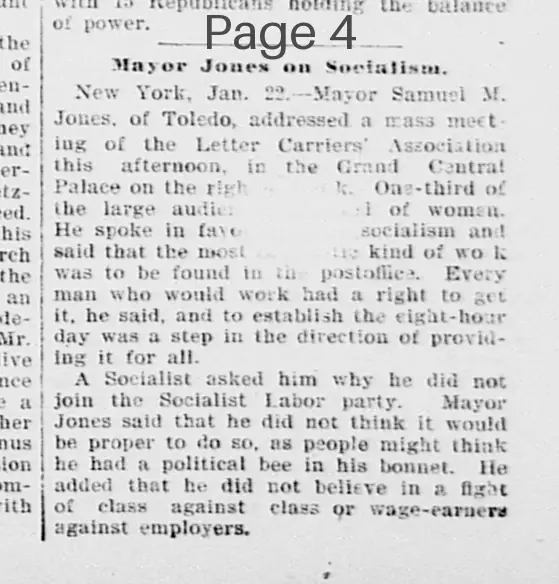
New York, Jan. 22.—Mayor Samuel M. Jones, of Toledo, addressed a mass meeting of the Letter Carriers' Association this afternoon, in the Grand Central Palace on the right. One-third of the large audience was composed of women.
He spoke in favor of socialism and said that the most honorable kind of work was to be found in the postoffice. Every man who would work had a right to a living, he said, and to establish the eight-hour day was a step in the direction of providing it for all.
A Socialist asked him why he did not join the Socialist Labor party. Mayor Jones said that he did not think it would be proper to do so, as people might think he had a political bee in his bonnet. He added that he did not believe in a fight of class against class or wage-earners against employers.
What sub-type of article is it?
What themes does it cover?
What keywords are associated?
What entities or persons were involved?
Where did it happen?
Story Details
Key Persons
Location
New York, Grand Central Palace
Event Date
Jan. 22
Story Details
Mayor Samuel M. Jones of Toledo addressed a mass meeting of the Letter Carriers' Association, speaking in favor of socialism, the honor of postoffice work, the right to a living for every worker, and the eight-hour day as a step toward it. He declined to join the Socialist Labor party to avoid perceptions of political ambition and rejected class against class fights.