Thank you for visiting SNEWPapers!
Sign up free
Windham County Observer
Putnam, Windham County, Connecticut
What is this article about?
Official U.S. government summary of key WWII developments for the week, including aggressive war strategy, Lend-Lease to Russia, war production ramps, Army appropriations and enlistments, Pacific fighting, Navy expansions, rationing preparations, and industrial priorities as of mid-February 1942.
Clipping
OCR Quality
Full Text
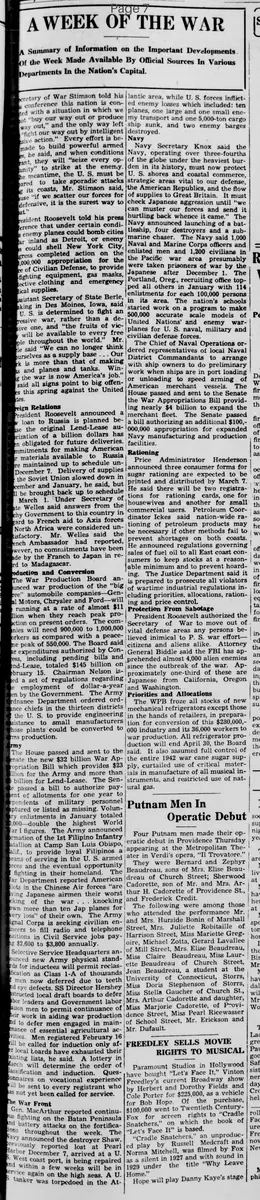
A Summary of Information on the Important Developments Of the Week Made Available By Official Sources In Various Departments In the Nation's Capital.
In conference this nation is confronted with a situation in which we cannot "buy our way out or produce our way out," and the only way left is to "fight our way out by intelligent aggressive action." Every effort is being made to build powerful armed forces, he said, and when conditions warrant, they will "seize every opportunity" to strike at the enemy. In the meantime, the U. S. must be prepared to take sporadic attacks along its coasts, Mr. Stimson said, guarding against a false sense of security "if we scatter our forces for purely defensive" purposes. President Roosevelt told his press conference that under certain conditions enemy planes could bomb cities as far inland as Detroit, or enemy ships could shell New York City. Congress completed action on the $100,000,000 appropriation for the Office of Civilian Defense, to provide firefighting equipment, gas masks, protective clothing and emergency medical supplies. Assistant Secretary of State Berle, speaking in Des Moines, Iowa, said the U. S. is determined to fight an aggressive war, rather than a defensive one, and "the fruits of victory will be available to every free people throughout the world." Mr. Berle said "We can no longer think of ourselves as a supply base . . . Our task is more than that of making guns and planes and tanks. Winning the war is now America's job."
All signs point to big offensives this spring against the United States. Foreign Relations
President Roosevelt announced a new loan to Russia is planned because the original Lend-Lease authorization of a billion dollars has been obligated for future deliveries. Commitments for making American war materials available to Russia are maintained up to schedule until December 7. Delivery of supplies to the Soviet Union slowed down in December and January, he said, but will be brought back up to schedule March 1. Under Secretary of State Welles said answers from the Vichy Government to this country in regard to French aid to Axis forces in North Africa were considered unsatisfactory. Mr. Welles said the French Ambassador had reported, however, no commitments have been made by the French to Japan in regard to Madagascar. Production and Conversion
The War Production Board announced war production of the "big three" automobile companies General Motors, Chrysler and Ford-will be running at a rate of almost $11 million when they reach peak production on present orders. The companies will need 900,000 to 1,000,000 workers as compared with a peacetime peak of 550,000. The Board said war expenditures authorized by Congress, including pending bills and Lend-Lease, totaled $145 billion on February 15. Chairman Nelson issued a set of regulations regarding the employment of dollar-a-year men by the Government. The Army Ordnance Department ordered ordnance chiefs in the thirteen districts of the U. S. to provide engineering assistance to small manufacturers whose plants could be converted to arms production. Army
The House passed and sent to the Senate the new $32 billion War Appropriation Bill which provides $23 billion for the Army and more than $8 billion for Lend-Lease. The Senate passed a bill to authorize payment of allotments for one year to dependents of military personnel captured or listed as missing. Voluntary enlistments in January totaled 100,000 double the highest World War I figures. The Army announced formation of the 1st Filipino Infantry Battalion at Camp San Luis Obispo, Calif., to provide loyal Filipinos a means of serving in the U. S. armed forces and the eventual opportunity of fighting in their homeland. The War Department reported American pilots in the Chinese Air forces "are giving Japanese airmen their worst licking of the war . . . knocking down more than ten Jap planes for every loss" of their own. The Army Signal Corps is seeking civilian engineers to fill radio and telephone positions in Civil Service jobs paying $2,600 to $3,800 annually. Selective Service Headquarters announced new Army physical standards for inductees will permit reclassification as Class 1-A of thousands of men now deferred due to teeth and eye defects. SS Director Hershey instructed local draft boards to defer labor leaders and Government labor liaison men to permit continuance of their work in aiding war production and to defer men engaged in maintenance of essential agricultural activities. Men registered February 16 will be called for induction only after local boards have exhausted their existing lists, he said. A lottery in March will determine the order of classification and induction. Questionnaires on vocational experience will be sent to every registrant who has not yet been called for service. The War Front
Gen. MacArthur reported continuous fighting on the Batan Peninsula and battery attacks on the fortifications throughout the week. The Navy announced the destroyer Shaw, previously reported lost at Pearl Harbor December 7, arrived at West coast port and is being repaired and within a few weeks will be in service again on the high seas. A U. S. tanker was torpedoed in the Atlantic area. while U. S. forces inflicted enemy losses which included: ten planes, one large and one small enemy transport and one 5,000-ton cargo ship sunk, and two enemy barges destroyed. Navy
Secretary Knox said the Navy, operating over three-fourths of the globe under the heaviest burden in its history, must now protect U. S. shores and coastal commerce, strategic areas vital to our defense, the American Republics, and the flow of supplies to Great Britain. It must check Japanese aggression until "we can muster our forces and send it hurtling back whence it came." The Navy announced launching of a battleship, four destroyers and a submarine chaser. The Navy said 1,000 Naval and Marine Corps officers and enlisted men and 1,200 civilians in the Pacific war area presumably were taken prisoners of war by the Japanese after December 7. The Portland, Oreg., recruiting office topped all others in January with 114 enlistments for each 100,000 persons in its area. The nation's schools started work on a program to make 500,000 accurate scale models of United Nations' and enemy warplanes for U. S. naval, military and civilian defense forces. The Chief of Naval Operations ordered representatives of local Naval District Commandants to arrange with ship owners to do preliminary work when ships are in port loading or unloading to speed arming of American merchant vessels. The House passed and sent to the Senate the War Appropriations Bill providing nearly $4 billion to expand the merchant fleet. The Senate passed a bill authorizing an additional $100,000,000 appropriation for expanded Navy manufacturing and production facilities. Rationing
Price Administrator Henderson announced three consumer forms for sugar rationing are expected to be printed and distributed by March 7. He said there will be two registrations for rationing cards, one for housewives and another for small commercial users. Petroleum Coordinator Ickes said nation-wide rationing of petroleum products may be necessary if other methods fail to prevent shortages on both coasts. He announced regulations governing sales of fuel oil to all East coast consumers to keep stocks at a reasonable minimum and to prevent hoarding. The Justice Department said it is prepared to prosecute all violators of wartime industrial regulations including priorities, allocations, rationing and price control. Protection From Sabotage
President Roosevelt authorized the Secretary of War to move out of vital defense areas any persons believed inimical to U. S. war effort-citizens and aliens alike. Attorney General Biddle said the FBI has apprehended almost 4,000 alien enemies since the outbreak of the war. Approximately one-third of these are Japanese from California, Oregon and Washington. Priorities and Allocations
The WPB froze all stocks of new mechanical refrigerators except those in the hands of retailers, in preparation for conversion of this $280,000,000 industry and its 36,000 workers to war production. All refrigerator production will end April 30, the Board said. It also assumed full control of the entire 1942 war cane sugar supply, curtailed use of critical materials in manufacture of all musical instruments, and restricted use of natural gas.
What sub-type of article is it?
What themes does it cover?
What keywords are associated?
What entities or persons were involved?
Where did it happen?
Story Details
Key Persons
Location
Nation's Capital, United States, Batan Peninsula, Atlantic Area, Pacific War Area
Event Date
February 1942
Story Details
Weekly report on U.S. war efforts: aggressive military strategy against enemies; new Lend-Lease loan to Russia; automobile companies converting to war production needing 900,000-1,000,000 workers; $32 billion Army appropriation; 100,000 January enlistments; Filipino battalion formed; U.S. pilots downing Japanese planes; physical standards relaxed for inductees; ongoing Batan fighting; destroyer Shaw repaired; tanker torpedoed; Navy protecting global interests and launching ships; 1,000+ presumed POWs; sugar and petroleum rationing planned; FBI apprehends alien enemies; refrigerator production ends April 30.