Thank you for visiting SNEWPapers!
Sign up free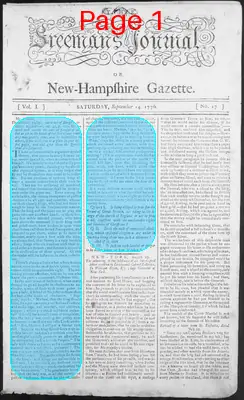
Letter to Editor
September 14, 1776
The Freeman's Journal, Or, New Hampshire Gazette
Portsmouth, Rockingham County, New Hampshire
What is this article about?
The letter quotes James Burgh on human revolt against slavery and tyranny, shares an anecdote from Sacheverell's time illustrating resistance to religious coercion, and queries the compatibility of Anglican liturgy, prayers for the British tyrant, and clerical oaths with Christian liberties in America.
Clipping
OCR Quality
98%
Excellent
Full Text
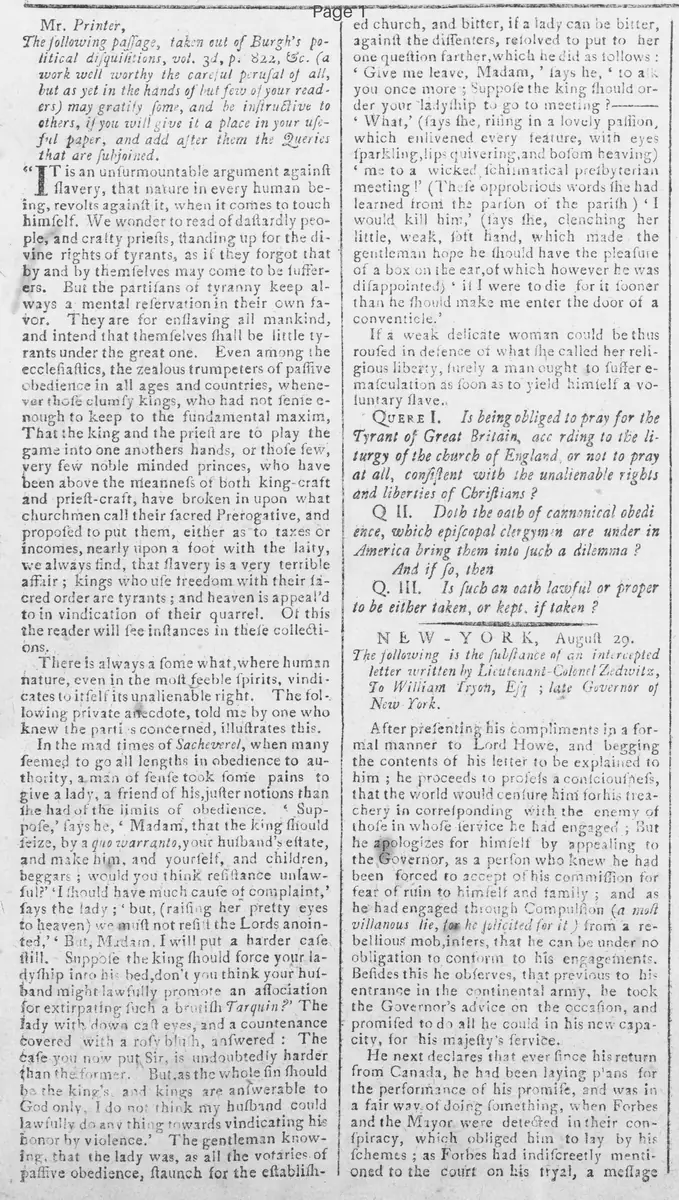
Mr. Printer,
The following passage, taken out of Burgh's political disquisitions, vol. 3d, p. 822, &c. (a work well worthy the careful perusal of all, but as yet in the hands of but few of your readers) may gratify some, and be instructive to others, if you will give it a place in your useful paper, and add after them the Queries that are subjoined.
"IT is an insurmountable argument against slavery, that nature in every human being, revolts against it, when it comes to touch himself. We wonder to read of dastardly people, and crafty priests, standing up for the divine rights of tyrants, as if they forgot that by and by themselves may come to be sufferers. But the partisans of tyranny keep always a mental reservation in their own favor. They are for enslaving all mankind, and intend that themselves shall be little tyrants under the great one. Even among the ecclesiastics, the zealous trumpeters of passive obedience in all ages and countries, whenever those clumsy kings, who had not sense enough to keep to the fundamental maxim, That the king and the priest are to play the game into one another's hands, or those few, very few noble minded princes, who have been above the meanness of both king-craft and priest-craft, have broken in upon what churchmen call their sacred Prerogative, and proposed to put them, either as to taxes or incomes, nearly upon a foot with the laity, we always find, that slavery is a very terrible affair; kings who use freedom with their sacred order are tyrants; and heaven is appealed to in vindication of their quarrel. Of this the reader will see instances in these collections."
There is always a something, where human nature, even in the most feeble spirits, vindicates to itself its unalienable right. The following private anecdote, told me by one who knew the parties concerned, illustrates this.
In the mad times of Sacheverel, when many seemed to go all lengths in obedience to authority, a man of sense took some pains to give a lady, a friend of his, juster notions than she had of the limits of obedience. "Suppose," says he, "Madam, that the king should seize, by a quo warranto, your husband's estate, and make him, and yourself, and children, beggars: would you think resistance unlawful?" "I should have much cause of complaint," says the lady: "but, (raising her pretty eyes to heaven) we must not resist the Lord's anointed."—"But, Madam, I will put a harder case still. Suppose the king should force your ladyship into his bed, don't you think your husband might lawfully promote an association for extirpating such a brutish Tarquin?" The lady with downcast eyes, and a countenance covered with a rosy blush, answered: "The case you now put Sir, is undoubtedly harder than the former. But as the whole sin should be the king's and kings are answerable to God only, I do not think my husband could lawfully do any thing towards vindicating his honor by violence." The gentleman knowing, that the lady was, as all the votaries of
passive obedience, staunch for the established church, and bitter, if a lady can be bitter, against the dissenters, resolved to put to her one question farther, which he did as follows:
"Give me leave, Madam," says he, "to ask you once more; Suppose the king should order your ladyship to go to meeting"
What, (says she, rising in a lovely passion, which enlivened every feature, with eyes sparkling, lips quivering, and bosom heaving) me to a wicked schismatical presbyterian meeting!" (These opprobrious words she had learned from the parson of the parish) "I would kill him," (says she, clenching her little, weak, soft hand, which made the gentleman hope he should have the pleasure of a box on the ear, of which however he was disappointed) "if I were to die for it sooner than he should make me enter the door of a conventicle."
If a weak delicate woman could be thus roused in defence of what she called her religious liberty, surely a man ought to suffer emasculation as soon as to yield himself a voluntary slave.
Quere I. Is being obliged to pray for the Tyrant of Great Britain, according to the liturgy of the church of England or not to pray at all, consistent with the unalienable rights and liberties of Christians?
Q II. Doth the oath of canonical obedience, which episcopal clergymen are under in America bring them into such a dilemma?
And if so, then
Q. III. Is such an oath lawful or proper to be either taken, or kept, if taken?
The following passage, taken out of Burgh's political disquisitions, vol. 3d, p. 822, &c. (a work well worthy the careful perusal of all, but as yet in the hands of but few of your readers) may gratify some, and be instructive to others, if you will give it a place in your useful paper, and add after them the Queries that are subjoined.
"IT is an insurmountable argument against slavery, that nature in every human being, revolts against it, when it comes to touch himself. We wonder to read of dastardly people, and crafty priests, standing up for the divine rights of tyrants, as if they forgot that by and by themselves may come to be sufferers. But the partisans of tyranny keep always a mental reservation in their own favor. They are for enslaving all mankind, and intend that themselves shall be little tyrants under the great one. Even among the ecclesiastics, the zealous trumpeters of passive obedience in all ages and countries, whenever those clumsy kings, who had not sense enough to keep to the fundamental maxim, That the king and the priest are to play the game into one another's hands, or those few, very few noble minded princes, who have been above the meanness of both king-craft and priest-craft, have broken in upon what churchmen call their sacred Prerogative, and proposed to put them, either as to taxes or incomes, nearly upon a foot with the laity, we always find, that slavery is a very terrible affair; kings who use freedom with their sacred order are tyrants; and heaven is appealed to in vindication of their quarrel. Of this the reader will see instances in these collections."
There is always a something, where human nature, even in the most feeble spirits, vindicates to itself its unalienable right. The following private anecdote, told me by one who knew the parties concerned, illustrates this.
In the mad times of Sacheverel, when many seemed to go all lengths in obedience to authority, a man of sense took some pains to give a lady, a friend of his, juster notions than she had of the limits of obedience. "Suppose," says he, "Madam, that the king should seize, by a quo warranto, your husband's estate, and make him, and yourself, and children, beggars: would you think resistance unlawful?" "I should have much cause of complaint," says the lady: "but, (raising her pretty eyes to heaven) we must not resist the Lord's anointed."—"But, Madam, I will put a harder case still. Suppose the king should force your ladyship into his bed, don't you think your husband might lawfully promote an association for extirpating such a brutish Tarquin?" The lady with downcast eyes, and a countenance covered with a rosy blush, answered: "The case you now put Sir, is undoubtedly harder than the former. But as the whole sin should be the king's and kings are answerable to God only, I do not think my husband could lawfully do any thing towards vindicating his honor by violence." The gentleman knowing, that the lady was, as all the votaries of
passive obedience, staunch for the established church, and bitter, if a lady can be bitter, against the dissenters, resolved to put to her one question farther, which he did as follows:
"Give me leave, Madam," says he, "to ask you once more; Suppose the king should order your ladyship to go to meeting"
What, (says she, rising in a lovely passion, which enlivened every feature, with eyes sparkling, lips quivering, and bosom heaving) me to a wicked schismatical presbyterian meeting!" (These opprobrious words she had learned from the parson of the parish) "I would kill him," (says she, clenching her little, weak, soft hand, which made the gentleman hope he should have the pleasure of a box on the ear, of which however he was disappointed) "if I were to die for it sooner than he should make me enter the door of a conventicle."
If a weak delicate woman could be thus roused in defence of what she called her religious liberty, surely a man ought to suffer emasculation as soon as to yield himself a voluntary slave.
Quere I. Is being obliged to pray for the Tyrant of Great Britain, according to the liturgy of the church of England or not to pray at all, consistent with the unalienable rights and liberties of Christians?
Q II. Doth the oath of canonical obedience, which episcopal clergymen are under in America bring them into such a dilemma?
And if so, then
Q. III. Is such an oath lawful or proper to be either taken, or kept, if taken?
What sub-type of article is it?
Persuasive
Philosophical
Political
What themes does it cover?
Slavery Abolition
Constitutional Rights
Religion
What keywords are associated?
Slavery Opposition
Tyranny
Passive Obedience
Religious Liberty
Clerical Oaths
American Episcopalians
Sacheverell
James Burgh
What entities or persons were involved?
Mr. Printer
Letter to Editor Details
Recipient
Mr. Printer
Main Argument
human nature inherently revolts against slavery and tyranny, as illustrated by a quote from burgh and an anecdote of resistance to religious coercion; queries challenge the legality of anglican oaths and prayers for the british tyrant in light of christian liberties.
Notable Details
Quote From Burgh's Political Disquisitions Vol. 3, P. 822
Anecdote From Sacheverell's Time Demonstrating Instinctive Defense Of Religious Liberty
Three Queries On Anglican Liturgy, Prayers For The 'Tyrant Of Great Britain', And Clerical Oaths In America