Thank you for visiting SNEWPapers!
Sign up free
Atlanta Daily World
Atlanta, Fulton County, Georgia
What is this article about?
President Eisenhower's federal budget recommends transferring Freedmen's Hospital to Howard University for better medical education and non-segregated services, per a commission's findings. Includes new $8M facility, federal funding, and phased support reduction. Hospital history from 1866.
Clipping
OCR Quality
Full Text
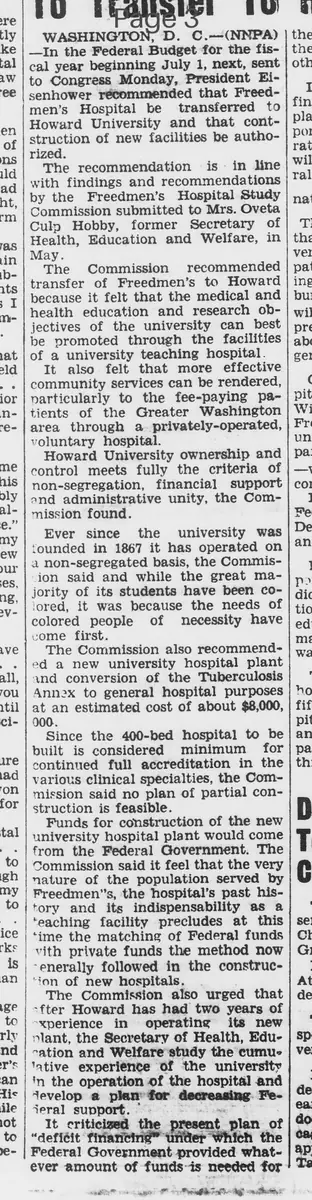
The recommendation is in line with findings and recommendations by the Freedmen's Hospital Study Commission submitted to Mrs. Oveta Culp Hobby, former Secretary of Health, Education and Welfare, in May.
The Commission recommended transfer of Freedmen's to Howard because it felt that the medical and health education and research objectives of the university can best be promoted through the facilities of a university teaching hospital. It also felt that more effective community services can be rendered, particularly to the fee-paying patients of the Greater Washington area through a privately-operated, voluntary hospital.
Howard University ownership and control meets fully the criteria of non-segregation, financial support and administrative unity, the Commission found.
Ever since the university was founded in 1867 it has operated on a non-segregated basis, the Commission said and while the great majority of its students have been colored, it was because the needs of colored people of necessity have come first.
The Commission also recommended a new university hospital plant and conversion of the Tuberculosis Annex to general hospital purposes at an estimated cost of about $8,000,000.
Since the 400-bed hospital to be built is considered minimum for continued full accreditation in the various clinical specialties, the Commission said no plan of partial construction is feasible.
Funds for construction of the new university hospital plant would come from the Federal Government. The Commission said it feels that the very nature of the population served by Freedmen's, the hospital's past history and its indispensability as a teaching facility precludes at this time the matching of Federal funds with private funds the method now generally followed in the construction of new hospitals.
The Commission also urged that after Howard has had two years of experience in operating its new plant, the Secretary of Health, Education and Welfare study the cumulative experience of the university in the operation of the hospital and develop a plan for decreasing Federal support.
It criticized the present plan of "deficit financing" under which the Federal Government provided whatever amount of funds is needed for the maintenance and operation of the hospital after income from all other sources is estimated.
It suggested that this method of financing be replaced by a phased plan which will limit Federal support to the additional cost of operating a teaching facility and which will demonstrate that direct Federal support can be ultimately eliminated.
The Commission also recommended that the District of Columbia Government supply the hospital with patients to meet its minimum teaching requirements. At current reimbursement rates, the report said, this will require an increase from the presently authorized $300,000 to about $460,000 for the care of indigent patients.
Construction of Freedmen's Hospital Asylum was begun in 1866. With the name later changed to Freedmen's Hospital, it operated under supervision of the War Department from 1866 to June 23, 1874 -when it was transferred to the control of the Interior Department. In 1940 it was transferred to the Federal Security Agency, now the Department of Health, Education and Welfare.
Freedmen's has now grown to the point where it has an extensive medical service program and, in addition to a number of educational activities, serves as the major teaching facility for the Howard University Medical School.
The hospital consists of a general hospital with a total of 335 beds and fifty bassinets, a tuberculosis hospital consisting of 135 adult beds and fifteen pediatric and an outpatient department composed of thirty-six organized clinics and two
What sub-type of article is it?
What themes does it cover?
What keywords are associated?
What entities or persons were involved?
Where did it happen?
Story Details
Key Persons
Location
Washington D.C.
Event Date
Fiscal Year Beginning July 1, Next; May (Commission Submission); 1867 (University Founded); 1866 (Construction Begun); June 23, 1874 (Transfer To Interior); 1940 (Transfer To Federal Security Agency)
Story Details
President Eisenhower recommends transferring Freedmen's Hospital to Howard University and authorizing new facilities construction in the federal budget sent to Congress. This aligns with the Freedmen's Hospital Study Commission's May recommendations to Mrs. Oveta Culp Hobby, promoting medical education, research, non-segregated operations, and community services. The commission suggests a new $8,000,000 hospital plant, federal funding without matching, phased reduction of federal support after two years, replacement of deficit financing, and increased D.C. government patient reimbursements from $300,000 to $460,000. Historical background includes hospital's founding in 1866, transfers in 1874 and 1940, and role as Howard's teaching facility with 335 beds, TB annex, and outpatient clinics.