Thank you for visiting SNEWPapers!
Sign up free
Gazette Of The United States, & Philadelphia Daily Advertiser
Philadelphia, Philadelphia County, Pennsylvania
What is this article about?
In a U.S. House debate, Mr. Harper defends a motion to allow merchant ships in the West India trade to arm for defense, arguing it upholds neutral rights under the law of nations without risking war. He proposes strict regulations to prevent abuses and criticizes opponents for questioning motives.
Clipping
OCR Quality
Full Text
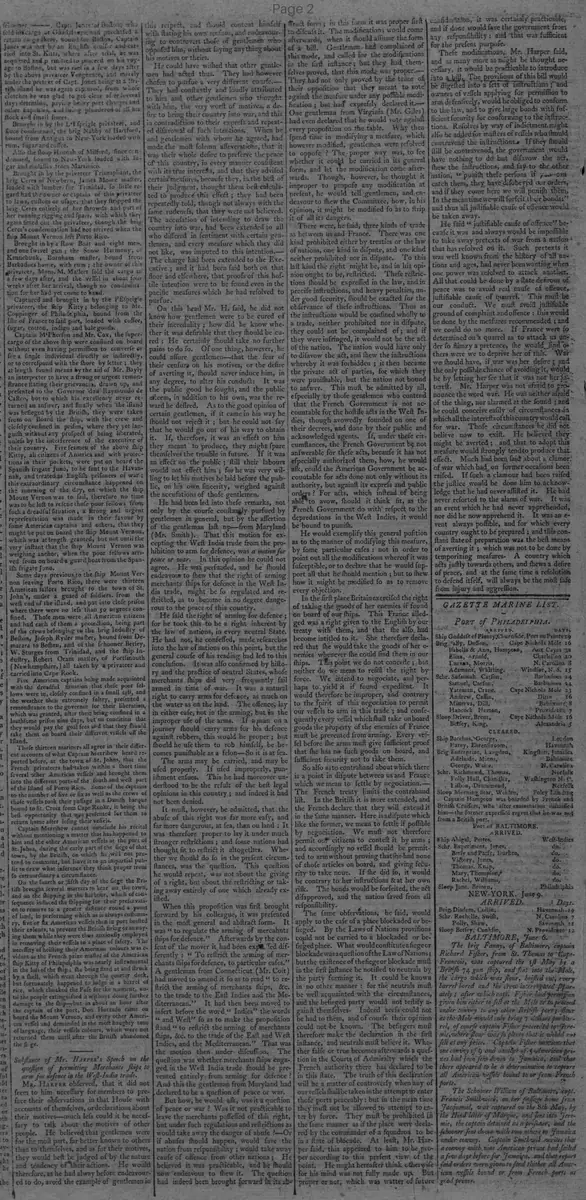
MR. Harper observed, that it did not seem to him necessary for members to preface their observations in that House with accounts of themselves, or declarations about their motives--much less could it be necessary to talk about the motives of other people. He believed that gentlemen were for the most part, far better known to others than to themselves, and as for their motives, they would best be judged of by the nature and tendency of their actions. He would therefore, as he had always before endeavoured to do, avoid the example of gentlemen in this respect, and should content himself with stating his own reasons, and endeavouring to controvert those of gentlemen who opposed him, without saying any thing about his motives or theirs.
He could have wished that other gentlemen had acted thus. They had however chosen to pursue a very different course.-- They had constantly and loudly attributed to him and other gentlemen who thought with him, the very worst of motives, a desire to bring their country into war, and this in contradiction to their express and repeated disavowal of such intentions. When he and gentlemen with whom he agreed, had made the most solemn averations, that it was their whole desire to preserve the peace of this country, in every manner consistent with its true interests, and that they advised certain measures, because they, in the best of their judgment, thought them best calculated to produce this effect; they had been repeatedly told, though not always with the same rudeness, that they were not believed.
The accusation of intending to draw the country into war, had been extended to all who differed in sentiment with certain gentlemen, and every measure which they did not like, was imputed to this intention.-- The charge had been extended to the Executive; and it had been said both on that floor and elsewhere, that proofs of this hostile intention were to be found even in the pacific measures which he had resolved to pursue.
On this head Mr. H. said, he did not know how gentlemen were to be cured of their incredulity; how did he know whether it was desirable that they should be cured : He certainly should take no further pains to do so. Of one thing, however, he could assure gentlemen-that the fear of their censure on his motives, or the desire of averting it, should never induce him, in any degree, to alter his conduct: It was the public good he ought, and the public esteem, in addition to his own, was the reward he desired. As to the good opinion of certain gentlemen, if it came in his way he should not reject it ; but he could not say that he would go out of his way to obtain it. If, therefore, it was an effect on him they meant to produce, they might spare themselves the trouble in future. If it was an effect on the public ; still their labours would not effect him ; for he was very willing to let his motives be laid before the public, on his own sincerity, weighed against the accusations of those gentlemen.
He had been led into these remarks, not only by the course constantly pursued by gentlemen in general, but by the assertion of the gentleman last up--from Maryland (Mr. Smith). That this motion for excepting the West India trade from the prohibition to arm for defence, was a motion for peace or war. In this opinion he could not agree. He was persuaded, and he should endeavour to show that the right of arming merchants ships for defence in the West India trade, might be so regulated and restricted, as to become in no degree dangerous to the peace-of this country.
He said the right of arming for defence ; for he took this to be a right inherent by the law of nations, in every neutral State. He had not, he confessed, made researches into the law of nations on this point, but the general course of his reading had led to this conclusion. It was also confirmed by history and the practice of neutral States, whose merchants ships did very frequently sail armed in time of war. . It was a natural right to carry arms for defence, as much on the water as on the land. The offence, lay in either case, not in the arming, but in the improper use of the arms. If a man on a journey should carry arms for his defence against robbers, this would be proper; but should he use them to rob himself, he becomes punishable as a felon-So it is at sea. The arms may be carried, and may be used properly. If used improperly, punishment ensues. This he had moreover understood to be the result of the best legal opinions in this country ; and indeed it had not been denied.
It must, however, be admitted, that the abuse of this right was far more easy, and far more dangerous, at sea, than on land : It was therefore proper to lay it under much stronger restrictions ; and some nations had thought fit to restrict it altogether. Whether we should do so in the present circumstances, was the question. This question he would repeat, was not about the giving of a right, but about the restricting or taking away entirely of one which already existed.
When this proposition was first brought forward by his colleague, it was presented in the most general and abstract form- It was " to regulate the arming of merchants ships for defence." Afterwards by the consent of the mover it had been expressed differently : " To restrict the arming of merchants ships for defence, to particular cases." A gentleman from Connecticut (Mr. Coit) had moved to amend it so as to read " to restrict the arming of merchants ships, &c. to the trade to the East Indies and the Mediterranean." It had then been moved to insert before the word " Indies" the words " and West" so as to make the proposition stand " to restrict the arming of merchants ships, &c. to the trade of the East and West Indies, and the Mediterranean." That was the motion then under discussion. The question was whether merchants ships engaged in the West India trade should be prevented entirely from arming for defence? And this the gentleman from Maryland had declared to be a question of peace or war.
But how, he would ask, was it a question of peace or war ? Was it not practicable to leave the merchants possessed of this right, but under such regulations and restrictions as would take away the danger of abuse ?Or if abuses should happen, would save the nation from responsibility ; would take away cause of offence from other nations; He believed it was practicable, and he should now endeavour to show it. The question had indeed been brought forward in its abstract form ; in this form it was proper first to discuss it. The modifications would come afterwards, when it should assume the form of a bill. Gentlemen had complained of this mode, and called for the modifications in the first instance; but they had themselves proved, that this mode was proper.-- They had not only proved by the tenor of their opposition that they meant to vote against the measure under any possible modification ; but had expressly declared it.- One gentleman from Virginia (Mr. Giles) had even declared that he would vote against every proposition on the table. Why then spend time in modifying a measure, which however modified, gentlemen were resolved to oppose ? The: proper way was, to see whether it could be carried in its general form, and let the modification come afterwards. Though, however, he thought it improper to propose any modification at present, he would tell gentlemen, and endeavour to shew the Committee, how, in his opinion, it might be modified so as to strip it of all its dangers.
There were, he said, three kinds of trade as between us and France. There was one kind prohibited either by treaties or the law of nations, one kind in dispute, and one kind neither prohibited nor in dispute. To this last kind the right might be, and in his opinion ought to be, restricted. These restrictions should be expressed in the law, and in precise instructions, and heavy penalties, under good security, should be exacted for the observance of these instructions. Thus as the instructions would be confined wholly to a trade, neither prohibited nor in dispute, they could not be complained of; and if they were infringed, it would not be the act of the nation. The nation would have only to disavow the act, and shew the instructions whereby it was forbidden ; it then became the private act of parties, for which they were punishable, but the nation not bound to answer. This must, be admitted by all, especially by those gentlemen who contend that the French Government is not accountable for the hostile acts in the West Indies, though avowedly founded on one of their decrees, and done by their public and acknowledged agents. If, under these circumstances, the French Government be not answerable for these acts, because it has not especially authorized them, how, he would ask, could the American Government be accountable for acts done not only without its authority, but against its express and public orders ? For acts, which instead of being able to avow, should it think fit, as the French Government do with respect to the depredations in the West Indies, it would be bound to punish.
He would exemplify this general position as to the manner of modifying this measure, by some particular cases : not in order to point out all the modifications whereof it was susceptible, or to declare that he would support all that he should mention ; but to shew how it might.be modified so as to remove every objection.
In the first place Britain exercised the right of taking the goods of her enemies if found on board of our ships. This France alleged. was a right given to the English by our treaty with them, and that she also, had become entitled to it. She therefore declared that she would take the goods of her enemies whenever she could find them in our ships. This point we do not concede ; but neither do we mean to resist the right by force. We intend to negotiate, and perhaps to yield it if found expedient. It would therefore be improper, and contrary to the spirit of this negociation to permit our vessels to arm in this trade ; and consequently every vessel which shall take onboard goods the property of the enemies of France must be prevented from arming. Every vessel before she arms must give sufficient proof that she has no such goods on board, and sufficient security not to take them.
So also as to contraband about which there is a point in dispute between us and France which we mean to settle by negociation.— The French treaty limits the contraband list. In the British it is more extended, and the French declare that they will extend it in the same manner. Here is a dispute which like the former, we mean to settle if possible by negociation. We must not therefore permit our. citizens to contest it by arms ; and accordingly no vessel should be permitted to arm without proving that she had none of those articles on board, and giving security to take none. If she did so, it would be contrary to her instructions &at her own risk. The bonds would be forfeited, the act disapproved, and the nation saved from all responsibility.
The same observations, he said, would apply to the case of a place blockaded or besieged. By the Laws of Nations provisions could not be carried to a blockaded or besieged place. What would constitute a siege or blockade was a question of the Law of Nations; but the existence of the siege or blockade must in the first instance be notified to neutrals by the party forming it. It could be known in no other manner : for the neutrals must be well acquainted with the circumstances, and the besieged party would not testify a- gainst themselves- Indeed access could not be had to them, and of course their opinion could not be known. The besiegers must therefore make the declaration in the first instance, and neutrals must believe it. Whether false or true becomes afterwards a question in the Courts of Admiralty which the French authority there has declared to be in this state. The truth of this declaration will be a matter of controversy when any of our vessels shall be taken in the attempt to enter those ports peaceably: but in the mean time they must not be allowed to attempt to enter by force. They must be prohibited in the same manner as if the place were declared by the commander of a squadron to be in a state of blockade. At least, Mr. Harper said, this appeared to him to be proper according to this present view of the point. He might hereafter think otherwise for his mind was not fully made up. But proper or not, which. was matter of future consideration, it was certainly practicable, and if done would save the government from any responsibility: and that was sufficient for the present purpose.
These modifications, Mr. Harper said. and as many more as might be thought necessary, it would be practicable to introduce into a bill. The provisions of this bill would be digested into a set of instructions ; and owners of vessels applying for permission to arm defensively, would be obliged to conform to the law, and to give large bonds with sufficient security for conforming to the instructions. Resolves by way of indictment, might also be added for masters of vessels who should. contravene the instructions. If they should still be contravened, the government would have nothing to do but disavow. the act, shew the instructions, and say to the other nation, " punish these persons if you can catch them, they have disobeyed our orders, and if they come here we will punish them. In the mean time we-will forfeit their bonds:" and thus all justifiable cause of offence would be taken away.
He said " justifiable cause of offence" be- cause it was and always would be impossible to take away pretexts of war from a nation that has resolved on it. Such pretexts it was well known from the history of all na- tions and ages, had never been wanting when one power was resolved to attack another. All that could be done by a state desirous of peace was to avoid real cause of offence,. justifiable cause of quarrel.' This must be our conduct. We must avoid justifiable ground of complaint and offence : this would be done by the measures recommended ; and we could do no more. If France were so determined on a quarrel as to attack us un-. der so flimsy a pretence, he would find others were we to deprive her of this. War we should have, if war was her desire ; and the only possible chance of avoiding it, would be by letting her see that it was not her in-. terest. Mr. Harper was not afraid to cro- nounce the word war. He was neither afraid of the thing, nor alarmed at the sound ; and he could. conceive easily of circumstances in which all the interests of this country would call for war. Those circumstances he did not believe. now to exist. He believed they. might be averted; and that to adopt this measure would strongly tend to produce that effect. Much had been said about a clamor. of war which had _on former occasions been raised. If such a clamour had been raised the justice would be done him to acknow- ledge that he had never assisted it. He had never resorted to the alarm of war. It was an event which he had never apprehended, nor did he now apprehend it. It was an e- vent always possible, and for which every country ought to be prepared ; and this con- stant state of preparation was the best means of averting it ; which was not to be done by temporizing measures- A country which acts justly towards others, and shews a desire of peace, and at the same time a resolution to defend itself, will always be the most safe from injury and aggression.
What sub-type of article is it?
What keywords are associated?
What entities or persons were involved?
Domestic News Details
Key Persons
Outcome
ongoing debate in the house on motion to restrict arming of merchant ships for defense to specific trades, including west india; no final resolution mentioned.
Event Details
Mr. Harper delivers a speech defending the inherent right under the law of nations for neutral merchant ships to arm for defense, particularly in the West India trade. He argues against opponents' claims that it risks war, proposes strict regulations and penalties to prevent abuses involving enemy goods, contraband, or blockaded ports, and emphasizes that such measures would protect national peace without responsibility for private violations.