Thank you for visiting SNEWPapers!
Sign up free
Story
September 23, 1929
The Milwaukee Leader
Milwaukee, Milwaukee County, Wisconsin
What is this article about?
Roger Shaw reports on Alaska's promising future in agriculture, timber, and minerals, capable of supporting millions, despite current small population of 55,000. He notes declining Eskimos and thriving white settlers, including pioneer women.
Clipping
OCR Quality
100%
Excellent
Full Text
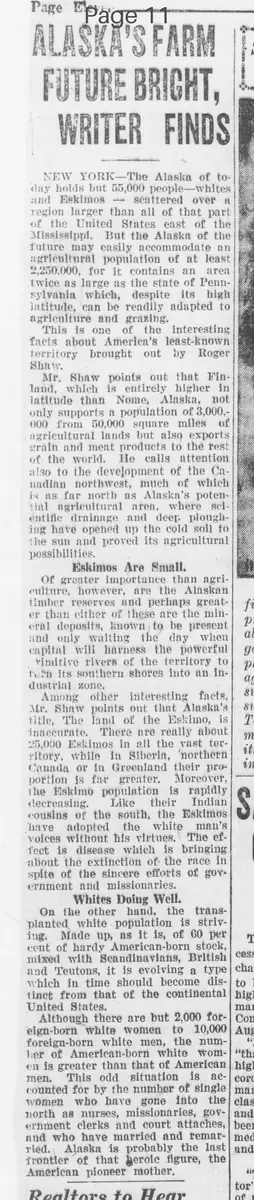
ALASKA'S FARM FUTURE BRIGHT, WRITER FINDS
NEW YORK—The Alaska of today holds but 55,000 people—whites and Eskimos—scattered over a region larger than all of that part of the United States east of the Mississippi. But the Alaska of the future may easily accommodate an agricultural population of at least 2,250,000, for it contains an area twice as large as the state of Pennsylvania which, despite its high latitude, can be readily adapted to agriculture and grazing.
This is one of the interesting facts about America's least-known territory brought out by Roger Shaw.
Mr. Shaw points out that Finland, which is entirely higher in latitude than Nome, Alaska, not only supports a population of 3,000,000 from 50,000 square miles of agricultural lands but also exports grain and meat products to the rest of the world. He calls attention also to the development of the Canadian northwest, much of which is as far north as Alaska's potential agricultural area, where scientific drainage and deep ploughing have opened up the cold soil to the sun and proved its agricultural possibilities.
Eskimos Are Small.
Of greater importance than agriculture, however, are the Alaskan timber reserves and perhaps greater than either of these are the mineral deposits, known to be present and only waiting the day when capital will harness the powerful primitive rivers of the territory to turn its southern shores into an industrial zone.
Among other interesting facts, Mr. Shaw points out that Alaska's title, The land of the Eskimo, is inaccurate. There are really about 25,000 Eskimos in all the vast territory, while in Siberia, northern Canada or in Greenland their proportion is far greater. Moreover, the Eskimo population is rapidly decreasing. Like their Indian cousins of the south, the Eskimos have adopted the white man's vices without his virtues. The effect is disease which is bringing about the extinction of the race in spite of the sincere efforts of government and missionaries.
Whites Doing Well.
On the other hand, the transplanted white population is thriving. Made up, as it is, of 60 per cent of hardy American-born stock mixed with Scandinavians, British and Teutons, it is evolving a type which in time should become distinct from that of the continental United States.
Although there are but 2,000 foreign-born white women to 10,000 foreign-born white men, the number of American-born white women is greater than that of American men. This odd situation is accounted for by the number of single women who have gone into the north as nurses, missionaries, government clerks and court attaches and who have married and remarried. Alaska is probably the last frontier of that heroic figure, the American pioneer mother.
NEW YORK—The Alaska of today holds but 55,000 people—whites and Eskimos—scattered over a region larger than all of that part of the United States east of the Mississippi. But the Alaska of the future may easily accommodate an agricultural population of at least 2,250,000, for it contains an area twice as large as the state of Pennsylvania which, despite its high latitude, can be readily adapted to agriculture and grazing.
This is one of the interesting facts about America's least-known territory brought out by Roger Shaw.
Mr. Shaw points out that Finland, which is entirely higher in latitude than Nome, Alaska, not only supports a population of 3,000,000 from 50,000 square miles of agricultural lands but also exports grain and meat products to the rest of the world. He calls attention also to the development of the Canadian northwest, much of which is as far north as Alaska's potential agricultural area, where scientific drainage and deep ploughing have opened up the cold soil to the sun and proved its agricultural possibilities.
Eskimos Are Small.
Of greater importance than agriculture, however, are the Alaskan timber reserves and perhaps greater than either of these are the mineral deposits, known to be present and only waiting the day when capital will harness the powerful primitive rivers of the territory to turn its southern shores into an industrial zone.
Among other interesting facts, Mr. Shaw points out that Alaska's title, The land of the Eskimo, is inaccurate. There are really about 25,000 Eskimos in all the vast territory, while in Siberia, northern Canada or in Greenland their proportion is far greater. Moreover, the Eskimo population is rapidly decreasing. Like their Indian cousins of the south, the Eskimos have adopted the white man's vices without his virtues. The effect is disease which is bringing about the extinction of the race in spite of the sincere efforts of government and missionaries.
Whites Doing Well.
On the other hand, the transplanted white population is thriving. Made up, as it is, of 60 per cent of hardy American-born stock mixed with Scandinavians, British and Teutons, it is evolving a type which in time should become distinct from that of the continental United States.
Although there are but 2,000 foreign-born white women to 10,000 foreign-born white men, the number of American-born white women is greater than that of American men. This odd situation is accounted for by the number of single women who have gone into the north as nurses, missionaries, government clerks and court attaches and who have married and remarried. Alaska is probably the last frontier of that heroic figure, the American pioneer mother.
What sub-type of article is it?
Curiosity
What themes does it cover?
Exploration
Triumph
What keywords are associated?
Alaska Agriculture
Timber Reserves
Mineral Deposits
Eskimo Population
White Settlers
Pioneer Mothers
What entities or persons were involved?
Roger Shaw
Where did it happen?
Alaska
Story Details
Key Persons
Roger Shaw
Location
Alaska
Story Details
Roger Shaw discusses Alaska's vast potential for agriculture supporting 2,250,000 people, compares to Finland and Canadian northwest, highlights timber and mineral resources, notes small and declining Eskimo population, thriving white settlers, and the role of pioneer women.