Thank you for visiting SNEWPapers!
Sign up free
Southern Argus
Columbus, Lowndes County, Mississippi
What is this article about?
U.S. Senator Hugh L. White of Tennessee resigns, refusing to obey state legislature instructions on opposing a national bank, supporting the Sub-Treasury Bill, condemning an election interference bill, and other policies, arguing they enhance executive power at the expense of liberty and state rights.
Merged-components note: Merged multiple split components forming the complete letter from Judge White on his resignation.
Clippings
1 of 2
OCR Quality
Full Text
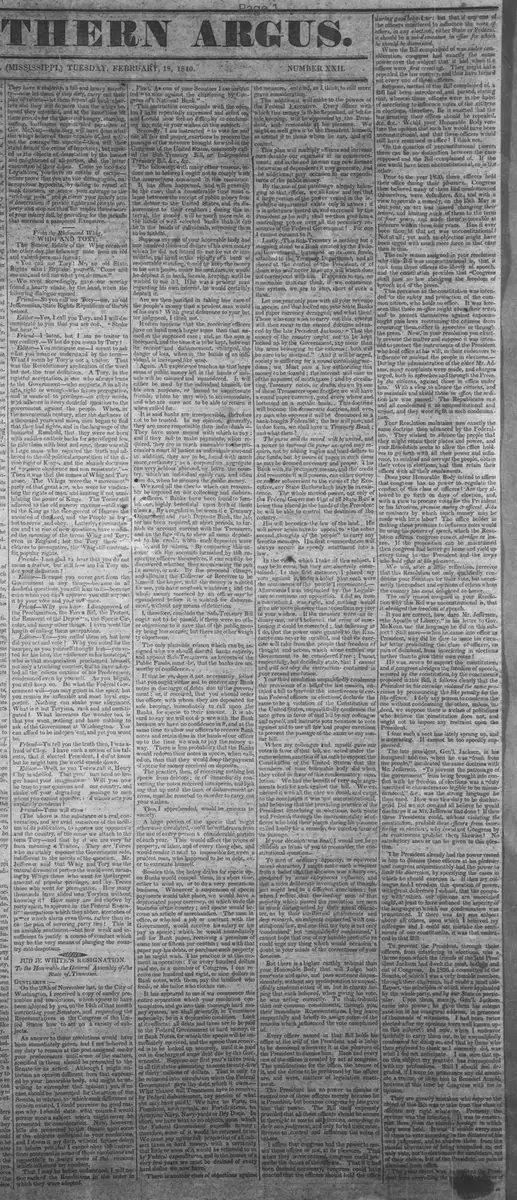
To the Honorable the General Assembly of the
State of Tennessee.
GENTLEMEN:
On the 29th of November last, in the City of
Washington, I received a copy of sundry pre-
ambles and resolutions, which appear to have
been adopted by you, on the 14th of that month
instructing your Senators, and requesting the
Representatives in the Congress of the United States how to act on a variety of subjects.
An answer to these resolutions would have
been immediately given, had I not believed it
my duty to remain at the post assigned me by
your predecessors until some of the matters,
specified in them, should be presented to the
Senate for its action. Although I might entertain an opinion different from that expressed by your honorable body, and might be un-
willing to surrender that opinion; yet, if no
case should be presented for the action of the
Senate, in relation to which such difference of
opinion existed, I could perceive no good reason why I should state what course I would
pursue upon a subject which might never be
presented for consideration. Now, however;
bills are presented to the Senate upon some
of the subjects embraced in your resolutions,
and I deem it my duty, without farther delay
to inform you that I cannot obey the instructions contained in some of those resolutions and
respectfully to assign some of the reasons
which influence my conduct.
That I may be better understood, I will notice each of the Resolutions in the order in
which they were adopted.
First. As one of your Senators I am instructed "to vote against the chartering by Congress of a National Bank."
This instruction corresponds with the opinion I have repeatedly expressed and acted on,
and I could now feel no difficulty in conforming my vote to your wishes on this subject.
Secondly. I am instructed "to vote for and
use all fair and proper exertions to procure the
passage of the measure brought forward in the
Congress of the United States, commonly called the Sub-Treasury Bill, or Independent
Treasury Bill, &c., &c.
The following, with many other reasons, induce me to believe I ought not to comply with
the instructions contained in this resolution.
It has often happened, and will generally
be the case; that a considerable time must elapse between the receipt of public money from
the debtor to the United States, and its disbursement to their creditors; during this interval, the money will be much more safe in
the hands of well selected banks than it can
be in the hands of individuals, supposing them
to be faithful.
Suppose any one of your honorable body had
one hundred thousand dollars of his own money
which he did not intend to use for six or nine
months, and lived in the vicinity of a bank of
respectable standing, would he keep the money
in his own house, under his own care, or would
he deposit it in bank, for safe keeping; until he
wished to use it? If he was a prudent man
regarding his own interest, he would certainly
deposit it.
Are we then justified in taking less care of
the people's money than a prudent man would
of his own? With great deference to your better judgment, I think not.
It often happens that the receiving officers
have on hand much larger sums than that named in the supposed case; and, as the sum is
increased, and the time it is to be kept, between its receipt and disbursement, enlarged, the
danger of loss, when in the hands of an individual, is increased likewise.
Again. All experience teaches us that large
sums of public money left in the hands of individuals will be misused and squandered. It will
either be used by the individual himself, for
his own purposes, or loaned to importunate
friends, whom he may wish to accommodate,
and who are sure not to be able to return it
when called for.
It is said banks are irresponsible, therefore
not to be trusted. In my opinion, generally,
they are more responsible than individuals.
They have more means with which to pay:
and if they fail to make payments, when required, they are as much amenable to the process of a court of justice as individuals are;—and
in addition, they are to be found with much
more certainty; as a corporation aggregate
can very seldom abscond, or leave the country, which an individual easily can, and often does do, when he misuses the public money.
We need all the checks which can reasonably be imposed on our collecting and disbursing officers. Banks have been found to furnish one, highly beneficial upon both of these
classes. By a regulation between the Treasury Department and each Deposite Bank, the latter has been required, at short periods, to furnish its account current with the Treasurer,
and on the face of it, to show all sums deposited to his credit, when such deposits were
made, and by whom. By comparing this account with the accounts furnished by the respective officers—themselves, it can readily be
discovered whether they are misusing the public money, or not. By the proposed change,
and allowing the Collector or Receiver to be
himself the keeper, until the money is wanted
for use, you have no check whatever; and the
whole money received by an officer may be
squandered before it is wanted for disbursement, without any means of detection.
I, therefore, conclude the Sub-Treasury Bill
ought not to be passed, if there were no other objections to it save that of the public money being less secure; but there are other weighty objections.
The only plausible reason which can be assigned why we should discard banks entirely,
and appoint Sub-Treasurers as keepers of the
Public Funds, must be, that the banks are unworthy of confidence.
If that be so, does it not necessarily follow
that you ought either not to receive any Bank
notes in discharge of debts due to the government; or, if received, that you should order
the officer with whom they are deposited for
safe keeping, immediately to call upon the
Banks for specie to their amount. It is absurd to say we will not deposit with the Bank
because we have no confidence in it, and at the
same time to allow our officers to receive Bank
notes and retain them in the hands of our officer up to the time we wish to pay the money away. There is less probability that the Banks
would redeem their notes in specie, when called on, than that they would deny the payment
of specie for money received on deposit.
The practice, then, of receiving nothing but
specie from debtors; or of immediately converting the notes received into specie, and locking that up until the time of disbursement arrives, must be resorted to in order to carry out
your wishes.
This, I apprehended, would be ruinous to
society.
A large portion of the specie that might
otherwise circulated, would be withdrawn from
the use of every person a considerable portion
of each year. This would affect the prices of
property, of labor, and of every thing else, and
would render it next to impossible for even a
prudent man, who happened to be in debt, ever to extricate himself.
Besides this, the heavy draws for specie upon Banks would compel them, in a short time,
either to wind up, or to do a very precarious
business. Whenever a suspension of specie
payments would take place, we would have a
depreciated paper currency, on which to do the
business of the country; and specie would become an article of merchandise. The man in
office, or who had a job or contract with the
Government, would receive his salary or his
pay in specie; which he would immediately
sell for Bank paper, receiving a premium of
some ten or fifteen per centum; and with that
paper pay his debts, or purchase such property as he might wish. This practice is at this moment in operation: For every hundred dollars
paid me, as a member of Congress, I can receive one hundred and eight, or nine dollars in
Bank notes, with them, pay the landlord who
feeds, or the tailor who clothes me.
It has appeared to me if we commence this
entire separation which your resolution contemplates, and go into this thorough hard money system, we shall presently, in Tennessee
especially, be in a deplorable condition. Look
at its effects: all debts and taxes are to be paid
to the Federal Government in hard money, or
in Bank Notes, for which the specie will be immediately received, and the specie thus received is to be locked up securely, until it is paid
out in discharge of some debt due by the Government. Suppose our first year's taxes paid.
in all the states amounting to some twenty-five
or thirty millions of dollars. That is only to
be returned into circulation when the Federal
Government pays the debt which it owes.—
What chance will Tennessee have to receive,
by Federal disbursement, any portion of what
she may have paid? We have no Forts, no
Foundries, no Arsenals, no Fortifications, no
Army, no Navy, Navy-yards or Dry Docks. In
short, we have next to no objects, upon which
the Federal Government expends money;
therefore, none of it would be returned to us.
We must pay up our full proportion of all indirect taxes in hard money with a certainty
that little or none of it would be returned to us
by Federal expenditures, and in the course of a
very few years we must be drained of every
hard dollar we now have.
There is another class of objections against
the measure, entitled, as I think, to still more
grave consideration.
The addition it will make to the powers of
the Federal Executive. Every officer with
which this money is to be deposited, or left for
safe keeping, will be appointed by the President, and removable at his pleasure. We
might as well give it to the President himself
as intrust it to those whom he can, and will
control.
This plan will multiply officers and increase
considerably our expenses at its commencement; and in the end no man can now foresee
the swarm of dependents it may generate, and
the additions it may occasion to our expenditures of the public money.
By the use of the patronage already belonging to that officer, we all know and feel that
a large portion of the power vested in the legislative department exists only in name; it
is in substance vested in, and exercised by the
President as he wills; shall we then give him a
controlling power over all the pecuniary resources of the Federal Government? For one
I cannot consent to it.
Lastly. This Sub-Treasury is nothing but a
stepping stone to a Bank created by the Federal Government, bottomed on its own funds,
attached to the Treasury Department; and all
placed at the control of the President, or of
those who will never have any will which does
not correspond with his. It appears to me, no
reasonable man can think, if we commence
this system, we are to stop, short of such a
Bank.
Let one year only pass with all your revenue in specie, and that locked up; your State Banks
and paper currency deranged; and what then?
Those who may wish to carry out this system
will then recur to the second doctrine advanced by the late President Jackson, "That the
money of the country ought not to be kept
locked up by the Government, any more than
the arms belonging to the citizens: both will
be sure to be misused." And it will be urged,
society is suffering for a sound circulating medium; we must pass a law authorizing this
money to be loaned; the interest will ease us
of the payment of much taxes; and by circulating Treasury notes, or drafts, drawn by one
of these Treasurers upon another we will have
a sound paper currency, good every where and
bottomed on a metallic basis. This doctrine
will become the democratic doctrine, and every man who opposes it will be denounced as a
bank-bought Federalist; the law will pass; and
in due form, we shall have a Treasury Bank;
and what then?
The purse and the sword will be united, and
a power to increase the purse as need may require, not by adding eagles and hard dollars to
our funds, but by issues of paper in such sums
as may be deemed necessary and proper. This
Bank with its pecuniary means, and the credit
and resources it will possess, can either destroy or render subservient to the views of the Executive, any State Banks which may be in existence. The whole monied power, not only of
the Federal Government but of all State Banks being thus placed in the hands of the President he will be able to control the destinies of the
country.
His will becomes the law of the land. He
will never again have to appeal to "the sober
second thoughts of the people" to carry any
favorite measure. His first recommendation will always secure its speedy enactment into a
law.
In the views, which I take of this subject, I
may be in error, but they are sincerely entertained. In this first instance I placed my
vote against it, under a belief that such were
the sentiments of the people I represented.—
Afterwards I was instructed by the Legislature to continue my opposition. I did so, from
a conviction I was right, and nothing would
give me more pleasure than to conform my vote to your wishes. If the measure were an ordinary one, or if I believed the error of sanctioning it could be corrected; but believing as
I do, that the power once granted to the Executive can never be recalled, and that its exercise will take from the people that freedom of
thought and action, which alone entitles our
Government to be considered Free: I most
respectfully, but decidedly state, that I cannot
and will not obey the instruction contained in
your second resolution.
Your third resolution unqualifiedly condemns the provisions of a bill of the last session, entitled a bill to prevent the interference of certain Federal officers in elections, declares the
same to be a violation of the Constitution of
the United States, unqualifiedly condemns the
vote given in favor of said bill by my colleague and myself, and instructs your Senators to vote
against and to use all fair and proper exertions to prevent the passage of the same or any similar bill.
When my colleague and myself gave our
votes in favor of that bill, we acted under the
same solemn sanction of an oath to support the
Constitution of the United States, that the
members of your honorable body did when
they voted in favor of this condemnatory resolution. We had the benefit of very able arguments both for and against the bill. We examined it with all the care we could, and came
to the conclusion it was not unconstitutional.
and believing that the prevailing practice of the
President interfering in elections, both State
and Federal through the instrumentality of officers who hold their places during his pleasure called loudly for a remedy, we voted in favor of
its passage.
If your decision was final, I would not be so
childish as to ask of you to reconsider the constitutional question.
To men of ordinary capacity, or equivocal
moral character, I might make such a request
from a belief that the decision was a hasty one,
produced by some extraneous influence, and
that a more deliberate investigation of the subject might lead to a different conclusion: but
when I reflect that the leading men of that
majority which passed the resolution are men
as much distinguished by their moral character, as by their intellectual attainments and
deep research, on subjects connected with constitutional law, and see that my vote is not only
'condemned' but 'unqualifiedly condemned,' I
cannot hope that one of my humble pretensions could urge any thing which would occasion a
doubt in your minds of the correctness of your
decision.
But there is a higher earthly tribunal than
your Honorable Body that will judge both
your vote and mine, and pass sentence dispassionately, without any predisposition to unqualifiedly condemn either of us, but in charity hoping that each believed, when giving his vote,
he was acting correctly. To that tribunal
then our common constituents, through you,
their immediate Representatives, I beg leave
respectfully and briefly to assign some of the
reasons which influenced the vote complained
of.
Every officer named in that Bill holds his
office at the will of the President and is liable
to be dismissed whenever it is the pleasure of
the President to dismiss him. Each and every
one of the offices is created by act of congress.
The qualifications for the office, the tenure of
it, and the duties to be performed by the officer are, and were, matters of legislative enactment.
The President has no power to dismiss or
control one of these officers merely because he
is President, but because congress by law gave
him that power. The Bill itself expressly
provided that all these officers should be secure in their right to vote in all elections according to their own judgment, and only forbid their interference to control and influence the votes of
others.
I affirm that congress had the power to create these offices or not, at its pleasure. That
when they were created, congress could prescribe the duties of the officers. That if it had
been deemed necessary, congress could have
enacted that the officers should hold the office
during good behavior: but that if any one of
the officers interfered to influence the votes of
others, in any election, either State or Federal,
it should be a misdemeanor in office for which
he should be dismissed.
When the Bill complained of was under consideration, congress had exactly the same
power over the subject that it had when the
offices were first creating. They might have
repealed the law entirely, and thus have turned out every one of these officers.
Suppose, instead of the Bill complained of, a
Bill had been introduced and passed, stating
that, whereas these officers were in the habit
of interfering to influence votes of the citizens
in elections, therefore, Be it enacted that the
law creating their offices should be repealed,
&c. &c. Would your Honorable Body venture the opinion that such law would have been
unconstitutional, and that these officers would
still have remained in office! I think not.
On the question of unconstitutional power
there can be no distinction between the case
supposed and the Bill complained of. If the
one would have been unconstitutional, so is the
other.
Prior to the year 1820, these officers held
their office during their pleasure. Congress
then believed many of them had misdemeaned
themselves, were defaulters, &c. and with a
view to provide a remedy, on the 15th May in
that year, an act was passed changing their
tenure, and limiting each of them to the term
of four years, and made them removable at
pleasure within these four years. Has it ever
been thought that act was unconstitutional!
Not at all: yet such an objection might have
been urged with much more force in that case
then in this.
The only reason assigned in your resolution why this Bill was unconstitutional is, that it
took from these officers the liberty of speech,
and the constitution provides that "Congress
shall pass no law abridging the freedom of
speech and of the press."
This provision in the constitution was intended for the safety and protection of the common citizen, who holds no office. It was foreseen that those in office might abuse their trust;
and to protect themselves against exposure
might pass laws restraining the citizens from
censuring them, either in speeches or through
the press. Now, in your resolution you exactly reverse the matter and suppose it was intended to protect the instruments of the President who hold office at his will, in their endeavors to
influence or mislead the people in elections.—
During the administration of the elder Mr. Adams, many complaints were made, and charges urged, both in speeches and through the Press,
by the citizens, against those in office under
him. With a view to silence the citizens, and
to maintain and shield those in office, the Sedition law was passed. The Republicans one
and all condemned it as unconstitutional and
unjust, and they were right in such condemnation.
Your Resolution maintains now exactly the
same doctrine then advanced by the Federalists. They wished to silence the people that
they might retain their places and power, and
your Resolution seeks to allow the office holders to go forth with all their power and influence, to mislead and corrupt the people, obtain
their votes in elections, and thus retain their
offices with all their emoluments.
Does your Honorable Body intend to affirm
that congress has no power to regulate the
conduct of this class of officers? Are they allowed to go forth on days of election, and,
with a view to procure votes for the President
or his favorites, promise offices? Jobs
or contracts by which much money may be
made with little labor? The office holder in
making these promises to influence votes would be using his powers of speech, which the Resolution affirms congress cannot abridge or lessen. If the proposition can be maintained
then congress had better go home and yield up
every thing to the President and the corps
who hold office at his pleasure.
We will, after a little reflection, perceive
that this Resolution not only qualifiedly condemns your Senators for their vote, but necessarily the conduct and opinions of others whom
the country has most delighted to honor.
The only reason assigned in your Resolution why this Bill was unconstitutional is, that
it abridged the freedom of speech.
If you are correct, how dare Mr. Jefferson,
the "Apostle of Liberty," in his letter to Gov.
McKean, use the language he did on this subject? Still more when he came into office as
President, why did he dare to issue his circular letter prohibiting this class of officers, on
pain of dismissal, from interfering in elections
further than to give their own votes?
He was sworn to support the constitution;
and if congress abridges the freedom of speech,
secured by the constitution, by the enactments proposed in this Bill, it follows clearly that the
President in his circular violated the same provision by pronouncing the like penalty on the
like offence. I defy any person to condemn the
one without condemning the other, unless, indeed, we suppose there is a class of politicians
who believe the constitution does not, and
ought not to impose any restraint upon the
President.
I fear such a sect has lately sprung up, and
is increasing. It cannot be too speedily suppressed.
The late president, Gen'l. Jackson, in his
inaugural address, when he was "fresh from
the people," inculcated the same doctrine with
Mr. Jefferson. "To prevent the patronage of
the government" from being brought into conflict with the freedom of elections was a "duty
inscribed in characters too legible to be misunderstood," &c., was the strong language he
then used. How was this duty to be discharged? Did we not one and all believe he would
discharge it as Mr. Jefferson had done? If then
these Presidents could, without violating the
constitution, prohibit these officers from interfering in elections, why could not Congress by
its enactments prohibit them likewise? No
satisfactory answer can be given to this question.
The President already had the power vested
in him to dismiss these officers at his pleasure
and congress unquestionably had the power to
limit his discretion, by specifying the cases in
which he should exercise it. If then my colleague and I erred on this question of power,
with great deference I submit, that the company with which our opinions are associated
ought, at least, to have softened the asperity of
the language in which our condemnation was
pronounced. If there was any one subject
above all others, upon which I believed my
colleague and I could not mistake the sentiments of our constituents, it was that embraced in that Bill.
To prevent the President, through these
officers, from interfering in elections, was a
theme upon which the friends of the late President Jackson had dwelt the most, both in and
out of Congress. In 1836, a committee of the
Senate, of which I was a very humble member,
through their chairman, had made a most able
Report, the principles of which were applauded
by the whole party, and by our State in particular. Upon them, mainly, Gen'l. Jackson
came into power; he gave them his solemn
sanction in his inaugural address, in presence
of thousands of witnesses. I had been twice
elected after my opinions were well known upon this subject; and now, when I endeavor
faithfully to carry them out, to be unqualifiedly condemned for doing so, and that by those who
then professed to think as I sincerely did, was
what I did not anticipate. I am sure that upon this subject my practice has corresponded
with my professions. Still I should feel degraded, if I were to pronounce any old associate a traitor, or liken him to Benedict Arnold,
because at this time he disagrees with me in
opinion.
They are greatly mistaken who suppose the
object of this Bill was to take from this class of
officers any right whatever. Precisely the
reverse was the intention. It was to emancipate them from the slavish bondage in which
they were held. It was to enable every man
of them to vote according to the dictates of his
own judgment, and to absolve them from the
painful alternative of being compelled to, not
only vote, but to electioneer for candidates, not
of their choice, but of the President, on pain of
dismissal from office.
The great object was to prevent the President from controlling their own officers, State and Federal. This class of officers, whose daily bread for their families depended on executive favor, were constrained, as a part of their official duty, not only to vote as the President wished, but to endeavor to influence others to do so likewise. If they did not perform this duty they were dismissed, and with their families left to starve. An enlightened statesman once called them "the enlisted soldiers of the President."
A politician, who knows as well as any other man the motives by which men are influenced in relation to election, says—"whenever he sees an office-holder interfering in elections, he concludes he is thinking of his salary and his bread, and is a very unfit adviser of the people."
By the passage of this Bill it was hoped the instruments for misleading the people would be taken from the President : that the "enlisted soldiers" would be discharged from electioneering duties, and yet receive their pay; and that if they performed the duties of their offices faithfully, they might safely vote according to the dictates of their own judgement and yet be secure in "their salaries and their daily bread."
By your fourth resolution, as one of your Senators, I am instructed "to vote against the measure, heretofore brought before congress which had for its object the distribution among the States of the proceeds of the sales of public lands.
In justice to myself as well as my constituents, I must be permitted to state the manner in which my mind has operated on the subject at different times, and under different circumstances
When a bill was first introduced having such distribution as that spoken of for its object, I voted against its passage, and in favor of the Veto of the Chief Magistrate, on the ground that no such distribution ought to be made until the Public debt was all paid.
Upon looking into the deeds, by which these lands were ceded to the United States by the respective States, I found that they were conveyed in Trust to pay out of the proceeds of their sales our public debt then owned by the United States, and that the residue should be for the joint benefit of each of the several States including those making the cessions.
At that time a portion of the public debt was unpaid, and I deemed it improper to distribute any part of this fund until the debt was fully discharged; that being the primary object of the Donor.
When a like bill was afterwards introduced, I not only voted for it, but gave it such support as my feeble abilities enabled me. By this time the Public debt had been fully paid, and we had a very large sum in the Treasury beyond the necessary wants of the Federal Government
I could not doubt the power of congress to make the distribution, because there was an express Trust that this fund should be for the use of the respective States; we had a large sum on hand which I thought in honesty belonged to the States; and the proportion belonging to Tennessee I believed would be highly useful in enabling her to make internal improvements, and in providing a system for the education of those who might be unable to bear the expense of educating themselves. In addition to these considerations, I fancied if this large sum was not distributed, it would encourage a system of extravagant expenditure inconsistent with the welfare of the country.
I still believe these views were sound; and, that if I committed any error, it was in not giving my support to the first bill, as well as the last.
I believe it would be unwise, perhaps unconstitutional, for the federal government to impose taxes for the purpose of collecting more money than is necessary to carry on its affairs, to the end that it might have a surplus to distribute among the States: but this fund stands on a different ground. it is a trust fund which belongs not only to the Federal but the State Governments. The ordinary duties necessary and proper for the regulation of our commerce with Foreign Nations ought to be sufficient to bring into the Treasury as much money as would defray the economical expenses of the federal government, and each of the States ought to receive its fair proportion of the proceeds of the sales of the public lands.
I consider Tennessee as honestly entitled to her proportion of this Fund as any of your Honorable Body is to a tract of land devised to him by his father.
It appears to me, even at this time, our State very much needs her portion of this Fund, and that in a short time we shall be much more in want of it. Your Honorable Body may be satisfied that a majority of our citizens are willing to relinquish their interest in this Fund, but I am not satisfied; and as a Senator in congress, I will not do any act by which such an idea is to be sanctioned.
It may be in the course of a short time, that this fund will be indispensably necessary to save our citizens from heavy taxation: and I should never forgive myself if by yielding to your instructions, I did an act which produced a serious injury to the people who have so long honored me with their confidence.
By the last clause in your fourth Resolution, I am instructed to vote for graduating the price of the public lands and for granting pre-emption rights to occupants.
These instructions correspond with the opinions I have maintained and acted on; therefore I should find no difficulty in conforming to your wishes in relation to them.
In the fifth Resolution, your instructions are "to vote for and use all fair and proper exertions to procure the passage of a law repealing the duties on imported Salt."
This subject has been before the Senate on several occasions since I have been a member, and my votes have ever been in favor of removing this duty: and I should still conform my conduct to my settled conviction that my past course on this subject has been correct.
In your sixth Resolution, you state that you "heartily approve the leading measures and policy of the administration of Andrew Jackson and Martin Van Buren, and "instruct" your Senators to support in good faith the leading measures and policy, as brought forward and advocated by the present President of the United States, and to use all fair and proper exertions to carry out, sustain and accomplish the same."
The phraseology of this Resolution, is So general and indefinite, that I am not sure to comprehend the meaning of your honorable body ; but I believe you intend that I shall support all the leading measures of the Chief Magistrate as well as those hereafter to be brought forward as those heretofore recommended.
To instructions of this description I could not with propriety pay any attention whatever.
Our Fathers and Statesmen believed they had done much towards the security of civil liberty when, by the Constitution, they divided the great powers conferred into three departments, each, in its sphere, independent of the other two. These were the Legislative, the Executive, and the Judicial. If the powers of any two of these departments should be placed in the same hands, the whole machinery of the Government is destroyed, and the checks interposed are removed.
You instruct your Senators to conform their votes on all leading measures to the will of the President, who is at the head of the Executive Department. If you have a right to give such instructions, and your Senators are bound to obey, every other legislature in the Union has the same right, and their Senators would be equally bound to yield obedience.
Why not let the President at once make the Law and then execute it! If we are bound to vote as he recommends it is a solemn mockery to consult us at all. The law would not be the will of the Senate, but the will of the President. By this process the whole legislative power would be yielded up and surrendered to the executive.
I have been educated to believe that continued watchfulness and constant jealousy of those in power are essential to the preservation of liberty.
Your honorable body would now teach me a different lesson ; and instead of being a sentinel on the watchtower, or to guard the liberty of my constituents, I am to betake myself to slumber, examine nothing, but vote on all leading measures as the president may recommend
kind of service to which your Senators are applied, I never can perform it, and unsuited to a station which I have considered most honorable as well as confidential.
After your Resolutions shall have performed their wonted office and my resignation shall have been received before electing my successor, I hope in your wisdom you will either rescind or expunge this sixth Resolution. Our common constituents, the free and chivalrous citizens of Tennessee, I hope, will never be represented in the Senate by those whose principles and feelings are in accordance with their own, and while this resolution is suffered to remain, no man can accept that high station but one who is himself enslaved, and fit only to represent those in the like condition with himself.
I have now troubled you with all the remarks I deem it necessary to make upon your sixth resolution taken separately ; but do not feel that I will have discharged my whole duty until I have shewn the deduction to be drawn from them connectively considered.
They contain the political creed of the present Chief Magistrate of the United States, as expressed through his friends in the Tennessee Legislature, and what is it?
By the 2d Resolution it is proved he wishes the whole monied power of the United States vested in him and subject to his control.
By the 3rd it is proved he will not agree that the patronage and power he now exercises shall be either lessened or regulated by law.
By the 4th it is proved that in order to have full coffers, he wishes the State to surrender their right to the monies arising from the sales of the Public lands: and.
By the 6th. It is proved that he wishes Congress compelled to vote for every leading measure he may recommend: and I am instructed in good faith to give my aid to maintain this creed.
These instructions I cannot and will not obey. So far from it, my creed upon these points is:
1. That the power over the public purse ought to be constantly kept under the control of the Legislature.
2.That the patronage, as well as the expenditures of the executive are already too large and ought to be reduced.
3. That instead of surrendering the rights of the States to any portion of the public monies, they ought to adhere to those rights; and in due season provide for a fair distribution of the land funds: and.
Lastly. For no consideration ought we to agree that any other portion of the Legislative power shall be vested, either directly or indirectly, in the President, save that which is already vested in him by the Constitution of the United States.
At last no person can help seeing that the difference between your honorable body and myself is, that you wish to add to the power and patronage of the Executive: I wish to lessen his power and patronage.
On the decision of this contest by the American people, in my opinion, the liberty of the country depends. Should your creed prevail, ere long the whole legislative power, vested in congress by the constitution, will be transferred, substantially, to the President; and the only use of congress will be to stand between the President and Public Odium, when laws are enacted which are disapproved by the people.
In addition to this, the election of private officers, and State legislation, will be regulated according to the will of the Executive of the Union. Should mine prevail, the States will retain the powers they now possess, the powers of the Federal Government will remain divided into different departments in substance as well as form.
Which of these creeds will best secure the liberty, the happiness and prosperity of the people, I cheerfully submit for decision to the freemen of Tennessee.
In England, this would be the common contest between the Prerogative of the Crown and the privileges of the people. Those maintaining your side would be called Tories; those maintaining mine would be called Whigs.
Here it is a contest between the patronage of the President and the right of suffrage of the people. I will not at present give those who maintain your creed any name: you may give those who maintain mine any one you choose.
"Names are nothing with me," My motto is, " principles in preference to men,"while I sometimes think that of some of my opponents ought to be-"Men without principles;" though I would be sorry to intimate that such a motto would suit your honorable body.
I shall trouble you with no farther observations on these important topics. It has been my aim to state my opinions with candor, and to maintain them with firmness: but at the same time to treat your honorable body with the most perfect respect.
I was called to the service of my State fifteen years ago, without any solicitation on my part. With reluctance I accepted the high station I now occupy. I have been continued in it, perhaps, too long for the interest of the country. I have been thrice elected by the unanimous vote of your predecessors.
My services have been rendered in times of high party excitement, sometimes threatening to burst asunder the bonds of this Union; and your resolutions contain the high compliment, that bitter political opponents can find only a solitary vote worthy, in their judgment, of "unqualified condemnation."
I hope it will be in your power to select a successor who can bring into the service of the State more talents; I feel a proud consciousness, more purity of intention, or more unremitting industry, he never can.
For the sake of place, I will never cringe to power. You have instructed me to do those things which, entertaining the opinions I do, I fear I would not be forgiven for, either in this world or the next : and practising upon the creed I have long professed. I hereby tender to you my resignation of the trust confided to me, as one of the Senators from the State of Tennessee to the Congress of the U. S.
Allow me to add my sincere prayer, that the Governor of the Universe may so overrule our dissentions, as to secure the Liberty, and promote the prosperity of our common constituents.
I have the honor to be, Gentlemen,
Your obedient servant,
HU. L WHITE.
Senate Chamber, Jan'ry 13, 1840.
What sub-type of article is it?
What themes does it cover?
What keywords are associated?
What entities or persons were involved?
Letter to Editor Details
Author
Hu. L White
Recipient
The Honorable The General Assembly Of The State Of Tennessee
Main Argument
senator white refuses to obey legislative instructions on the sub-treasury bill, election interference legislation, public lands distribution, and blind support for the president's policies, as they would unduly expand executive power and undermine constitutional checks, leading to his resignation.
Notable Details