Thank you for visiting SNEWPapers!
Sign up free
Editorial
January 12, 1866
Southern Christian Advocate
Charleston, Charleston County, South Carolina
What is this article about?
An anonymous Georgia Conference Methodist critiques Dr. Green's memorial proposals, arguing that youth departure from the church stems from inadequate doctrinal preaching, neutral Sabbath school materials, lack of church pride, and excessive self-criticism, while defending Methodism's scriptural doctrines and unmatched success as of 1865.
Clipping
OCR Quality
98%
Excellent
Full Text
Contributions.
DR. GREEN'S MEMORIAE.-No. 2.
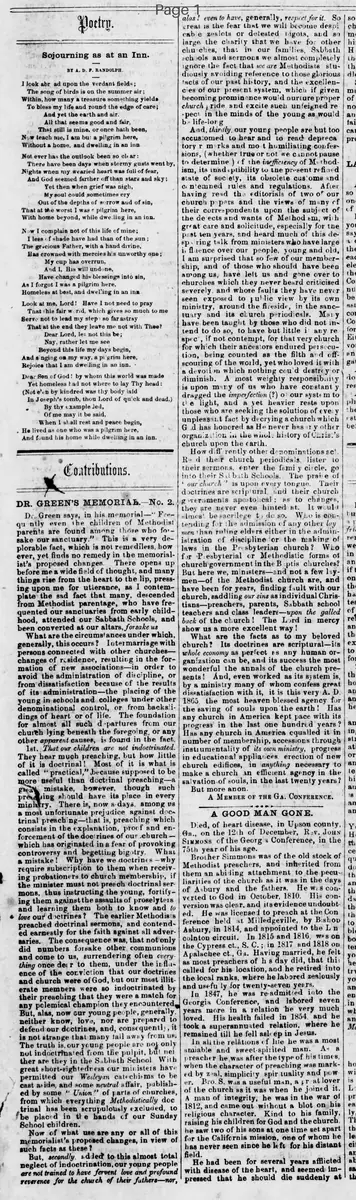
Dr. Green says, in his memorial-" Frequently even the children of Methodist parents are found among those who forsake our sanctuary." This is a very deplorable fact, which is not remediless, however, yet finds no remedy in the memorialist's proposed changes. There opens up before me a wide field of thought, and many things rise from the heart to the lip, pressing upon me for utterance, as I contemplate the sad fact that many, descended from Methodist parentage, who have frequented our sanctuaries from early childhood, attended our Sabbath Schools, and been converted at our altars, forsake us. What are the circumstances under which, generally, this occurs? Intermarriage with persons connected with other churches- changes of residence, resulting in the formation of new associations-in order to avoid the administration of discipline, or from dissatisfaction because of the results of its administration-the placing of the young in schools and colleges under other denominational control, or from backslidings of heart or of life. The foundation for almost all such departures from our church lying beneath the foregoing, or any other apparent causes, is found in the fact.
Ist. That our children are not indoctrinated. They hear much preaching, but how little of it is doctrinal! Most of it is what is called "practical," because supposed to be more useful than doctrinal preaching-a great mistake, however, though such preaching should have its place in every ministry. There is, now a-days, among us a most unfortunate prejudice against doctrinal preaching-that is, preaching which consists in the explanation, proof and enforcement of the doctrines of our church- which has originated in a fear of provoking controversy and begetting bigotry. What a mistake! Why have we doctrines-why require subscription to them when receiving probationers to church membership, if the minister must not preach doctrinal sermons, thus instructing the young, fortifying them against the assaults of proselyters and learning them both to know and to love our doctrines? The earlier Methodists preached doctrinal sermons, and contended earnestly for the faith against all adversaries. The consequence was, that not only did numbers forsake other communions and come to us, surrendering often everything once dear to them, under the influence of the conviction that our doctrines and church were of God, but our most illiterate members were so indoctrinated by their preaching that they were a match for any polemical champion they encountered. But, alas, now our young people, generally, neither know, love, nor are prepared to defend our doctrines, and, consequently, it is not strange that many fall away from us. The truth is, our young people are not only not indoctrinated from the pulpit, but neither are they in the Sabbath School. With great short-sightedness our ministers have permitted our Wesleyan catechisms to be cast aside, and some neutral affair, published by some "Union" of parts of churches, from which everything Methodistically doctrinal has been scrupulously excluded, to be placed in the hands of our Sunday School children.
Now of what use are any or all of this memorialist's proposed changes, in view of such facts as these? But, secondly, added to this almost total neglect of indoctrination, our young people are not trained to have fervent love and profound reverence for the church of their fathers-nor, alas! even to have, generally, respect for it. So great is the fear that we will become despised zealots or detested bigots, and so large the charity that we have for other churches, that in our families, Sabbath schools and sermons we almost completely ignore the fact that we are Methodists studiously avoiding reference to those glorious facts of our past history, and the excellencies of our present system, which if given becoming prominence would nurture proper church pride and excite such unfeigned respect in the minds of the young as would be life-long.
And, thirdly, our young people are but too accustomed to hear and to read deprecatory remarks and most humiliating confessions, (whether true or not we cannot pause to determine,) of the inefficiency of Methodism, its inadaptibility to the present refined state of society, its obsolete customs and condemned rules and regulations. After having read the editorials of two of our church papers and the views of many of their correspondents upon the subject of the defects and wants of Methodism, with great care and solicitude, especially for the past ten years, and heard much of this desponding talk from ministers who have large influence over our people, young and old, I am surprised that so few of our membership, and of those who should have been among us, have left us and gone over to churches which they never heard criticised severely, and whose faults they have never seen exposed to public view by its own ministry, around the fireside, in the sanctuary and its church periodicals. Many have been taught by those who did not intend to do so, to have but little if any respect, if not contempt, for that very church for which their ancestors endured persecution, being counted as the filth and offscouring of the world, yet who loved it with a devotion which nothing could destroy or diminish. A most weighty responsibility is upon many of us who have constantly dragged the imperfection (?) of our system to the light, and a yet heavier rests upon those who are seeking the solution of every unpleasant fact by decrying a church which God has honored as He never has any other organization in the whole history of Christ's church upon the earth.
How differently other denominations act! Read their church periodicals, listen to their sermons, enter the family circle, go into their Sabbath Schools. The praise of "our church" is upon every tongue. Their doctrines are scriptural, and their church governments apostolical; as to changes, they are never even hinted at. It would almost be sacrilege to do so. Who is contending for the admission of any other laymen than ruling elders either in the administration of discipline or the making of laws in the Presbyterian church? Who for Presbyterial or Methodistic forms of church government in the Baptist churches? But here we, ministers-and not a few laymen-of the Methodist church are, and have been for years, finding fault with our church, saddling our sins as individual Christians-preachers, parents, Sabbath school teachers and class leaders-upon the galled back of the church! The Lord in mercy show us a more excellent way!
What are the facts as to my beloved church? Its doctrines are scriptural-its whole economy as perfect as any human organization can be, and its success the most wonderful the annals of the church presents! And, even worked as its system is, by a ministry many of whom confess great dissatisfaction with it, it is this very A. D. 1865, the most heaven blessed agency for the saving of souls upon the earth! Has any church in America kept pace with its progress in the last one hundred years? Has any church in America equalled it in number of membership, accessions through instrumentality of its own ministry, progress in educational appliances, erection of new church edifices, in anything necessary to make a church an efficient agency in the salvation of souls, in the last twenty years? But more anon.
A Member of The Ga. Conference.
DR. GREEN'S MEMORIAE.-No. 2.
Dr. Green says, in his memorial-" Frequently even the children of Methodist parents are found among those who forsake our sanctuary." This is a very deplorable fact, which is not remediless, however, yet finds no remedy in the memorialist's proposed changes. There opens up before me a wide field of thought, and many things rise from the heart to the lip, pressing upon me for utterance, as I contemplate the sad fact that many, descended from Methodist parentage, who have frequented our sanctuaries from early childhood, attended our Sabbath Schools, and been converted at our altars, forsake us. What are the circumstances under which, generally, this occurs? Intermarriage with persons connected with other churches- changes of residence, resulting in the formation of new associations-in order to avoid the administration of discipline, or from dissatisfaction because of the results of its administration-the placing of the young in schools and colleges under other denominational control, or from backslidings of heart or of life. The foundation for almost all such departures from our church lying beneath the foregoing, or any other apparent causes, is found in the fact.
Ist. That our children are not indoctrinated. They hear much preaching, but how little of it is doctrinal! Most of it is what is called "practical," because supposed to be more useful than doctrinal preaching-a great mistake, however, though such preaching should have its place in every ministry. There is, now a-days, among us a most unfortunate prejudice against doctrinal preaching-that is, preaching which consists in the explanation, proof and enforcement of the doctrines of our church- which has originated in a fear of provoking controversy and begetting bigotry. What a mistake! Why have we doctrines-why require subscription to them when receiving probationers to church membership, if the minister must not preach doctrinal sermons, thus instructing the young, fortifying them against the assaults of proselyters and learning them both to know and to love our doctrines? The earlier Methodists preached doctrinal sermons, and contended earnestly for the faith against all adversaries. The consequence was, that not only did numbers forsake other communions and come to us, surrendering often everything once dear to them, under the influence of the conviction that our doctrines and church were of God, but our most illiterate members were so indoctrinated by their preaching that they were a match for any polemical champion they encountered. But, alas, now our young people, generally, neither know, love, nor are prepared to defend our doctrines, and, consequently, it is not strange that many fall away from us. The truth is, our young people are not only not indoctrinated from the pulpit, but neither are they in the Sabbath School. With great short-sightedness our ministers have permitted our Wesleyan catechisms to be cast aside, and some neutral affair, published by some "Union" of parts of churches, from which everything Methodistically doctrinal has been scrupulously excluded, to be placed in the hands of our Sunday School children.
Now of what use are any or all of this memorialist's proposed changes, in view of such facts as these? But, secondly, added to this almost total neglect of indoctrination, our young people are not trained to have fervent love and profound reverence for the church of their fathers-nor, alas! even to have, generally, respect for it. So great is the fear that we will become despised zealots or detested bigots, and so large the charity that we have for other churches, that in our families, Sabbath schools and sermons we almost completely ignore the fact that we are Methodists studiously avoiding reference to those glorious facts of our past history, and the excellencies of our present system, which if given becoming prominence would nurture proper church pride and excite such unfeigned respect in the minds of the young as would be life-long.
And, thirdly, our young people are but too accustomed to hear and to read deprecatory remarks and most humiliating confessions, (whether true or not we cannot pause to determine,) of the inefficiency of Methodism, its inadaptibility to the present refined state of society, its obsolete customs and condemned rules and regulations. After having read the editorials of two of our church papers and the views of many of their correspondents upon the subject of the defects and wants of Methodism, with great care and solicitude, especially for the past ten years, and heard much of this desponding talk from ministers who have large influence over our people, young and old, I am surprised that so few of our membership, and of those who should have been among us, have left us and gone over to churches which they never heard criticised severely, and whose faults they have never seen exposed to public view by its own ministry, around the fireside, in the sanctuary and its church periodicals. Many have been taught by those who did not intend to do so, to have but little if any respect, if not contempt, for that very church for which their ancestors endured persecution, being counted as the filth and offscouring of the world, yet who loved it with a devotion which nothing could destroy or diminish. A most weighty responsibility is upon many of us who have constantly dragged the imperfection (?) of our system to the light, and a yet heavier rests upon those who are seeking the solution of every unpleasant fact by decrying a church which God has honored as He never has any other organization in the whole history of Christ's church upon the earth.
How differently other denominations act! Read their church periodicals, listen to their sermons, enter the family circle, go into their Sabbath Schools. The praise of "our church" is upon every tongue. Their doctrines are scriptural, and their church governments apostolical; as to changes, they are never even hinted at. It would almost be sacrilege to do so. Who is contending for the admission of any other laymen than ruling elders either in the administration of discipline or the making of laws in the Presbyterian church? Who for Presbyterial or Methodistic forms of church government in the Baptist churches? But here we, ministers-and not a few laymen-of the Methodist church are, and have been for years, finding fault with our church, saddling our sins as individual Christians-preachers, parents, Sabbath school teachers and class leaders-upon the galled back of the church! The Lord in mercy show us a more excellent way!
What are the facts as to my beloved church? Its doctrines are scriptural-its whole economy as perfect as any human organization can be, and its success the most wonderful the annals of the church presents! And, even worked as its system is, by a ministry many of whom confess great dissatisfaction with it, it is this very A. D. 1865, the most heaven blessed agency for the saving of souls upon the earth! Has any church in America kept pace with its progress in the last one hundred years? Has any church in America equalled it in number of membership, accessions through instrumentality of its own ministry, progress in educational appliances, erection of new church edifices, in anything necessary to make a church an efficient agency in the salvation of souls, in the last twenty years? But more anon.
A Member of The Ga. Conference.
What sub-type of article is it?
Moral Or Religious
Education
What keywords are associated?
Methodist Doctrines
Indoctrination Neglect
Church Loyalty
Doctrinal Preaching
Sabbath Schools
Methodist History
Church Criticism
Religious Education
What entities or persons were involved?
Dr. Green
Methodist Church
Ga. Conference
Editorial Details
Primary Topic
Defense Of Methodist Doctrines Against Proposed Changes And Neglect Of Indoctrination
Stance / Tone
Defensive And Exhortative, Criticizing Internal Church Neglect And Excessive Self Criticism
Key Figures
Dr. Green
Methodist Church
Ga. Conference
Key Arguments
Children Of Methodist Parents Forsake The Church Due To Intermarriage, Residence Changes, Discipline Avoidance, Educational Influences, And Backsliding.
Lack Of Doctrinal Preaching Leaves Youth Uninstructed And Unprepared Against Proselytizers.
Sabbath Schools Use Neutral Materials Instead Of Wesleyan Catechisms, Neglecting Methodist Indoctrination.
Young People Are Not Trained To Love And Respect The Methodist Church, Avoiding References To Its History And Excellencies.
Excessive Deprecatory Remarks About Methodism's Inefficiencies Erode Respect Among Youth.
Other Denominations Praise Their Own Churches Without Hinting At Changes, Fostering Loyalty.
Methodist Doctrines Are Scriptural, Economy Perfect, And Success Unparalleled, Especially In 1865.
Methodism Has Outpaced Other Churches In Growth, Education, And Soul Saving In Recent Decades.