Thank you for visiting SNEWPapers!
Sign up free
Story
January 12, 1898
The Saint Paul Globe
Saint Paul, Ramsey County, Minnesota
What is this article about?
William Jennings Bryan addresses a massive crowd of 10,000+ at Minneapolis Exposition Building, promoting silver bimetallism despite 1896 election loss; receives ovation, bouquet from women's league; local speakers praise him amid cold conditions.
Clipping
OCR Quality
95%
Excellent
Full Text
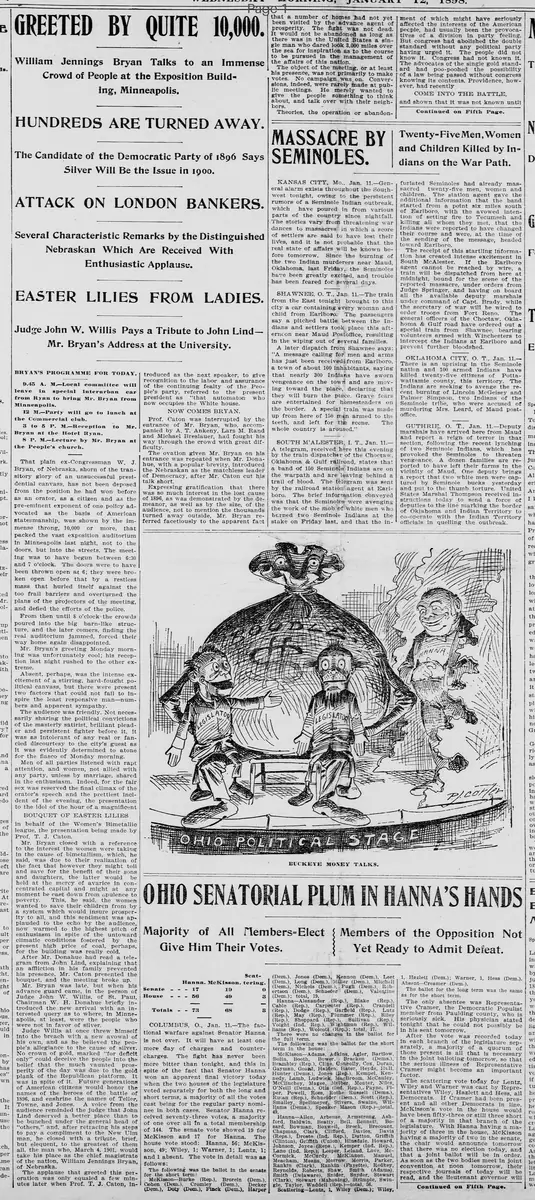
GREETED BY QUITE 10,000.
William Jennings Bryan Talks to an Immense Crowd of People at the Exposition Building, Minneapolis.
HUNDREDS ARE TURNED AWAY.
The Candidate of the Democratic Party of 1896 Says Silver Will Be the Issue in 1900.
ATTACK ON LONDON BANKERS.
Several Characteristic Remarks by the Distinguished Nebraskan Which Are Received With Enthusiastic Applause.
EASTER LILIES FROM LADIES.
Judge John W. Willis Pays a Tribute to John Lind-
Mr. Bryan's Address at the University.
BRYAN'S PROGRAMME FOR TODAY.
9:45 A. M.-Local committee will leave in special interurban car from Ryan to bring Mr. Bryan from Minneapolis.
12 M.-Party will go to lunch at the Commercial club.
3 to 5 P. M.-Reception to Mr. Bryan at the Hotel Ryan.
8 P. M.-Lecture by Mr. Bryan at the People's church.
That plain ex-Congressman W. J. Bryan, of Nebraska, shorn of the transitory glory of an unsuccessful presidential canvass, has not been deposed from the position he had won before as an orator, as a citizen and as the pre-eminent exponent of one policy advocated as the basis of American statesmanship, was shown by the immense throng, 10,000 or more, that packed the vast exposition auditorium in Minneapolis last night, not to the doors, but into the streets. The meeting was to have begun between 6:30 and 7 o'clock. The doors were to have been thrown open at 6; they were broken open before that by a restless mass that hurled itself against the too frail barriers and overturned the plans of the projectors of the meeting, and defied the efforts of the police. From then until 8 o'clock the crowds poured into the big barn-like structure, and the later comers, finding the real auditorium jammed, forced their way home again disappointed.
Mr. Bryan's greeting Monday morning was unfortunately cool; his reception last night rushed to the other extreme.
Absent, perhaps, was the intense excitement of a stirring, hard-fought political canvass, but there were present two factors that could not fail to inspire the least responsive man-numbers and apparent sympathy.
The audience was friendly. Not necessarily sharing the political convictions of the masterly satirist, brilliant pleader and persistent fighter before it, it was as intolerant of any real or fancied discourtesy to the city's guest as it was evidently determined to atone for the fiasco of Monday morning.
Men of all parties listened with rapt attention, and women, not allied with any party, unless by marriage, shared in the enthusiasm. Indeed, for the fair sex was reserved the final climax of the orator's speech and the prettiest incident of the evening, the presentation to the idol of the hour of a magnificent bouquet of Easter lilies in behalf of the Women's Bimetallic league, the presentation being made by Prof. T. J. Caton.
Mr. Bryan closed with a reference to the interest the women were taking in the cause of bimetallism, which, he said, was due to their realization of the fact that however they might toil and save for the benefit of their sons and daughters, the latter would be held at the mercy of avarice in concentrated capital and might at any moment be cast down from opulence to poverty.
This, he said, the women wanted to save their children from by a system which would insure prosperity to all, and this sentiment was applauded to the echo by the audience, now warmed to the highest pitch of enthusiasm in spite of the untoward climatic conditions fostered by the present high price of coal, perhaps, for the building was really cold.
After Mr. Donahue had read a telegram from John Lind, explaining that an affliction in his family prevented his presence, Mr. Caton presented the bouquet, and the meeting broke up.
Mr. Bryan was late, but when his advance guard came, in the person of Judge John W. Willis, of St. Paul, Chairman W. H. Donahue briefly introduced the new arrival with an interested query as to where, in Minneapolis, at least, were the people who were not in favor of silver.
Judge Willis at once threw himself into the breach with a new avowal of his own, and as he believed the people's allegiance to the cause of silver.
No crown of gold, marked "for deficit only" could deceive the people into the belief that the much vaunted prosperity of the day was due to the gold plank of the Republican platform. It was in spite of it. Future generations of American citizens would honor the names of the heroes of the battle of 1896, and enshrine the names of Teller, Towne, and Jones. A voice from the audience reminded the judge that John Lind deserved a better place than to be bunched under the general head of "others," and, after retracing his steps to pay a compliment to the New Ulm man, he closed with a tribute, brief, but eloquent, to the greatest of them all, the man who, March 4, 1901, would take his place as the chief magistrate of the nation, William Jennings Bryan, of Nebraska.
The applause that greeted this peroration was only equaled a few minutes later when Prof. T. J. Caton, introduced as the next speaker, to give recognition to the labor and assurance of the continuing fealty of the People's party, referred to the present president as "that automaton who now occupies the White house."
NOW COMES BRYAN.
Prof. Caton was interrupted by the entrance of Mr. Bryan, who, accompanied by A. T. Ankeny, Lars M. Rand and Michael Breslauer, had fought his way through the crowd with great difficulty.
The ovation given Mr. Bryan on his entrance was repeated when Mr. Donahue, with a popular brevity, introduced the Nebraskan as the matchless leader of Democracy, after Mr. Caton cut his talk short.
Expressing gratification that there was so much interest in the lost cause of 1896, as was demonstrated by the demeanor, as well as by the size, of the audience, not to mention the thousands turned away outside, Mr. Bryan referred facetiously to the apparent fact that a number of homes had not yet been visited by the advance agent of prosperity. The fight was not dead. It would not be abandoned as long as there was in the United States a single man who dared look 3,000 miles over the sea for inspiration as to the course to be pursued in the management of the affairs of this nation.
The object of the meeting, or at least his presence, was not primarily to make votes. No campaign was on. Conversions, indeed, were rarely made at public meetings. He merely wanted to give the people something to think about, and talk over with their neighbors.
Theories, the operation or abandonment of which might have seriously affected the interests of the American people, had usually been the provocatives of a division in party feeling.
But congress had abolished the double standard without any political party having urged it. The people did not know it. Congress had not known it.
The advocates of the single gold standard had poo-poohed the possibility of a law being passed without congress knowing its contents. Providence, however, had recently COME INTO THE BATTLE, and shown that it was not known until Continued on Fifth Page.
William Jennings Bryan Talks to an Immense Crowd of People at the Exposition Building, Minneapolis.
HUNDREDS ARE TURNED AWAY.
The Candidate of the Democratic Party of 1896 Says Silver Will Be the Issue in 1900.
ATTACK ON LONDON BANKERS.
Several Characteristic Remarks by the Distinguished Nebraskan Which Are Received With Enthusiastic Applause.
EASTER LILIES FROM LADIES.
Judge John W. Willis Pays a Tribute to John Lind-
Mr. Bryan's Address at the University.
BRYAN'S PROGRAMME FOR TODAY.
9:45 A. M.-Local committee will leave in special interurban car from Ryan to bring Mr. Bryan from Minneapolis.
12 M.-Party will go to lunch at the Commercial club.
3 to 5 P. M.-Reception to Mr. Bryan at the Hotel Ryan.
8 P. M.-Lecture by Mr. Bryan at the People's church.
That plain ex-Congressman W. J. Bryan, of Nebraska, shorn of the transitory glory of an unsuccessful presidential canvass, has not been deposed from the position he had won before as an orator, as a citizen and as the pre-eminent exponent of one policy advocated as the basis of American statesmanship, was shown by the immense throng, 10,000 or more, that packed the vast exposition auditorium in Minneapolis last night, not to the doors, but into the streets. The meeting was to have begun between 6:30 and 7 o'clock. The doors were to have been thrown open at 6; they were broken open before that by a restless mass that hurled itself against the too frail barriers and overturned the plans of the projectors of the meeting, and defied the efforts of the police. From then until 8 o'clock the crowds poured into the big barn-like structure, and the later comers, finding the real auditorium jammed, forced their way home again disappointed.
Mr. Bryan's greeting Monday morning was unfortunately cool; his reception last night rushed to the other extreme.
Absent, perhaps, was the intense excitement of a stirring, hard-fought political canvass, but there were present two factors that could not fail to inspire the least responsive man-numbers and apparent sympathy.
The audience was friendly. Not necessarily sharing the political convictions of the masterly satirist, brilliant pleader and persistent fighter before it, it was as intolerant of any real or fancied discourtesy to the city's guest as it was evidently determined to atone for the fiasco of Monday morning.
Men of all parties listened with rapt attention, and women, not allied with any party, unless by marriage, shared in the enthusiasm. Indeed, for the fair sex was reserved the final climax of the orator's speech and the prettiest incident of the evening, the presentation to the idol of the hour of a magnificent bouquet of Easter lilies in behalf of the Women's Bimetallic league, the presentation being made by Prof. T. J. Caton.
Mr. Bryan closed with a reference to the interest the women were taking in the cause of bimetallism, which, he said, was due to their realization of the fact that however they might toil and save for the benefit of their sons and daughters, the latter would be held at the mercy of avarice in concentrated capital and might at any moment be cast down from opulence to poverty.
This, he said, the women wanted to save their children from by a system which would insure prosperity to all, and this sentiment was applauded to the echo by the audience, now warmed to the highest pitch of enthusiasm in spite of the untoward climatic conditions fostered by the present high price of coal, perhaps, for the building was really cold.
After Mr. Donahue had read a telegram from John Lind, explaining that an affliction in his family prevented his presence, Mr. Caton presented the bouquet, and the meeting broke up.
Mr. Bryan was late, but when his advance guard came, in the person of Judge John W. Willis, of St. Paul, Chairman W. H. Donahue briefly introduced the new arrival with an interested query as to where, in Minneapolis, at least, were the people who were not in favor of silver.
Judge Willis at once threw himself into the breach with a new avowal of his own, and as he believed the people's allegiance to the cause of silver.
No crown of gold, marked "for deficit only" could deceive the people into the belief that the much vaunted prosperity of the day was due to the gold plank of the Republican platform. It was in spite of it. Future generations of American citizens would honor the names of the heroes of the battle of 1896, and enshrine the names of Teller, Towne, and Jones. A voice from the audience reminded the judge that John Lind deserved a better place than to be bunched under the general head of "others," and, after retracing his steps to pay a compliment to the New Ulm man, he closed with a tribute, brief, but eloquent, to the greatest of them all, the man who, March 4, 1901, would take his place as the chief magistrate of the nation, William Jennings Bryan, of Nebraska.
The applause that greeted this peroration was only equaled a few minutes later when Prof. T. J. Caton, introduced as the next speaker, to give recognition to the labor and assurance of the continuing fealty of the People's party, referred to the present president as "that automaton who now occupies the White house."
NOW COMES BRYAN.
Prof. Caton was interrupted by the entrance of Mr. Bryan, who, accompanied by A. T. Ankeny, Lars M. Rand and Michael Breslauer, had fought his way through the crowd with great difficulty.
The ovation given Mr. Bryan on his entrance was repeated when Mr. Donahue, with a popular brevity, introduced the Nebraskan as the matchless leader of Democracy, after Mr. Caton cut his talk short.
Expressing gratification that there was so much interest in the lost cause of 1896, as was demonstrated by the demeanor, as well as by the size, of the audience, not to mention the thousands turned away outside, Mr. Bryan referred facetiously to the apparent fact that a number of homes had not yet been visited by the advance agent of prosperity. The fight was not dead. It would not be abandoned as long as there was in the United States a single man who dared look 3,000 miles over the sea for inspiration as to the course to be pursued in the management of the affairs of this nation.
The object of the meeting, or at least his presence, was not primarily to make votes. No campaign was on. Conversions, indeed, were rarely made at public meetings. He merely wanted to give the people something to think about, and talk over with their neighbors.
Theories, the operation or abandonment of which might have seriously affected the interests of the American people, had usually been the provocatives of a division in party feeling.
But congress had abolished the double standard without any political party having urged it. The people did not know it. Congress had not known it.
The advocates of the single gold standard had poo-poohed the possibility of a law being passed without congress knowing its contents. Providence, however, had recently COME INTO THE BATTLE, and shown that it was not known until Continued on Fifth Page.
What sub-type of article is it?
Historical Event
Biography
What themes does it cover?
Triumph
Bravery Heroism
What keywords are associated?
Bryan Speech
Minneapolis Rally
Bimetallism
Silver Standard
Political Enthusiasm
What entities or persons were involved?
William Jennings Bryan
Judge John W. Willis
Prof. T. J. Caton
W. H. Donahue
John Lind
Where did it happen?
Exposition Building, Minneapolis
Story Details
Key Persons
William Jennings Bryan
Judge John W. Willis
Prof. T. J. Caton
W. H. Donahue
John Lind
Location
Exposition Building, Minneapolis
Event Date
Last Night
Story Details
William Jennings Bryan speaks to a crowd of over 10,000 in Minneapolis, advocating for bimetallism and silver as the issue for 1900, receives enthusiastic applause and a bouquet from the Women's Bimetallic league, introduced by local figures praising his leadership.