Thank you for visiting SNEWPapers!
Sign up free
Editorial
November 14, 1849
Morning Star
Limerick, York County, Maine
What is this article about?
A letter critiquing papal Rome's religious practices by contrasting the ancient Pantheon's pagan dedication with its modern veneration of the Virgin Mary, including historical details and a satirical account of a miracle dispute between canons and friars.
Clipping
OCR Quality
95%
Excellent
Full Text
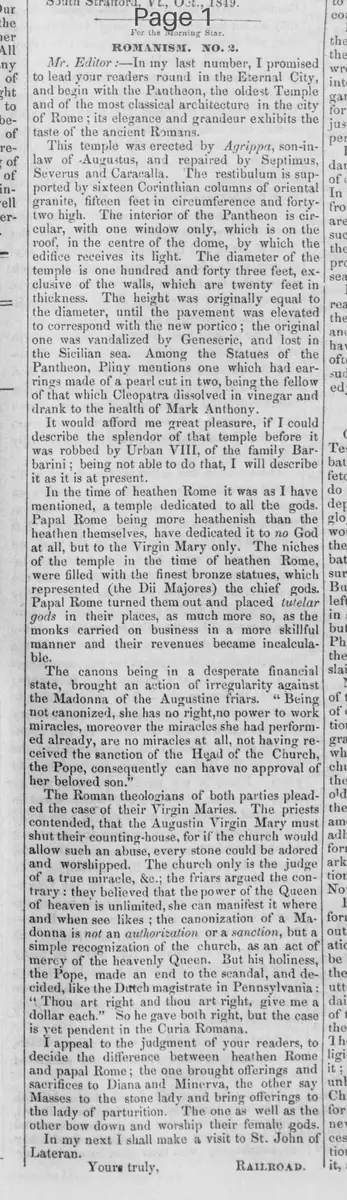
For the Morning Star.
ROMANISM. NO. 2.
Mr. Editor: In my last number, I promised to lead your readers round in the Eternal City, and begin with the Pantheon, the oldest Temple and of the most classical architecture in the city of Rome: its elegance and grandeur exhibits the taste of the ancient Romans.
This temple was erected by Agrippa, son-in-law of Augustus, and repaired by Septimus, Severus and Caracalla. The vestibulum is supported by sixteen Corinthian columns of oriental granite, fifteen feet in circumference and forty-two high. The interior of the Pantheon is circular, with one window only, which is on the roof, in the centre of the dome, by which the edifice receives its light. The diameter of the temple is one hundred and forty three feet, exclusive of the walls, which are twenty feet in thickness. The height was originally equal to the diameter, until the pavement was elevated to correspond with the new portico; the original one was vandalized by Geneseric, and lost in the Sicilian sea. Among the Statues of the Pantheon, Pliny mentions one which had ear-rings made of a pearl cut in two, being the fellow of that which Cleopatra dissolved in vinegar and drank to the health of Mark Anthony.
It would afford me great pleasure, if I could describe the splendor of that temple before it was robbed by Urban VIII, of the family Barbarini; being not able to do that, I will describe it as it is at present.
In the time of heathen Rome it was as I have mentioned, a temple dedicated to all the gods. Papal Rome being more heathenish than the heathen themselves, have dedicated it to no God at all, but to the Virgin Mary only. The niches of the temple in the time of heathen Rome, were filled with the finest bronze statues, which represented (the Dii Majores) the chief gods. Papal Rome turned them out and placed tutelar gods in their places, as much more so, as the monks carried on business in a more skillful manner and their revenues became incalculable.
The canons being in a desperate financial state, brought an action of irregularity against the Madonna of the Augustine friars. "Being not canonized, she has no right, no power to work miracles, moreover the miracles she had performed already, are no miracles at all, not having received the sanction of the Head of the Church, the Pope, consequently can have no approval of her beloved son."
The Roman theologians of both parties pleaded the case of their Virgin Maries. The priests contended that the Augustin Virgin Mary must shut their counting-house. for if the church would allow such an abuse, every stone could be adored and worshipped. The church only is the judge of a true miracle, &c.; the friars argued the contrary: they believed that the power of the Queen of heaven is unlimited, she can manifest it where and when she likes ; the canonization of a Madonna is not an authorization or a sanction, but a simple recognization of the church, as an act of mercy of the heavenly Queen. But his holiness, the Pope, made an end to the scandal, and decided, like the Dutch magistrate in Pennsylvania : "Thou art right and thou art right, give me a dollar each." So he gave both right, but the case is yet pendent in the Curia Romana.
I appeal to the judgment of your readers, to decide the difference between heathen Rome and papal Rome; the one brought offerings and sacrifices to Diana and Minerva, the other say Masses to the stone lady and bring offerings to the lady of parturition. The one as well as the other bow down and worship their female gods.
In my next I shall make a visit to St. John of Lateran.
Your
RAILROAD.
ROMANISM. NO. 2.
Mr. Editor: In my last number, I promised to lead your readers round in the Eternal City, and begin with the Pantheon, the oldest Temple and of the most classical architecture in the city of Rome: its elegance and grandeur exhibits the taste of the ancient Romans.
This temple was erected by Agrippa, son-in-law of Augustus, and repaired by Septimus, Severus and Caracalla. The vestibulum is supported by sixteen Corinthian columns of oriental granite, fifteen feet in circumference and forty-two high. The interior of the Pantheon is circular, with one window only, which is on the roof, in the centre of the dome, by which the edifice receives its light. The diameter of the temple is one hundred and forty three feet, exclusive of the walls, which are twenty feet in thickness. The height was originally equal to the diameter, until the pavement was elevated to correspond with the new portico; the original one was vandalized by Geneseric, and lost in the Sicilian sea. Among the Statues of the Pantheon, Pliny mentions one which had ear-rings made of a pearl cut in two, being the fellow of that which Cleopatra dissolved in vinegar and drank to the health of Mark Anthony.
It would afford me great pleasure, if I could describe the splendor of that temple before it was robbed by Urban VIII, of the family Barbarini; being not able to do that, I will describe it as it is at present.
In the time of heathen Rome it was as I have mentioned, a temple dedicated to all the gods. Papal Rome being more heathenish than the heathen themselves, have dedicated it to no God at all, but to the Virgin Mary only. The niches of the temple in the time of heathen Rome, were filled with the finest bronze statues, which represented (the Dii Majores) the chief gods. Papal Rome turned them out and placed tutelar gods in their places, as much more so, as the monks carried on business in a more skillful manner and their revenues became incalculable.
The canons being in a desperate financial state, brought an action of irregularity against the Madonna of the Augustine friars. "Being not canonized, she has no right, no power to work miracles, moreover the miracles she had performed already, are no miracles at all, not having received the sanction of the Head of the Church, the Pope, consequently can have no approval of her beloved son."
The Roman theologians of both parties pleaded the case of their Virgin Maries. The priests contended that the Augustin Virgin Mary must shut their counting-house. for if the church would allow such an abuse, every stone could be adored and worshipped. The church only is the judge of a true miracle, &c.; the friars argued the contrary: they believed that the power of the Queen of heaven is unlimited, she can manifest it where and when she likes ; the canonization of a Madonna is not an authorization or a sanction, but a simple recognization of the church, as an act of mercy of the heavenly Queen. But his holiness, the Pope, made an end to the scandal, and decided, like the Dutch magistrate in Pennsylvania : "Thou art right and thou art right, give me a dollar each." So he gave both right, but the case is yet pendent in the Curia Romana.
I appeal to the judgment of your readers, to decide the difference between heathen Rome and papal Rome; the one brought offerings and sacrifices to Diana and Minerva, the other say Masses to the stone lady and bring offerings to the lady of parturition. The one as well as the other bow down and worship their female gods.
In my next I shall make a visit to St. John of Lateran.
Your
RAILROAD.
What sub-type of article is it?
Moral Or Religious
Satire
What keywords are associated?
Pantheon Rome
Papal Rome
Virgin Mary
Religious Critique
Heathen Comparison
Catholic Satire
What entities or persons were involved?
Pantheon
Agrippa
Augustus
Septimus Severus
Caracalla
Urban Viii
Virgin Mary
Pope
Augustine Friars
Canons
Editorial Details
Primary Topic
Critique Of Papal Veneration In The Pantheon
Stance / Tone
Anti Catholic Satire Comparing Papal Rome To Ancient Paganism
Key Figures
Pantheon
Agrippa
Augustus
Septimus Severus
Caracalla
Urban Viii
Virgin Mary
Pope
Augustine Friars
Canons
Key Arguments
Pantheon Originally Dedicated To All Gods By Ancient Romans
Papal Rome Dedicates It Solely To Virgin Mary, More Heathenish Than Ancients
Historical Statues Replaced By Tutelary Figures For Monetary Gain
Legal Dispute Over Madonna's Miracles Resolved By Pope Taking Both Sides
Both Ancient And Papal Rome Worship Female Deities With Offerings