Thank you for visiting SNEWPapers!
Sign up free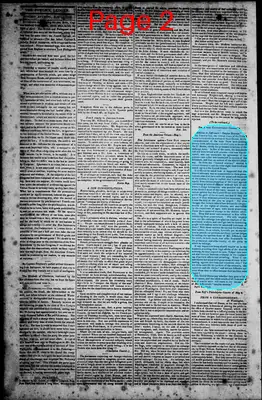
Norfolk Gazette And Publick Ledger
Norfolk, Virginia
What is this article about?
The U.S. Circuit Court session at New Haven ended on Tuesday last with most embargo law violation cases resulting in acquittals or dismissals. The article satirizes the district attorney's unsuccessful prosecutions and links costs to Jefferson's surplus revenue.
Clipping
OCR Quality
Full Text
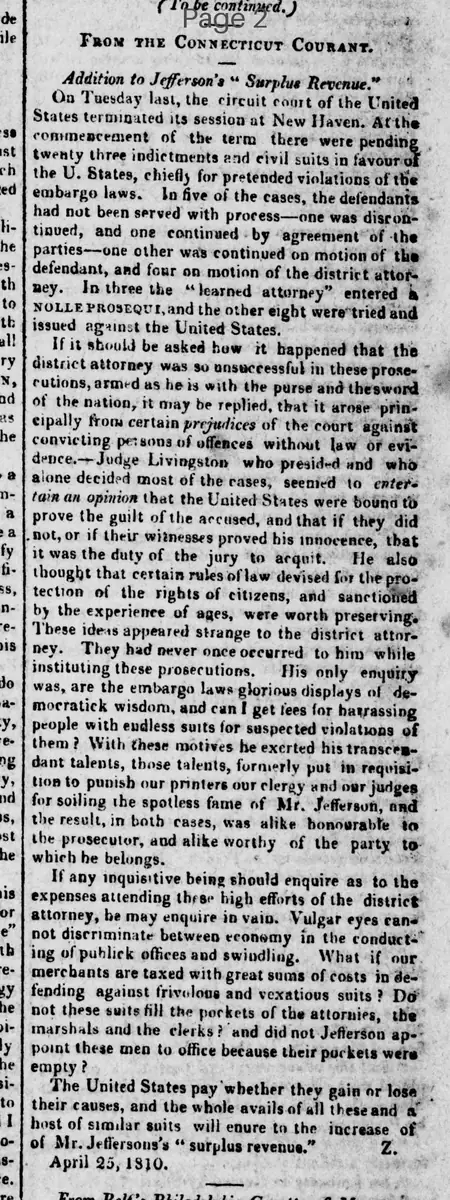
Addition to Jefferson's "Surplus Revenue."
On Tuesday last, the circuit court of the United States terminated its session at New Haven. At the commencement of the term there were pending twenty three indictments and civil suits in favour of the U. States, chiefly for pretended violations of the embargo laws. In five of the cases, the defendants had not been served with process—one was discontinued, and one continued—by agreement of the parties—one other was continued on motion of the defendant, and four on motion of the district attorney. In three the "learned attorney" entered NOLLE PROSEQUI, and the other eight were tried and acquitted—the verdicts being issued against the United States.
If it should be asked how it happened that the district attorney was so unsuccessful in these prosecutions, armed as he is with the purse and the sword of the nation, it may be replied, that it arose principally from certain prejudices of the court against convicting persons of offences without law or evidence.—Judge Livingston who presided and who alone decided most of the cases, seemed to entertain an opinion that the United States were bound to prove the guilt of the accused, and that if they did not, or if their witnesses proved his innocence, that it was the duty of the jury to acquit. He also thought that certain rules of law devised for the protection of the rights of citizens, and sanctioned by the experience of ages, were worth preserving.
These ideas appeared strange to the district attorney. They had never once occurred to him while instituting these prosecutions. His only enquiry was, are the embargo laws glorious displays of democratical wisdom, and can I get fees for harrassing people with endless suits for suspected violations of them? With these motives he exerted his transcendent talents, those talents, formerly put in requisition to punish our printers our clergy and our judges for soiling the spotless fame of Mr. Jefferson, and the result, in both cases, was alike honourable to the prosecutor, and alike worthy of the party to which he belongs.
If any inquisitive being should enquire as to the expenses attending these high efforts of the district attorney, he may enquire in vain. Vulgar eyes cannot discriminate between economy in the conducting of publick offices and swindling. What if our merchants are taxed with great sums of costs in defending against frivolous and vexatious suits? Do not these suits fill the pockets of the attornies, the marshals and the clerks? and did not Jefferson appoint these men to office because their pockets were empty?
The United States pay whether they gain or lose their causes, and the whole avails of all these and a host of similar suits will enure to the increase of Mr. Jefferson's "surplus revenue."
z.
April 25, 1810.
What sub-type of article is it?
What keywords are associated?
What entities or persons were involved?
Where did it happen?
Domestic News Details
Primary Location
New Haven
Event Date
Tuesday Last
Key Persons
Outcome
twenty-three indictments and civil suits pending; five not served, one discontinued, two continued by agreement or motion, four continued by district attorney, three nolle prosequi, eight tried and acquitted with verdicts against the united states.
Event Details
The U.S. Circuit Court session terminated with cases chiefly for violations of embargo laws; most resulted in continuances, discontinuances, nolle prosequi, or acquittals due to lack of evidence and legal protections emphasized by Judge Livingston.