Thank you for visiting SNEWPapers!
Sign up free
Story
October 8, 1905
Daily Press
Newport News, Virginia
What is this article about?
Article describes peculiar Brazilian flowers that imitate animals and figures, including the 'running antelope' flower, the 'caricature plant' resembling the Duke of Wellington, and orchids mimicking insects, bees, and other creatures.
Clipping
OCR Quality
95%
Excellent
Full Text
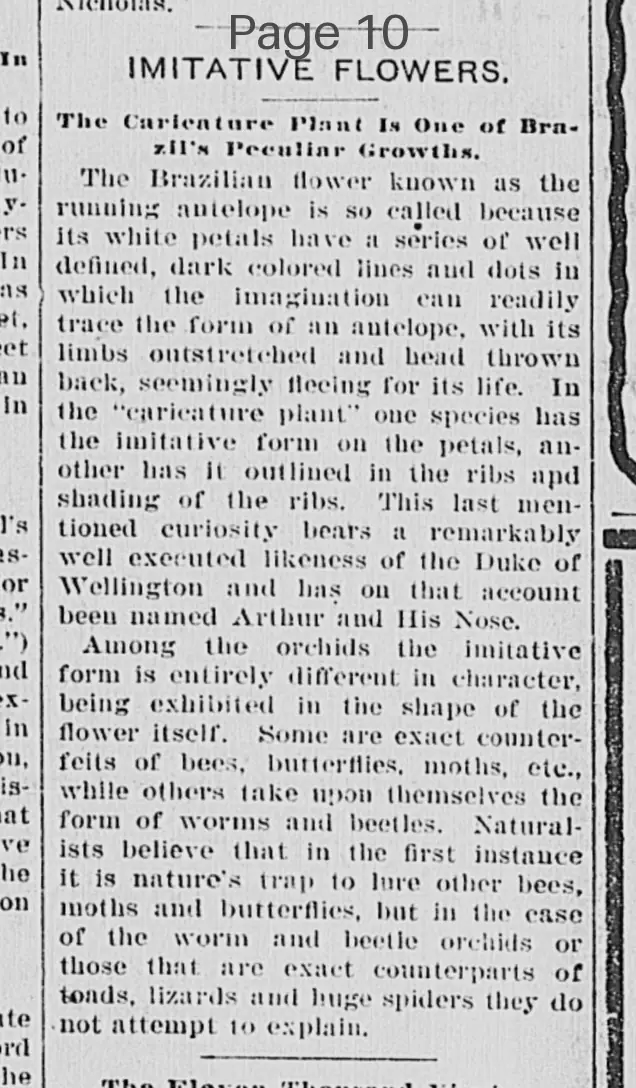
IMITATIVE FLOWERS.
The Caricature Plant Is One of Brazil's Peculiar Growths.
The Brazilian flower known as the running antelope is so called because its white petals have a series of well defined, dark colored lines and dots in which the imagination can readily trace the form of an antelope, with its limbs outstretched and head thrown back, seemingly fleeing for its life. In the "caricature plant" one species has the imitative form on the petals, another has it outlined in the ribs and shading of the ribs. This last mentioned curiosity bears a remarkably well executed likeness of the Duke of Wellington and has on that account been named Arthur and His Nose.
Among the orchids the imitative form is entirely different in character, being exhibited in the shape of the flower itself. Some are exact counterfeits of bees, butterflies, moths, etc., while others take upon themselves the form of worms and beetles. Naturalists believe that in the first instance it is nature's trap to lure other bees, moths and butterflies, but in the case of the worm and beetle orchids or those that are exact counterparts of toads, lizards and huge spiders they do not attempt to explain.
The Caricature Plant Is One of Brazil's Peculiar Growths.
The Brazilian flower known as the running antelope is so called because its white petals have a series of well defined, dark colored lines and dots in which the imagination can readily trace the form of an antelope, with its limbs outstretched and head thrown back, seemingly fleeing for its life. In the "caricature plant" one species has the imitative form on the petals, another has it outlined in the ribs and shading of the ribs. This last mentioned curiosity bears a remarkably well executed likeness of the Duke of Wellington and has on that account been named Arthur and His Nose.
Among the orchids the imitative form is entirely different in character, being exhibited in the shape of the flower itself. Some are exact counterfeits of bees, butterflies, moths, etc., while others take upon themselves the form of worms and beetles. Naturalists believe that in the first instance it is nature's trap to lure other bees, moths and butterflies, but in the case of the worm and beetle orchids or those that are exact counterparts of toads, lizards and huge spiders they do not attempt to explain.
What sub-type of article is it?
Curiosity
Extraordinary Event
What themes does it cover?
Nature
What keywords are associated?
Imitative Flowers
Brazilian Plants
Caricature Plant
Running Antelope
Orchid Imitations
Nature Mimicry
What entities or persons were involved?
Duke Of Wellington
Where did it happen?
Brazil
Story Details
Key Persons
Duke Of Wellington
Location
Brazil
Story Details
Brazilian flowers imitate animals and figures: 'running antelope' petals show fleeing antelope; 'caricature plant' resembles Duke of Wellington, named 'Arthur and His Nose'; orchids mimic bees, butterflies, moths, worms, beetles, toads, lizards, spiders, possibly as traps for pollinators.