Thank you for visiting SNEWPapers!
Sign up free
Story
September 1, 1874
The Daily Gazette
Wilmington, New Castle County, Delaware
What is this article about?
Article describes pre-Revolutionary War life in colonial America, focusing on elaborate fashions among the elite, sumptuary regulations, and affordable food and drink in places like Massachusetts, Boston, and Philadelphia during the 1700s.
Clipping
OCR Quality
97%
Excellent
Full Text
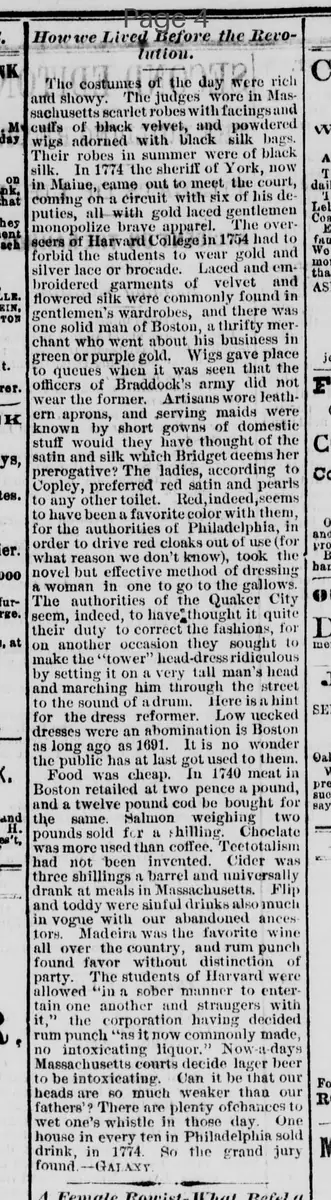
How we Lived Before the Revolution.
The costumes of the day were rich and showy. The judges wore in Massachusetts scarlet robes with facings and cuffs of black velvet, and powdered wigs adorned with black silk bags. Their robes in summer were of black silk. In 1774 the sheriff of York, now in Maine, came out to meet the court, coming on a circuit with six of his deputies, all with gold laced gentlemen monopolize brave apparel. The overseers of Harvard College in 1754 had to forbid the students to wear gold and silver lace or brocade. Laced and embroidered garments of velvet and flowered silk were commonly found in gentlemen's wardrobes, and there was one solid man of Boston, a thrifty merchant who went about his business in green or purple gold. Wigs gave place to queues when it was seen that the officers of Braddock's army did not wear the former. Artisans wore leather aprons, and serving maids were known by short gowns of domestic stuff would they have thought of the satin and silk which Bridget deems her prerogative? The ladies, according to Copley, preferred red satin and pearls to any other toilet. Red, indeed, seems to have been a favorite color with them. for the authorities of Philadelphia, in order to drive red cloaks out of use (for what reason we don't know), took the novel but effective method of dressing a woman in one to go to the gallows. The authorities of the Quaker City seem, indeed, to have thought it quite their duty to correct the fashions, for on another occasion they sought to make the "tower" head-dress ridiculous by setting it on a very tall man's head and marching him through the street to the sound of a drum. Here is a hint for the dress reformer. Low necked dresses were an abomination in Boston as long ago as 1691. It is no wonder the public has at last got used to them.
Food was cheap. In 1740 meat in Boston retailed at two pence a pound, and a twelve pound cod be bought for the same. Salmon weighing two pounds sold for a shilling. Chocolate was more used than coffee. Teetotalism had not been invented. Cider was three shillings a barrel and universally drank at meals in Massachusetts. Flip and toddy were sinful drinks also much in vogue with our abandoned ancestors. Madeira was the favorite wine all over the country, and rum punch found favor without distinction of party. The students of Harvard were allowed "in a sober manner to entertain one another and strangers with it," the corporation having decided rum punch "as it now commonly made no intoxicating liquor." Now-a-days Massachusetts courts decide lager beer to be intoxicating. Can it be that our heads are so much weaker than our fathers'? There are plenty of chances to wet one's whistle in those days. One house in every ten in Philadelphia sold drink. in 1774. So the grand jury found. --GALAXY
The costumes of the day were rich and showy. The judges wore in Massachusetts scarlet robes with facings and cuffs of black velvet, and powdered wigs adorned with black silk bags. Their robes in summer were of black silk. In 1774 the sheriff of York, now in Maine, came out to meet the court, coming on a circuit with six of his deputies, all with gold laced gentlemen monopolize brave apparel. The overseers of Harvard College in 1754 had to forbid the students to wear gold and silver lace or brocade. Laced and embroidered garments of velvet and flowered silk were commonly found in gentlemen's wardrobes, and there was one solid man of Boston, a thrifty merchant who went about his business in green or purple gold. Wigs gave place to queues when it was seen that the officers of Braddock's army did not wear the former. Artisans wore leather aprons, and serving maids were known by short gowns of domestic stuff would they have thought of the satin and silk which Bridget deems her prerogative? The ladies, according to Copley, preferred red satin and pearls to any other toilet. Red, indeed, seems to have been a favorite color with them. for the authorities of Philadelphia, in order to drive red cloaks out of use (for what reason we don't know), took the novel but effective method of dressing a woman in one to go to the gallows. The authorities of the Quaker City seem, indeed, to have thought it quite their duty to correct the fashions, for on another occasion they sought to make the "tower" head-dress ridiculous by setting it on a very tall man's head and marching him through the street to the sound of a drum. Here is a hint for the dress reformer. Low necked dresses were an abomination in Boston as long ago as 1691. It is no wonder the public has at last got used to them.
Food was cheap. In 1740 meat in Boston retailed at two pence a pound, and a twelve pound cod be bought for the same. Salmon weighing two pounds sold for a shilling. Chocolate was more used than coffee. Teetotalism had not been invented. Cider was three shillings a barrel and universally drank at meals in Massachusetts. Flip and toddy were sinful drinks also much in vogue with our abandoned ancestors. Madeira was the favorite wine all over the country, and rum punch found favor without distinction of party. The students of Harvard were allowed "in a sober manner to entertain one another and strangers with it," the corporation having decided rum punch "as it now commonly made no intoxicating liquor." Now-a-days Massachusetts courts decide lager beer to be intoxicating. Can it be that our heads are so much weaker than our fathers'? There are plenty of chances to wet one's whistle in those days. One house in every ten in Philadelphia sold drink. in 1774. So the grand jury found. --GALAXY
What sub-type of article is it?
Historical Event
Curiosity
Biography
What themes does it cover?
Social Manners
Fortune Reversal
Moral Virtue
What keywords are associated?
Colonial Fashion
Sumptuary Laws
Pre Revolution Life
Cheap Food
Colonial Drink
Harvard Students
Philadelphia Authorities
What entities or persons were involved?
Sheriff Of York
Overseers Of Harvard College
Thrifty Merchant Of Boston
Where did it happen?
Massachusetts, Boston, Philadelphia, York (Now Maine)
Story Details
Key Persons
Sheriff Of York
Overseers Of Harvard College
Thrifty Merchant Of Boston
Location
Massachusetts, Boston, Philadelphia, York (Now Maine)
Event Date
Pre 1776, 1691 1774
Story Details
Describes extravagant colonial fashions regulated by authorities, preferences for red and elaborate attire, shift from wigs to queues, and cheap food like meat at two pence per pound in 1740, with cider and rum punch commonly consumed.