Thank you for visiting SNEWPapers!
Sign up free
Literary
November 3, 1872
New York Dispatch
New York, New York County, New York
What is this article about?
Miss Prudence Gray, a spinster averse to men and theater due to her pious upbringing, receives omens predicting a male visitor. Her visitor Jennie shares stories of actor Edward Carlton's good deeds, leading Prudence to attend a show and reunite with her former fiancé. They reconcile, marry, and she overcomes her prejudices.
Clipping
OCR Quality
95%
Excellent
Full Text
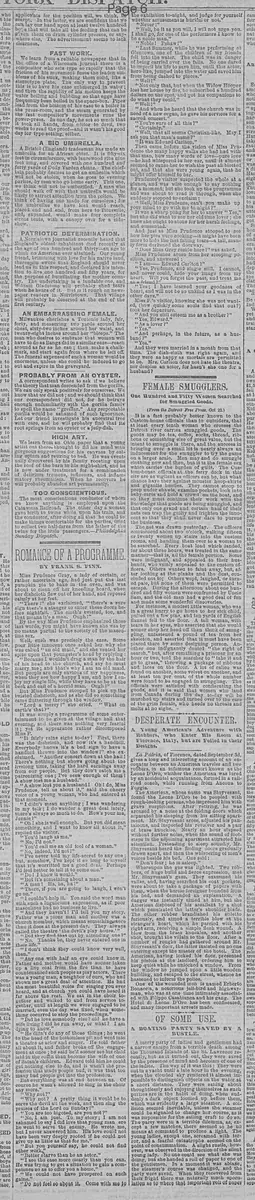
ROMANCE OF A PROGRAMME
BY FRANK S. FINN.
Miss Prudence Gray, a lady of certain, or
rather uncertain age, had just put the last
pumpkin pie to bake in the oven, and was
about to clean off her kneading board, when
her dishcloth flew out of her hand, and reposed calmly at her feet.
"There !" she exclaimed, "there's a sure
sign there's a stranger to enter these doors before nightfall. The cloth's twisted, too, and
that means it's a man. Ough!"
By the way Miss Prudence emphasized those
last words, you might have known she was by
no means partial to the society of the masculine sex.
Well, such was precisely the case. Some
poor little innocent once asked her why she
was called "an old maid," and she vented her
spite upon that youngster's head by replying:
"Because I wouldn't drag a man by the hair
of his head to the church, and say he must
marry me; and that's why I am an old maid.
But people are only envious of my happiness,
when they see how happy I am, and how I enjoy my single life, while they have to be at the beck and call of a horrid man. Ough!"
But Miss Prudence stooped to pick up the
twisted dishcloth, and as she did so something
came fluttering through the window.
"Lord a mercy !" she cried.
"What on
earth's that?"
It was simply a programme of some entertainment to be given at the village hall that
evening, and there was nothing very fearful
in it; yet its appearance rather discomposed
Miss P.
"It fairly rains signs to-day! First, there
was the dishcloth, and now it's a handbill.
Everybody knows it's a bad sign to have a
handbill thrown into the window!" she exclaimed. "Another concert down at the hall!
There's nothing but shows going about the
livelong time, taking the hard earnings away
from our people. But they don't catch me a
patronizing one; I've seen enough of them!
A show lost me a husband."
"A show lost you a husband! Oh! do, Miss
Prudence, tell us about it," said the cheery
voice of a young woman, who had entered at
that moment.
"I didn't mean anything; I was wandering
in my talk; I do wander a great deal lately,
there's always so much to do. How's your ma,
Jennie?"
"Oh! she is well enough. But you did mean
something, and I want to know all about it,"
replied the visitor.
"You'd laugh at me."
"No, I'd not."
"You'd call me an old fool of a woman."
"No, indeed, I'd not!"
"I've never told my life-secret to any one;
but, somehow, I've kept it so long to myself
that it's worrited me a good deal. Perhaps
I'd feel better to tell it to some one."
"Do! I know it would."
"But it's something about a man."
"A man! Ha, ha, ha!"
"There, if you are going to laugh, I won't
go on."
"I couldn't help it. You said the word man
with such a lugubrious expression, as if poor
masculines had no business to live."
"And they haven't! I'll tell you my story.
Father was a pious man and mother was a
church member, which meant something more
than it does at the present day. They always
called the theatre 'the devil's play house.'"
"Did they find that out by attending one?"
"No. Thanks be, they never entered one in
their life."
"I don't think they could know very well
then."
"Any one with half an eye could know it.
Father and mother would have sooner taken
up a live coal from the fire than to have
countenanced such people as play actors. There
was a young man, a neighbor of ours, who had
shown me a great deal of attention. He had
the most beautiful voice for singing you ever
heard, and at church you could have heard it
far above the rest. We sat in the choir together and walked to and from service together, until at length we were engaged to be
married, even the day was fixed, when something occurred to stop the proceedings."
"Did he love somebody else? did he have a
wife living? did he run away, or what? I am
dying to know."
"He didn't do any of those things; he went
to the head of the bottomless pit and went into
a theatre as actor and singer. He told father
all about it, and father broke off the engagement at once ; he said he'd sooner see his child
laid in the coffin than become the wife of one
of Satan's children. Edward told him he could
get nothing else to do, and it wasn't the profession that made people bad, it was that too
many bad people got into the profession.
But everything was at end between us. Of
course he wasn't allowed to sing in the choir
any more."
"Why not?"
"Why not? A pretty thing it would be to
serve the devil all the week, and then sing the
praises of the Lord on Sunday!"
"You are too bigoted, are you not?"
"No, I am just. To my story; I am not
ashamed to say I did love that young man ere
he went to serve the enemy. He wrote me,
but I never answered him. His love could not
have been very deeply rooted if he could not
give up as little as that for me,"
"But you yourself say, he could not find
other work."
"Better starve than be an actor."
"I see the case more clearly than you can.
He was trying to get a situation to gain a competence so as to offer you a home,"
"We could not have prospered on such
gains."
"Do not feel so about it," Come with me to
the exhibition to-night, and judge for yourself
whether amusement is hurtful or not."
"Never!"
"Well, be it as you will, I will not urge you.
I shall go, for one of the performers I know to
be a noble man."
"Noble! Pshaw!"
"Last Summer, while he was performing at
Glentown, one of the children of my friends
fell into the water. The child was in danger
of being carried over the falls. No one dared
to imperil his life to save him, until this actor,
hero-like, jumped into the water and saved him
from being dashed to pieces."
"Well!"
Not only that, but when the Widow Hooper
lost her house by fire, he subscribed a hundred
dollars on the spot, and got his companions to
do what they could."
"And when he heard that the church was in
need of a new organ, he gave his services for a
sacred concert.'"
"You're sure of all this?"
"Certainly."
"Well, that all seems Christian-like. May I
ask you that man's name?"
"It was Edward Carlton."
Then came before the vision of Miss Prudence the many happy walks she had had with
that man, how many words of love —pure love
—he had whispered in her ear, until it almost
seemed to cause her to wish the past all blotted out, and that she were young again, that he
might offer himself to her.
Prudence's visitor suspected the whole at a
glance, and was wise enough to say nothing
for a moment; but she took up the programme
and was about to read it through, when she
suddenly stopped to exclaim:
"Well, Miss Prudence, can't you make up
your mind to go with me to-night?"
It was a sharp pang for her to answer "Yes,"
but she did want to see her old time lover; she
knew she ought to atone for her harsh feelings,
and consented.
And just as Miss Prudence stooped to see
how her pies were cooking—it might have been
more to hide the fast falling tears—a tall, manly form darkened the doorway.
"Does Miss Grey reside here ?" was asked.
Miss Prudence arose from her stooping position, and answered:
"I am."
"Edward Carlton?"
"Yes, Prudence, and single still. I cannot,
and never could, hide your image from my
heart. Will you forget the past, and treat me
as a friend?"
"Yes; I have learned your goodness of
heart, and will not be so unkind as I was in the
other days."
Miss P.'s visitor, knowing she was not wanted, (how quickly some souls find that out?)
took her departure.
"And you still esteem me as a brother?"
"Yes, Edward."
"As a lover?"
"Yes."
"And
perhaps, in the future, as a husband?"
"Yes."
And they were married in a month from that
time. The dish-cloth was right again, and
they were as happy as mortals are permitted
to be. Mrs. Carlton does not hate the theatre,
nor despise an actor, for hasn't she one for a
husband?
BY FRANK S. FINN.
Miss Prudence Gray, a lady of certain, or
rather uncertain age, had just put the last
pumpkin pie to bake in the oven, and was
about to clean off her kneading board, when
her dishcloth flew out of her hand, and reposed calmly at her feet.
"There !" she exclaimed, "there's a sure
sign there's a stranger to enter these doors before nightfall. The cloth's twisted, too, and
that means it's a man. Ough!"
By the way Miss Prudence emphasized those
last words, you might have known she was by
no means partial to the society of the masculine sex.
Well, such was precisely the case. Some
poor little innocent once asked her why she
was called "an old maid," and she vented her
spite upon that youngster's head by replying:
"Because I wouldn't drag a man by the hair
of his head to the church, and say he must
marry me; and that's why I am an old maid.
But people are only envious of my happiness,
when they see how happy I am, and how I enjoy my single life, while they have to be at the beck and call of a horrid man. Ough!"
But Miss Prudence stooped to pick up the
twisted dishcloth, and as she did so something
came fluttering through the window.
"Lord a mercy !" she cried.
"What on
earth's that?"
It was simply a programme of some entertainment to be given at the village hall that
evening, and there was nothing very fearful
in it; yet its appearance rather discomposed
Miss P.
"It fairly rains signs to-day! First, there
was the dishcloth, and now it's a handbill.
Everybody knows it's a bad sign to have a
handbill thrown into the window!" she exclaimed. "Another concert down at the hall!
There's nothing but shows going about the
livelong time, taking the hard earnings away
from our people. But they don't catch me a
patronizing one; I've seen enough of them!
A show lost me a husband."
"A show lost you a husband! Oh! do, Miss
Prudence, tell us about it," said the cheery
voice of a young woman, who had entered at
that moment.
"I didn't mean anything; I was wandering
in my talk; I do wander a great deal lately,
there's always so much to do. How's your ma,
Jennie?"
"Oh! she is well enough. But you did mean
something, and I want to know all about it,"
replied the visitor.
"You'd laugh at me."
"No, I'd not."
"You'd call me an old fool of a woman."
"No, indeed, I'd not!"
"I've never told my life-secret to any one;
but, somehow, I've kept it so long to myself
that it's worrited me a good deal. Perhaps
I'd feel better to tell it to some one."
"Do! I know it would."
"But it's something about a man."
"A man! Ha, ha, ha!"
"There, if you are going to laugh, I won't
go on."
"I couldn't help it. You said the word man
with such a lugubrious expression, as if poor
masculines had no business to live."
"And they haven't! I'll tell you my story.
Father was a pious man and mother was a
church member, which meant something more
than it does at the present day. They always
called the theatre 'the devil's play house.'"
"Did they find that out by attending one?"
"No. Thanks be, they never entered one in
their life."
"I don't think they could know very well
then."
"Any one with half an eye could know it.
Father and mother would have sooner taken
up a live coal from the fire than to have
countenanced such people as play actors. There
was a young man, a neighbor of ours, who had
shown me a great deal of attention. He had
the most beautiful voice for singing you ever
heard, and at church you could have heard it
far above the rest. We sat in the choir together and walked to and from service together, until at length we were engaged to be
married, even the day was fixed, when something occurred to stop the proceedings."
"Did he love somebody else? did he have a
wife living? did he run away, or what? I am
dying to know."
"He didn't do any of those things; he went
to the head of the bottomless pit and went into
a theatre as actor and singer. He told father
all about it, and father broke off the engagement at once ; he said he'd sooner see his child
laid in the coffin than become the wife of one
of Satan's children. Edward told him he could
get nothing else to do, and it wasn't the profession that made people bad, it was that too
many bad people got into the profession.
But everything was at end between us. Of
course he wasn't allowed to sing in the choir
any more."
"Why not?"
"Why not? A pretty thing it would be to
serve the devil all the week, and then sing the
praises of the Lord on Sunday!"
"You are too bigoted, are you not?"
"No, I am just. To my story; I am not
ashamed to say I did love that young man ere
he went to serve the enemy. He wrote me,
but I never answered him. His love could not
have been very deeply rooted if he could not
give up as little as that for me,"
"But you yourself say, he could not find
other work."
"Better starve than be an actor."
"I see the case more clearly than you can.
He was trying to get a situation to gain a competence so as to offer you a home,"
"We could not have prospered on such
gains."
"Do not feel so about it," Come with me to
the exhibition to-night, and judge for yourself
whether amusement is hurtful or not."
"Never!"
"Well, be it as you will, I will not urge you.
I shall go, for one of the performers I know to
be a noble man."
"Noble! Pshaw!"
"Last Summer, while he was performing at
Glentown, one of the children of my friends
fell into the water. The child was in danger
of being carried over the falls. No one dared
to imperil his life to save him, until this actor,
hero-like, jumped into the water and saved him
from being dashed to pieces."
"Well!"
Not only that, but when the Widow Hooper
lost her house by fire, he subscribed a hundred
dollars on the spot, and got his companions to
do what they could."
"And when he heard that the church was in
need of a new organ, he gave his services for a
sacred concert.'"
"You're sure of all this?"
"Certainly."
"Well, that all seems Christian-like. May I
ask you that man's name?"
"It was Edward Carlton."
Then came before the vision of Miss Prudence the many happy walks she had had with
that man, how many words of love —pure love
—he had whispered in her ear, until it almost
seemed to cause her to wish the past all blotted out, and that she were young again, that he
might offer himself to her.
Prudence's visitor suspected the whole at a
glance, and was wise enough to say nothing
for a moment; but she took up the programme
and was about to read it through, when she
suddenly stopped to exclaim:
"Well, Miss Prudence, can't you make up
your mind to go with me to-night?"
It was a sharp pang for her to answer "Yes,"
but she did want to see her old time lover; she
knew she ought to atone for her harsh feelings,
and consented.
And just as Miss Prudence stooped to see
how her pies were cooking—it might have been
more to hide the fast falling tears—a tall, manly form darkened the doorway.
"Does Miss Grey reside here ?" was asked.
Miss Prudence arose from her stooping position, and answered:
"I am."
"Edward Carlton?"
"Yes, Prudence, and single still. I cannot,
and never could, hide your image from my
heart. Will you forget the past, and treat me
as a friend?"
"Yes; I have learned your goodness of
heart, and will not be so unkind as I was in the
other days."
Miss P.'s visitor, knowing she was not wanted, (how quickly some souls find that out?)
took her departure.
"And you still esteem me as a brother?"
"Yes, Edward."
"As a lover?"
"Yes."
"And
perhaps, in the future, as a husband?"
"Yes."
And they were married in a month from that
time. The dish-cloth was right again, and
they were as happy as mortals are permitted
to be. Mrs. Carlton does not hate the theatre,
nor despise an actor, for hasn't she one for a
husband?
What sub-type of article is it?
Prose Fiction
Dialogue
What themes does it cover?
Love Romance
Moral Virtue
Social Manners
What keywords are associated?
Old Maid
Theater Prejudice
Actor Lover
Reconciliation
Moral Tale
Village Romance
Dishcloth Omen
What entities or persons were involved?
By Frank S. Finn.
Literary Details
Title
Romance Of A Programme
Author
By Frank S. Finn.
Key Lines
"A Show Lost Me A Husband."
"Better Starve Than Be An Actor."
"It Was Edward Carlton."
"Yes; I Have Learned Your Goodness Of Heart, And Will Not Be So Unkind As I Was In The Other Days."
Mrs. Carlton Does Not Hate The Theatre, Nor Despise An Actor, For Hasn't She One For A Husband?