Thank you for visiting SNEWPapers!
Sign up free
Atlanta Daily World
Atlanta, Fulton County, Georgia
What is this article about?
Anthony Miles Overton, an American Black agricultural specialist from North Carolina, graduated from A&T College in 1929 and now supervises a Soviet state cattle farm near Poland. He describes improved living conditions and racial equality in the USSR compared to discriminatory experiences in America.
Merged-components note: Title and body merged on page 1, then continued on page 6.
Clippings
1 of 2
OCR Quality
Full Text
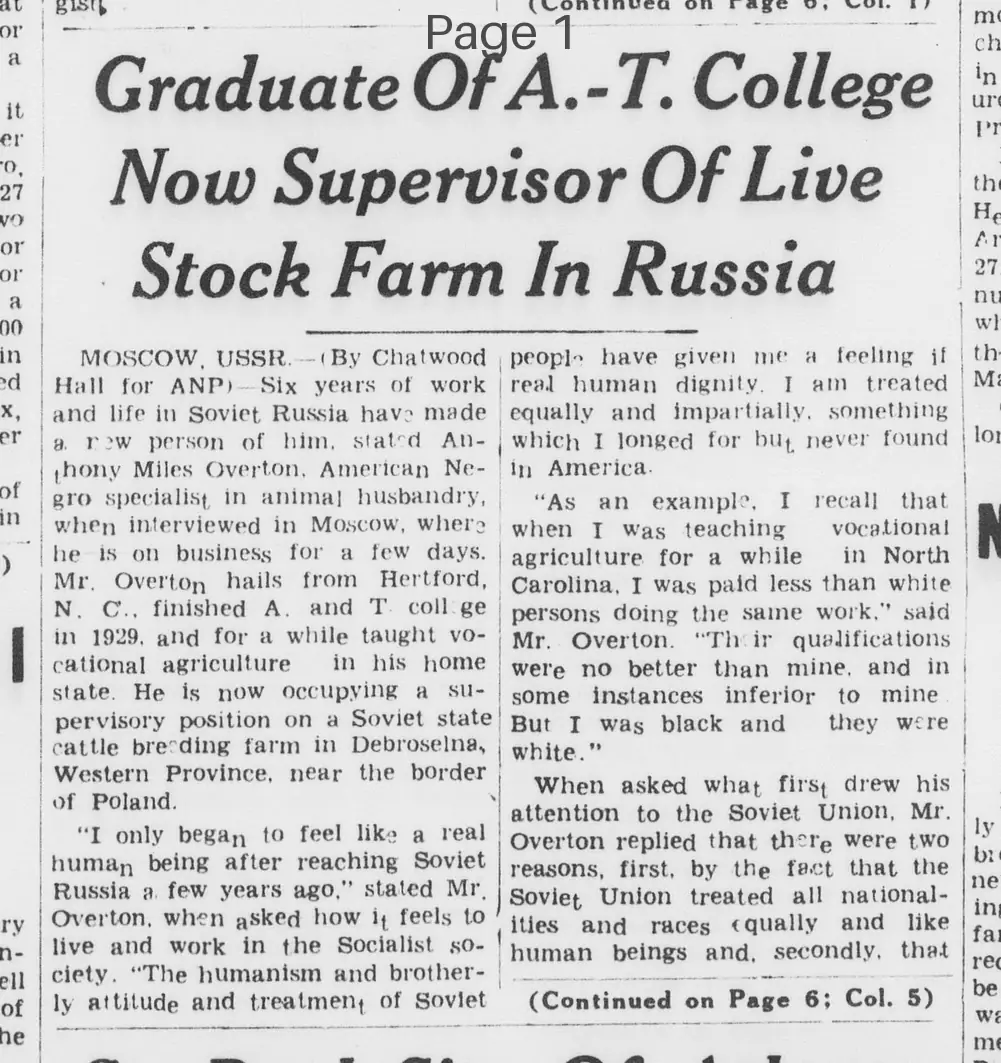
MOSCOW. USSR.-(By Chatwood Hall for ANP)Six years of work and life in Soviet Russia have made a new person of him. stated Anthony Miles Overton, American Negro specialist in animal husbandry, when interviewed in Moscow. where he is on business for a few days.
Mr. Overton hails from Hertford, N. C.. finished A. and T. college in 1929. and for a while taught vocational agriculture in his home state. He is now occupying a supervisory position on a Soviet state cattle breeding farm in Debroselna, Western Province. near the border of Poland
"I only began to feel like a real human being after reaching Soviet Russia a few years ago." stated Mr. Overton. when asked how it feels to live and work in the Socialist society. "The humanism and brotherly attitude and treatment. of Soviet
people have given me a feeling of real human dignity. I am treated equally and impartially, something which I longed for but, never found in America.
"As an example. I recall that when I was teaching vocational agriculture for a while in North Carolina. I was paid less than white persons doing the same work," said Mr. Overton. "Their qualifications were no better than mine. and in some instances inferior to mine But I was black and they were white."
When asked what first drew his attention to the Soviet Union, Mr. Overton replied that there were two reasons, first. by the fact that the Soviet. Union treated all nationalities and races equally and like human beings and. secondly, that
(Continued on Page 6: Col. 5)
Graduate of A&T
(Continued from Page 1)
he early developed a deep interest in observing the superiority of the Socialist collectivization of agriculture over the planlessness and chaos of capitalist agriculture.
His first experience with Soviet collective agriculture was in Soviet Central Asia, where he spent his first years here testing and experimenting with mechanized agricultural machinery in this great cotton base of Soviet Russia. Since finishing his assigned work in Soviet Central Asia, Mr. Overton has had wide experience in other districts in Soviet collective farming, and has served as assistant director of a huge state dairy farm near Leningrad.
Concerning his own living conditions, Mr. Overton remarked: "My general material conditions are far superior to what they were in America. I have a three-room apartment for my personal use. My monthly salary is equal to that of any agricultural specialist in America. Besides my money wages, I receive an additional Socialist wage in the form of free medical services, minimum rent, light and heat costs, and other social wages which workers in capitalist countries know nothing about. An additional compensation which cannot be measured in dollars and cents is that, I am free and equal socially."
What sub-type of article is it?
What themes does it cover?
What keywords are associated?
What entities or persons were involved?
Where did it happen?
Story Details
Key Persons
Location
Moscow, Ussr; Debroselna, Western Province; Soviet Central Asia; Near Leningrad
Event Date
1929
Story Details
Anthony Miles Overton, after graduating from A&T College in 1929 and facing racial discrimination in North Carolina, moved to Soviet Russia where he works in agriculture, experiencing equality, better pay, and social benefits.