Thank you for visiting SNEWPapers!
Sign up free
The Religious Herald
Hartford, Hartford County, Connecticut
What is this article about?
Article from April 1855 appeals for funds to establish a Christian mission in the Marquesan Islands, based on Robert Mills' experiences reforming the islanders after being shipwrecked there 16 years prior. Mills seeks missionaries after failed attempts elsewhere; American Missionary Association supports but needs $2000.
Clipping
OCR Quality
Full Text
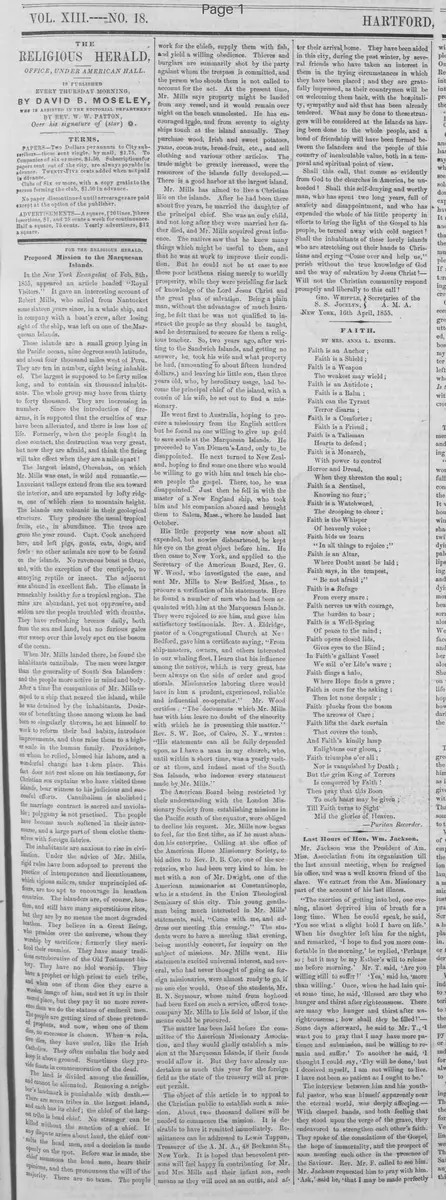
Proposed Mission to the Marquesan Islands.
In the New York Evangelist of Feb. 8th, 1855, appeared an article headed "Royal Visitors." It gave an interesting account of Robert Mills, who sailed from Nantucket some sixteen years since, in a whale ship, and in company with a boat's crew, after losing sight of the ship, was left on one of the Marquesan Islands.
These islands are a small group lying in the Pacific ocean, nine degrees south latitude, and about four thousand miles west of Peru. They are ten in number, eight being inhabited. The largest is supposed to be forty miles long, and to contain six thousand inhabitants. The whole group may have from thirty to forty thousand. They are increasing in number. Since the introduction of fire-arms, it is supposed that the cruelties of war have been alleviated, and there is less loss of life. Formerly, when the people fought in close contact, the destruction was very great, but now they are afraid, and think the firing will take effect when they are a mile apart!
The largest island, Ohevahoa, on which Mr. Mills was cast, is wild and romantic. Luxuriant valleys extend from the sea toward the interior, and are separated by lofty ridges, one of which rises to mountain height. The islands are volcanic in their geological structure. They produce the usual tropical fruits, etc., in abundance. The trees are green the year round. Capt. Cook anchored here, and left pigs, goats, cats, dogs, and fowls: no other animals are now to be found on the islands. No ravenous beast is there, and, with the exception of the centipede, no annoying reptile or insect. The adjacent seas abound in excellent fish. The climate is remarkably healthy for a tropical region. The rains are abundant, yet not oppressive, and seldom are the people troubled with drouths. They have refreshing breezes daily, both from the sea and land, but no furious gales ever sweep over this lovely spot on the bosom of the ocean.
When Mr. Mills landed there, he found the inhabitants cannibals. The men were larger than the generality of South Sea Islanders: and the people more active in mind and body. After a time the companions of Mr. Mills escaped to a ship that neared the island, while he was detained by the inhabitants. Desirous of benefitting those among whom he had been so singularly thrown, he set himself to work to reform their bad habits, introduce improvements, and thus raise them to a higher scale in the human family. Providence, on whom he relied, blessed his labors, and a wonderful change has taken place. This fact does not rest alone on his testimony, for Christian sea captains who have visited these islands, bear witness to his judicious and successful efforts. Cannibalism is abolished; the marriage contract is sacred and inviolable; polygamy is not practised. The people have become much softened in their intercourse, and a large part of them clothe themselves with foreign fabrics.
The inhabitants are anxious to rise in civilization. Under the advice of Mr. Mills, rigid rules have been adopted to prevent the practice of intemperance and licentiousness, which vicious sailors, under unprincipled officers, are too apt to encourage in heathen countries. The islanders are, of course, heathen, and still have many superstitious rites, but they are by no means the most degraded heathen. They believe in a Great Being, who presides over the universe, whom they worship by sacrifices; formerly they sacrificed their enemies. They have many traditions corroborative of the Old Testament history. They have no idol worship. They have a prophet or high priest to each tribe, and when one of them dies they carve a wooden image of him, and set it up in their sacred place, but they pay it no more reverence than we do the statues of eminent men.
The people are getting tired of these pretended prophets, and now, when one of them dies, no successor is chosen. When a relative dies, they have wakes, like the Irish Catholics. They often embalm the body and keep it above ground. Sometimes they provide feasts in commemoration of the dead. The land is divided among the families, and cannot be alienated. Removing a neighbor's landmark is punishable with death.
There are seven tribes in the largest island, and each has its chief; the chief of the largest tribe is head chief. No stranger can be killed without the sanction of a chief. If any dispute arises about land, the chief consults the head men, and a decision is made openly on the spot.
Before war is made, the chief summons the head men, hears their opinions, and then pronounces the will of the majority. There are no taxes. The people work for the chiefs, supply them with fish, and yield a willing obedience. Thieves and burglars are summarily shot by the party against whom the trespass is committed, and the person who shoots them is not called to account for the act. At the present time, Mr. Mills says property might be landed from any vessel, and it would remain over night on the beach unmolested. He has encouraged trade, and from seventy to eighty ships touch at the island annually. They purchase wood, Irish and sweet potatoes, yams, cocoa-nuts, bread-fruit, etc., and sell clothing and various other articles. The trade might be greatly increased, were the resources of the islands fully developed.
There is a good harbor at the largest island. Mr. Mills has aimed to live a Christian life on the islands. After he had been there about five years, he married the daughter of the principal chief. She was an only child, and not long after they were married her father died, and Mr. Mills acquired great influence. The natives saw that he knew many things which might be useful to them, and that he was at work to improve their condition. But he could not be at ease to see these poor heathens rising merely to worldly prosperity, while they were perishing for lack of knowledge of the Lord Jesus Christ and the great plan of salvation. Being a plain man, without the advantages of much learning, he felt that he was not qualified to instruct the people as they should be taught, and he determined to secure for them a religious teacher. So, two years ago, after writing to the Sandwich Islands, and getting no answer, he took his wife and what property he had, (amounting to about fifteen hundred dollars,) and leaving his little son, then three years old, who, by hereditary usage, had become the principal chief of the island, with a cousin of his wife, he set out to find a missionary.
He went first to Australia, hoping to procure a missionary from the English settlers but he found no one willing to give up gold to save souls at the Marquesan Islands. He proceeded to Van Diemen's-Land, only to be disappointed. He next turned to New Zealand, hoping to find some one there who would be willing to go with him and teach his chosen people the gospel. There, too, he was disappointed. Just then he fell in with the master of a New England ship, who took him and his companion aboard and brought them to Salem, Mass., where he landed last October.
His little property was now about all expended, but nowise disheartened, he kept his eye on the great object before him. He then came to New York, and applied to the Secretary of the American Board, Rev. G. W. Wood, who investigated the case, and sent Mr. Mills to New Bedford, Mass., to procure a verification of his statements. Here he found a number of men who had been acquainted with him at the Marquesan Islands. They were rejoiced to see him, and gave him satisfactory testimonials. Rev. A. Eldridge, pastor of a Congregational Church at New Bedford, gave him a certificate saying, "From ship-masters, owners, and others interested in our whaling fleet, I learn that his influence among the natives, which is very great, has been always on the side of order and good morals. Missionaries laboring there would have in him a prudent, experienced, reliable and influential co-operator." Mr. Wood certifies: "The documents which Mr. Mills has with him leave no doubt of the sincerity with which he is presenting this matter." Rev. S. W. Roe, of Cairo, N. Y., writes: "His statements can all be fully depended upon, as I have a man in my church, who, until within a short time, was a yearly visitor at these, and indeed most of the South Sea Islands, who indorses every statement made by Mr. Mills."
The American Board being restricted by their understanding with the London Missionary Society from establishing missions in the Pacific south of the equator, were obliged to decline his request. Mr. Mills now began to feel, for the first time, as if he must abandon his enterprise. Calling at the office of the American Home Missionary Society, to bid adieu to Rev. D. B. Coe, one of the secretaries, who had been very kind to him, he met with a son of Mr. Dwight, one of the American missionaries at Constantinople, who is a student in the Union Theological Seminary of this city. This young gentleman being much interested in Mr. Mills' statements, said, "Come with me, and address our meeting this evening." The students were to have a meeting that evening, being monthly concert, for inquiry on the subject of missions. Mr. Mills went. His statements excited universal interest, and several, who had never thought of going as foreign missionaries, were almost ready to go, if no one else would. One of the students, Mr. B. N. Seymour, whose mind from boyhood had been fixed on such a service, offered to accompany Mr. Mills to his field of labor, if the means could be procured.
The matter has been laid before the committee of the American Missionary Association, and they would gladly establish a mission at the Marquesan Islands, if their funds would allow it. But they have already undertaken as much this year for the foreign field as the state of the treasury will at present permit.
The object of this article is to appeal to the Christian public to establish such a mission. About two thousand dollars will be needed to commence the mission. It is desirable to have it remitted immediately. Remittances can be addressed to Lewis Tappan, Treasurer of the A. M. A., 48 Beekman St., New York. It is hoped that benevolent persons will feel happy in contributing for Mr. and Mrs. Mills and their infant son, such means as they will need as an outfit, and after their arrival home. They have been aided in this city, during the past winter, by several friends who have taken an interest in them in the trying circumstances in which they have been placed; and they are gratefully impressed, as their countrymen will be on welcoming them back, with the hospitality, sympathy and aid that has been already tendered. What may be done to these strangers will be considered at the Islands as having been done to the whole people, and a bond of friendship will have been formed between the Islanders and the people of this country of incalculable value, both in a temporal and spiritual point of view.
Shall this call, that comes so evidently from God to the churches in America, be unheeded? Shall this self-denying and worthy man, who has spent two long years, full of anxiety and disappointment, and who has expended the whole of his little property in efforts to bring the light of the Gospel to his people, be turned away with cold neglect? Shall the inhabitants of these lovely islands who are stretching out their hands to Christians and crying "Come over and help us," perish without the true knowledge of God and the way of salvation by Jesus Christ?
Will not the Christian community respond promptly and liberally to this call?
Geo. Whipple,
S. S. Jocelyn.
Secretaries of the A. M. A.
New York, 16th April, 1855.
What sub-type of article is it?
What keywords are associated?
What entities or persons were involved?
Where did it happen?
Foreign News Details
Primary Location
Marquesan Islands
Event Date
16th April, 1855
Key Persons
Outcome
call for $2000 to fund mission; abolition of cannibalism and polygamy on islands; increased trade and civilization under mills' influence.
Event Details
Robert Mills, shipwrecked on Marquesan Islands 16 years ago, reformed local customs, abolished cannibalism, and married chief's daughter. Now seeks missionaries for the heathens; after failed searches in Australia, New Zealand, etc., appeals in New York to American Missionary Association for support.