Thank you for visiting SNEWPapers!
Sign up free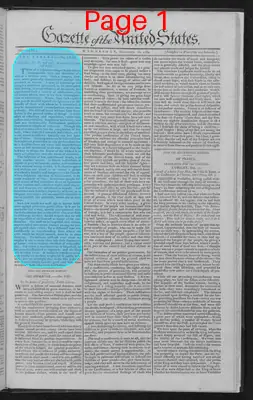
Editorial
December 16, 1789
Gazette Of The United States
New York, New York County, New York
What is this article about?
An editorial discussing the nature of suspicion, distinguishing circumspect caution from baseless jealousy, particularly criticizing low-minded suspicions against public officials that undermine trust and responsibility.
Clipping
OCR Quality
98%
Excellent
Full Text
[No. LXXI.]
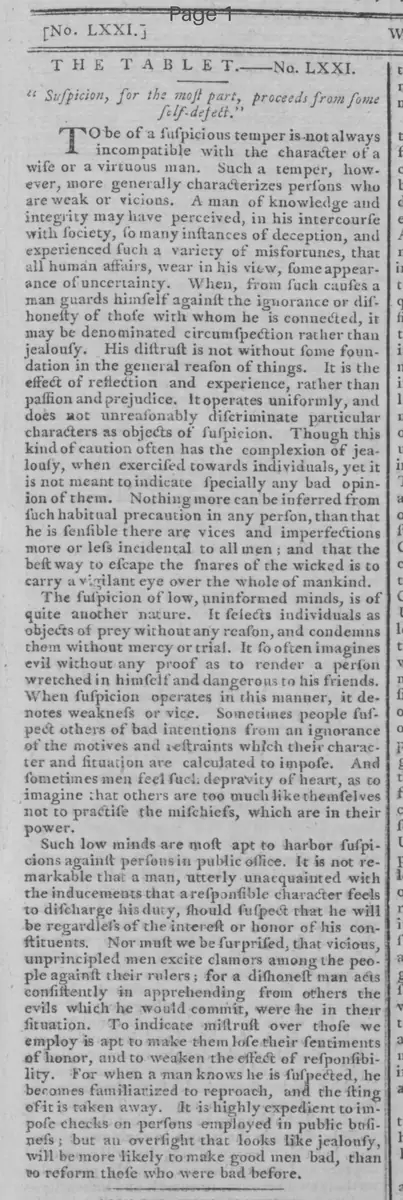
THE TABLET.-No. LXXI.
"Suspicion, for the most part, proceeds from some self-defect."
To be of a suspicious temper is not always incompatible with the character of a wise or a virtuous man. Such a temper, however, more generally characterizes persons who are weak or vicious. A man of knowledge and integrity may have perceived, in his intercourse with society, so many instances of deception, and experienced such a variety of misfortunes, that all human affairs, wear in his view, some appearance of uncertainty. When, from such causes a man guards himself against the ignorance or dishonesty of those with whom he is connected, it may be denominated circumspection rather than jealousy. His distrust is not without some foundation in the general reason of things. It is the effect of reflection and experience, rather than passion and prejudice. It operates uniformly, and does not unreasonably discriminate particular characters as objects of suspicion. Though this kind of caution often has the complexion of jealousy, when exercised towards individuals, yet it is not meant to indicate especially any bad opinion of them. Nothing more can be inferred from such habitual precaution in any person, than that he is sensible there are vices and imperfections more or less incidental to all men; and that the best way to escape the snares of the wicked is to carry a vigilant eye over the whole of mankind.
The suspicion of low, uninformed minds, is of quite another nature. It selects individuals as objects of prey without any reason, and condemns them without mercy or trial. It so often imagines evil without any proof as to render a person wretched in himself and dangerous to his friends. When suspicion operates in this manner, it denotes weakness or vice. Sometimes people suspect others of bad intentions from an ignorance of the motives and restraints which their character and situation are calculated to impose. And sometimes men feel such depravity of heart, as to imagine that others are too much like themselves not to practice the mischiefs, which are in their power.
Such low minds are most apt to harbor suspicions against persons in public office. It is not remarkable that a man, utterly unacquainted with the inducements that are responsible character feels to discharge his duty, should suspect that he will be regardless of the interest or honor of his constituents. Nor must we be surprised, that vicious, unprincipled men excite clamors among the people against their rulers; for a dishonest man acts consistently in apprehending from others the evils which he would commit, were he in their situation. To indicate mistrust over those we employ is apt to make them lose their sentiments of honor, and to weaken the effect of responsibility. For when a man knows he is suspected, he becomes familiarized to reproach, and the sting of it is taken away. It is highly expedient to impose checks on persons employed in public business; but an oversight that looks like jealousy, will be more likely to make good men bad, than to reform those who were bad before.
THE TABLET.-No. LXXI.
"Suspicion, for the most part, proceeds from some self-defect."
To be of a suspicious temper is not always incompatible with the character of a wise or a virtuous man. Such a temper, however, more generally characterizes persons who are weak or vicious. A man of knowledge and integrity may have perceived, in his intercourse with society, so many instances of deception, and experienced such a variety of misfortunes, that all human affairs, wear in his view, some appearance of uncertainty. When, from such causes a man guards himself against the ignorance or dishonesty of those with whom he is connected, it may be denominated circumspection rather than jealousy. His distrust is not without some foundation in the general reason of things. It is the effect of reflection and experience, rather than passion and prejudice. It operates uniformly, and does not unreasonably discriminate particular characters as objects of suspicion. Though this kind of caution often has the complexion of jealousy, when exercised towards individuals, yet it is not meant to indicate especially any bad opinion of them. Nothing more can be inferred from such habitual precaution in any person, than that he is sensible there are vices and imperfections more or less incidental to all men; and that the best way to escape the snares of the wicked is to carry a vigilant eye over the whole of mankind.
The suspicion of low, uninformed minds, is of quite another nature. It selects individuals as objects of prey without any reason, and condemns them without mercy or trial. It so often imagines evil without any proof as to render a person wretched in himself and dangerous to his friends. When suspicion operates in this manner, it denotes weakness or vice. Sometimes people suspect others of bad intentions from an ignorance of the motives and restraints which their character and situation are calculated to impose. And sometimes men feel such depravity of heart, as to imagine that others are too much like themselves not to practice the mischiefs, which are in their power.
Such low minds are most apt to harbor suspicions against persons in public office. It is not remarkable that a man, utterly unacquainted with the inducements that are responsible character feels to discharge his duty, should suspect that he will be regardless of the interest or honor of his constituents. Nor must we be surprised, that vicious, unprincipled men excite clamors among the people against their rulers; for a dishonest man acts consistently in apprehending from others the evils which he would commit, were he in their situation. To indicate mistrust over those we employ is apt to make them lose their sentiments of honor, and to weaken the effect of responsibility. For when a man knows he is suspected, he becomes familiarized to reproach, and the sting of it is taken away. It is highly expedient to impose checks on persons employed in public business; but an oversight that looks like jealousy, will be more likely to make good men bad, than to reform those who were bad before.
What sub-type of article is it?
Moral Or Religious
What keywords are associated?
Suspicion
Circumspection
Jealousy
Public Office
Mistrust
Virtue
Vice
Responsibility
What entities or persons were involved?
Persons In Public Office
Rulers
Editorial Details
Primary Topic
The Nature And Dangers Of Suspicion, Especially Toward Public Officials
Stance / Tone
Cautionary Against Baseless Suspicion And Advocacy For Circumspect Caution
Key Figures
Persons In Public Office
Rulers
Key Arguments
Suspicion Often Stems From Self Defect And Characterizes Weak Or Vicious Persons.
Circumspection Based On Experience Is Reasonable, Unlike Baseless Jealousy.
Low Minds Suspect Without Reason, Leading To Personal Wretchedness And Harm To Others.
Ignorance Or Personal Depravity Fuels Unfounded Suspicions Of Others' Intentions.
Suspicions Against Public Officials Arise From Unacquainted Low Minds Or Vicious Agitators.
Mistrust Undermines Honor And Responsibility In Officials.
Jealous Oversight May Corrupt Good Men Rather Than Reform The Bad.