Thank you for visiting SNEWPapers!
Sign up free
Editorial
June 7, 1805
The Enquirer
Richmond, Henrico County, Virginia
What is this article about?
The Aurora editorial defends Thomas Jefferson's acceptance of a second presidential term to refute federalist calumnies, asserts his original intent to serve only one term for rotation in office, denies cabinet dissensions, and urges republicans to resist federalist efforts to sow party disunion. It praises Jefferson's virtuous administration as a model for republican governance.
Clipping
OCR Quality
98%
Excellent
Full Text
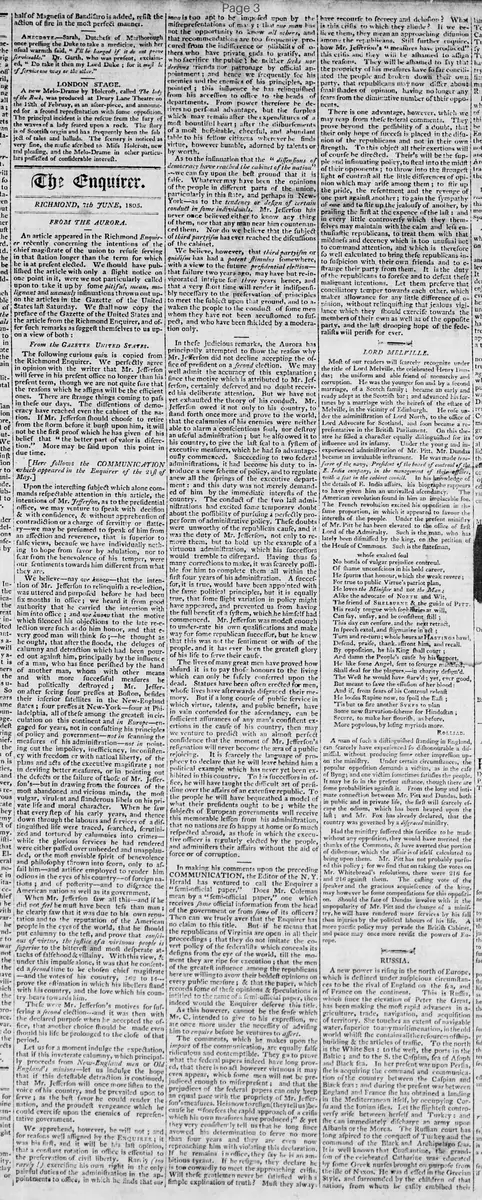
FROM THE AURORA.
An article appeared in the Richmond Enquirer recently concerning the intentions of the chief magistrate of the union to refuse serving in that station longer than the term for which he is at present elected. We should have published the article with only a slight notice on one point in it, were we not particularly called upon to take it up by some pitiful, mean, malignant and unmanly insinuations thrown out upon the articles in the Gazette of the United States last Saturday. We shall now copy the preface of the Gazette of the United States and the article from the Richmond Enquirer, and offer such remarks as suggest themselves to us upon a view of both:
From the GAZETTE UNITED STATES.
The following curious quiz is copied from the Richmond Enquirer. We perfectly agree in opinion with the writer that Mr. Jefferson will serve in his present office no longer than his present term, though we are not quite sure that the reasons which he assigns will be the efficient ones. There are strange things coming to pass in these our days. The dissensions of democracy have reached even the cabinet of the nation. If Mr. Jefferson should choose to retire from the storm before it burst upon him, it will not be the first proof which he has given of his belief that "the better part of valor is discretion." More may be said upon this point in due time.
Here follows the COMMUNICATION which appeared in the Enquirer of the 21st of May.]
Upon the interesting subject which alone commands respectable attention in this article, the intentions of Mr. Jefferson, as to the presidential office, we may venture to speak with decision & with confidence, & without apprehension of contradiction or a charge of servility or flattery--we may be presumed to speak of him from an affection and reverence, that is superior to false views, because we have individually nothing to hope from favor by adulation, nor to fear from the benevolence of his temper, were our sentiments towards him different from what they are.
We believe--nay we know--that the intention of Mr. Jefferson to relinquish a re-election, was uttered and purposed before he had been six months in office; we heard it from good authority that he carried the intention with him into office; and we know that the motive which silenced his objections to the late re-election were such as do him honor, and that every good man will think so;--he thought as he ought, that after the floods, the deluges of calumny and detraction which had been poured out against him, principally by the influence of a man, who has since perished by the hand of another man, whom with other means and with more successful measures he had politically destroyed; Mr. Jefferson after seeing four presses at Boston, besides their inferior satellites in the New-England states; four presses at New-York--four at Philadelphia, all of these among the greatest in circulation on this continent and in Europe--engaged for years, not in consulting his principles of policy and government--not in scanning the measures of his administration--not in pointing out the impolicy, inefficiency, inconsistency with freedom or with national liberty, of the plans and acts of the executive magistrate; not in devising better measures, or in pointing out the defects or the failure of those of Mr. Jefferson's--but in drawing from the sources of the most abandoned and vicious minds, the most vulgar, virulent and slanderous libels on his private life and moral character. When he saw that every step of his early years, and thence down through the labours and services of a distinguished life were traced, searched, scrutinized and tortured by calumnies into crimes--while the glorious services he had rendered were either passed over unheeded and unapplauded, or the most enviable spirit of benevolence and philosophy thrown into scorn, only to assail him--and artifice employed to render him odious in the eyes of his country--of foreign nations; and of posterity--and to disgrace the American nation as well as its government.
When Mr. Jefferson saw all this--and if he did not feel he must have been less than man; he clearly saw that it was due to his own reputation and to the reputation of the American people in the eyes of the world, that he should put calumny to the test, and prove that conscious of virtue, the justice of a virtuous people is superior to the bitterest and most desperate attacks of falsehood & villainy. With this view, & under this impulse alone, it was that he consented a second time to be chosen chief magistrate --and the votes of his country, 162 to 14--- prove the estimation in which his libellers stand with his country, and the love which his country bears towards him.
These were Mr. Jefferson's motives for suffering a second election.--and it was then with the declared purpose when he accepted the office, that another choice should be made even should his life be prolonged to the close of that period.
Let us for a moment indulge the expectation, that if this inveterate calumny, which principally proceeds from New-England men or Old England's minions--let us indulge the hope that if this detestable detraction is continued, that Mr. Jefferson will once more listen to the voice of his country, and be prevailed upon to serve; as the best favor he could render the nation, and the proudest vengeance which he could exercise upon the enemies of representative government.
We apprehend, however, he will not: and for reasons well assigned by the Enquirer; it was his first, and it will be his last opinion, that a constant rotation in office is essential to the preservation of civil liberty. Rarely (too rarely!) exercising his own right in the only painful duties of the administration in the appointments to office, in which he finds that one man is too apt to be imposed upon by the misrepresentations of many: that one man has not the opportunity to know all others, and that recommendations are too frequently procured from the indifference or pliability of others who have private ends to gratify, and who sacrifice the public; he neither seeks nor derives friends nor patronage by official appointment; and hence we frequently see his enemies and the enemies of his principles, appointed: this influence he has relinquished from his accession to office to the heads of departments. From power therefore he derives no personal advantage, but the surplus which may remain after the expenditures of a most bountiful heart: after the disbursements of a most hospitable, cheerful, and abundant table to his fellow citizens wherever he finds virtue, however humble, adorned by talents or by worth.
As to the insinuation that the "dissensions of democracy have reached the cabinet of the nation" --we can say upon the best ground that it is false. Whatever may have been the opinions of the people in different parts of the union, particularly in this state, and perhaps in New-York as to the tendency or design of certain conduct in some individuals. Mr. Jefferson has never once believed either to know any thing of them, nor that any man near him countenanced them. Nor do we believe that the subject of third partyism has ever reached the discussions of the cabinet.
We believe, however, that third partyism or quiddism has had a potent stimulus somewhere, with a view to the future presidential election— that failure two years ago, may have but re-invigorated intrigue for three years hence, and that a very short time will render it indispensably necessary to the preservation of principles to meet the subject upon that ground, and to awaken the people to the conduct of some men whom they have not been accustomed to suspect, and who have been shielded by a moderation only.
In these judicious remarks, the Aurora has principally attempted to show the reason why Mr. Jefferson did not decline accepting the office of president on a second election. We may well admit the accuracy of this explanation; since the motive which is attributed to Mr. Jefferson, certainly deserved and no doubt received his deliberate attention. But we have not yet exhausted the theory of his conduct. Mr. Jefferson owed it not only to his country, to stand forth once more and prove to the world, that the calumnies of his enemies were neither able to alarm a conscientious soul, nor destroy an useful administration; but he also owed it to his country, to give the last seal to a system of executive measures, which he had so advantageously commenced. Succeeding to two federal administrations, it had become his duty to introduce a new scheme of policy, and to regulate anew all the springs of the executive department: and this duty was not merely demanded of him by the immediate interests of the country. The conduct of the two last administrations had excited some temporary doubt about the possibility of pursuing a perfectly proper form of administrative policy. These doubts were unworthy of the republican cause, and it was the duty of Mr. Jefferson, not only to remove them, but to hold up the example of a virtuous administration, which his successors would tremble to disregard. Having thus so many corrections to make, it was scarcely possible for him to complete them all within the first four years of his administration. A successor, it is true, would have been appointed with the same political principles, but it is equally true, that some slight variation in policy might have appeared, and prevented us from having the full benefit of a system, which he himself had commenced. Mr. Jefferson was modest enough to under-rate his own qualifications and make way for some republican successor, but he knew that this was not the sentiment or wish of the people, and it has ever been the greatest glory of his life to serve their cause.
The lives of many great men have proved how absurd it is to pay those honours to the living which can only be safely conferred upon the dead. Statues have been often erected for men, whose lives have afterwards disgraced their memory. But if a long course of public service in which virtue, talents, and public benefit, have in vain contended for the ascendancy, can be sufficient assurances of any man's consistent exertions in the cause of his country, then may we venture to predict with an almost perfect confidence that the moment of Mr. Jefferson's resignation will never become the era of a public rejoicing. It is scarcely the language of prophecy to declare that he will leave behind him a political example which has never yet been exhibited in this country. To his successors in office, he will have taught the difficult art of presiding over the affairs of an extensive republic. To the people he will have bequeathed a model of what their presidents ought to be: while the subjects of European governments will receive this memorable lesson from his administration, that no nations are so happy at home or so much respected abroad, as those in which the executive officer is regularly elected by the people, and administers their affairs without the aid of force or of corruption.
In making his comments upon the preceding COMMUNICATION, the Editor of the N. Y. Herald has ventured to call the Enquirer a "semi-official paper." Does Mr. Coleman mean by a "semi-official paper," one which receives some official information from the head of the government or from some of its officers? Then can we truly aver that the Enquirer has no claim to this title. But if he means that the republicans of Virginia are open in all their proceedings; that they do not imitate the covert policy of the federalists which conceals its designs from the eye of the world, till the moment they are ripe for execution; that the men of the greatest influence among the republicans here are willing to avow their boldest opinions on every public measure; & that the paper, which records some of these opinions & speculations is entitled to the name of a semi-official paper, then indeed would the Enquirer deserve this title.
As this however, cannot be the sense which Mr. C. intended to give to his expression, we are once more under the necessity of advising him to enquire before he ventures to assert.
The comments, which he makes upon the import of the communication, are equally false ridiculous and contemptible. They go to prove what the federal papers indeed have long proved, that there is no act however virtuous it may even appear, which some men will not be prejudiced enough to misrepresent; and that the prejudices of the federal papers can only keep an equal pace with the propriety of Mr. Jefferson's measures. He is now to resign (they tell us) because he "foresees the rapid approach of a crisis which his own measures have produced;" & yet they very consistently tell us that he long since avowed his determination to serve no more than four years and they are even now reproaching him with violating this declaration. If he remains in office, they say he is an ambitious tyrant. If he resigns, they declare he is too cowardly to meet the approaching crisis. Will these gentlemen never be satisfied with a simple explanation of truth? Must they always have recourse to secrecy and delusion? What is this crisis to which they allude? If we believe them, they mean an approaching disunion among the republicans. Still further enquire, how Mr. Jefferson's "measures have produced" this crisis and they will be ashamed to assign the reasons. They will be ashamed to say that the propriety of his measures have so far conciliated the people and broken down their own party, that republicans may now differ about mere shades of opinion, having no longer any fears from the diminutive number of their opponents.
There is one advantage, however, which we may reap from these federal comments. They prove beyond the possibility of a doubt, that their only hope of success is placed in the disunion of the republicans and not in their own strength. To this object all their exertions will of course be directed. Their's will be the sly and insinuating policy, to steal into the midst of their opponents; to throw into the strongest light of contrast all the little differences of opinion which may arise among them; to stir up the pride, the resentment and the revenge of one part against another; to gain the sympathy of one and to stir up the jealousy of another, by praising the First at the expense of the last: and in every little controversy which they themselves may maintain with the calm and less enthusiastic republicans, to treat them with that mildness and decency which is too unusual not to command attention, and which is therefore so well calculated to bring these republicans into suspicion with their own friends and to estrange their party from them. It is the duty of the republicans to foresee and to defeat these malignant intentions. Let them preserve that conciliatory temper towards each other, which makes allowance for any little difference of opinion, without relinquishing that jealous vigilance which they should exercise towards the members of their own as well as of the opposite party, and the last drooping hope of the federalists will perish for ever.
An article appeared in the Richmond Enquirer recently concerning the intentions of the chief magistrate of the union to refuse serving in that station longer than the term for which he is at present elected. We should have published the article with only a slight notice on one point in it, were we not particularly called upon to take it up by some pitiful, mean, malignant and unmanly insinuations thrown out upon the articles in the Gazette of the United States last Saturday. We shall now copy the preface of the Gazette of the United States and the article from the Richmond Enquirer, and offer such remarks as suggest themselves to us upon a view of both:
From the GAZETTE UNITED STATES.
The following curious quiz is copied from the Richmond Enquirer. We perfectly agree in opinion with the writer that Mr. Jefferson will serve in his present office no longer than his present term, though we are not quite sure that the reasons which he assigns will be the efficient ones. There are strange things coming to pass in these our days. The dissensions of democracy have reached even the cabinet of the nation. If Mr. Jefferson should choose to retire from the storm before it burst upon him, it will not be the first proof which he has given of his belief that "the better part of valor is discretion." More may be said upon this point in due time.
Here follows the COMMUNICATION which appeared in the Enquirer of the 21st of May.]
Upon the interesting subject which alone commands respectable attention in this article, the intentions of Mr. Jefferson, as to the presidential office, we may venture to speak with decision & with confidence, & without apprehension of contradiction or a charge of servility or flattery--we may be presumed to speak of him from an affection and reverence, that is superior to false views, because we have individually nothing to hope from favor by adulation, nor to fear from the benevolence of his temper, were our sentiments towards him different from what they are.
We believe--nay we know--that the intention of Mr. Jefferson to relinquish a re-election, was uttered and purposed before he had been six months in office; we heard it from good authority that he carried the intention with him into office; and we know that the motive which silenced his objections to the late re-election were such as do him honor, and that every good man will think so;--he thought as he ought, that after the floods, the deluges of calumny and detraction which had been poured out against him, principally by the influence of a man, who has since perished by the hand of another man, whom with other means and with more successful measures he had politically destroyed; Mr. Jefferson after seeing four presses at Boston, besides their inferior satellites in the New-England states; four presses at New-York--four at Philadelphia, all of these among the greatest in circulation on this continent and in Europe--engaged for years, not in consulting his principles of policy and government--not in scanning the measures of his administration--not in pointing out the impolicy, inefficiency, inconsistency with freedom or with national liberty, of the plans and acts of the executive magistrate; not in devising better measures, or in pointing out the defects or the failure of those of Mr. Jefferson's--but in drawing from the sources of the most abandoned and vicious minds, the most vulgar, virulent and slanderous libels on his private life and moral character. When he saw that every step of his early years, and thence down through the labours and services of a distinguished life were traced, searched, scrutinized and tortured by calumnies into crimes--while the glorious services he had rendered were either passed over unheeded and unapplauded, or the most enviable spirit of benevolence and philosophy thrown into scorn, only to assail him--and artifice employed to render him odious in the eyes of his country--of foreign nations; and of posterity--and to disgrace the American nation as well as its government.
When Mr. Jefferson saw all this--and if he did not feel he must have been less than man; he clearly saw that it was due to his own reputation and to the reputation of the American people in the eyes of the world, that he should put calumny to the test, and prove that conscious of virtue, the justice of a virtuous people is superior to the bitterest and most desperate attacks of falsehood & villainy. With this view, & under this impulse alone, it was that he consented a second time to be chosen chief magistrate --and the votes of his country, 162 to 14--- prove the estimation in which his libellers stand with his country, and the love which his country bears towards him.
These were Mr. Jefferson's motives for suffering a second election.--and it was then with the declared purpose when he accepted the office, that another choice should be made even should his life be prolonged to the close of that period.
Let us for a moment indulge the expectation, that if this inveterate calumny, which principally proceeds from New-England men or Old England's minions--let us indulge the hope that if this detestable detraction is continued, that Mr. Jefferson will once more listen to the voice of his country, and be prevailed upon to serve; as the best favor he could render the nation, and the proudest vengeance which he could exercise upon the enemies of representative government.
We apprehend, however, he will not: and for reasons well assigned by the Enquirer; it was his first, and it will be his last opinion, that a constant rotation in office is essential to the preservation of civil liberty. Rarely (too rarely!) exercising his own right in the only painful duties of the administration in the appointments to office, in which he finds that one man is too apt to be imposed upon by the misrepresentations of many: that one man has not the opportunity to know all others, and that recommendations are too frequently procured from the indifference or pliability of others who have private ends to gratify, and who sacrifice the public; he neither seeks nor derives friends nor patronage by official appointment; and hence we frequently see his enemies and the enemies of his principles, appointed: this influence he has relinquished from his accession to office to the heads of departments. From power therefore he derives no personal advantage, but the surplus which may remain after the expenditures of a most bountiful heart: after the disbursements of a most hospitable, cheerful, and abundant table to his fellow citizens wherever he finds virtue, however humble, adorned by talents or by worth.
As to the insinuation that the "dissensions of democracy have reached the cabinet of the nation" --we can say upon the best ground that it is false. Whatever may have been the opinions of the people in different parts of the union, particularly in this state, and perhaps in New-York as to the tendency or design of certain conduct in some individuals. Mr. Jefferson has never once believed either to know any thing of them, nor that any man near him countenanced them. Nor do we believe that the subject of third partyism has ever reached the discussions of the cabinet.
We believe, however, that third partyism or quiddism has had a potent stimulus somewhere, with a view to the future presidential election— that failure two years ago, may have but re-invigorated intrigue for three years hence, and that a very short time will render it indispensably necessary to the preservation of principles to meet the subject upon that ground, and to awaken the people to the conduct of some men whom they have not been accustomed to suspect, and who have been shielded by a moderation only.
In these judicious remarks, the Aurora has principally attempted to show the reason why Mr. Jefferson did not decline accepting the office of president on a second election. We may well admit the accuracy of this explanation; since the motive which is attributed to Mr. Jefferson, certainly deserved and no doubt received his deliberate attention. But we have not yet exhausted the theory of his conduct. Mr. Jefferson owed it not only to his country, to stand forth once more and prove to the world, that the calumnies of his enemies were neither able to alarm a conscientious soul, nor destroy an useful administration; but he also owed it to his country, to give the last seal to a system of executive measures, which he had so advantageously commenced. Succeeding to two federal administrations, it had become his duty to introduce a new scheme of policy, and to regulate anew all the springs of the executive department: and this duty was not merely demanded of him by the immediate interests of the country. The conduct of the two last administrations had excited some temporary doubt about the possibility of pursuing a perfectly proper form of administrative policy. These doubts were unworthy of the republican cause, and it was the duty of Mr. Jefferson, not only to remove them, but to hold up the example of a virtuous administration, which his successors would tremble to disregard. Having thus so many corrections to make, it was scarcely possible for him to complete them all within the first four years of his administration. A successor, it is true, would have been appointed with the same political principles, but it is equally true, that some slight variation in policy might have appeared, and prevented us from having the full benefit of a system, which he himself had commenced. Mr. Jefferson was modest enough to under-rate his own qualifications and make way for some republican successor, but he knew that this was not the sentiment or wish of the people, and it has ever been the greatest glory of his life to serve their cause.
The lives of many great men have proved how absurd it is to pay those honours to the living which can only be safely conferred upon the dead. Statues have been often erected for men, whose lives have afterwards disgraced their memory. But if a long course of public service in which virtue, talents, and public benefit, have in vain contended for the ascendancy, can be sufficient assurances of any man's consistent exertions in the cause of his country, then may we venture to predict with an almost perfect confidence that the moment of Mr. Jefferson's resignation will never become the era of a public rejoicing. It is scarcely the language of prophecy to declare that he will leave behind him a political example which has never yet been exhibited in this country. To his successors in office, he will have taught the difficult art of presiding over the affairs of an extensive republic. To the people he will have bequeathed a model of what their presidents ought to be: while the subjects of European governments will receive this memorable lesson from his administration, that no nations are so happy at home or so much respected abroad, as those in which the executive officer is regularly elected by the people, and administers their affairs without the aid of force or of corruption.
In making his comments upon the preceding COMMUNICATION, the Editor of the N. Y. Herald has ventured to call the Enquirer a "semi-official paper." Does Mr. Coleman mean by a "semi-official paper," one which receives some official information from the head of the government or from some of its officers? Then can we truly aver that the Enquirer has no claim to this title. But if he means that the republicans of Virginia are open in all their proceedings; that they do not imitate the covert policy of the federalists which conceals its designs from the eye of the world, till the moment they are ripe for execution; that the men of the greatest influence among the republicans here are willing to avow their boldest opinions on every public measure; & that the paper, which records some of these opinions & speculations is entitled to the name of a semi-official paper, then indeed would the Enquirer deserve this title.
As this however, cannot be the sense which Mr. C. intended to give to his expression, we are once more under the necessity of advising him to enquire before he ventures to assert.
The comments, which he makes upon the import of the communication, are equally false ridiculous and contemptible. They go to prove what the federal papers indeed have long proved, that there is no act however virtuous it may even appear, which some men will not be prejudiced enough to misrepresent; and that the prejudices of the federal papers can only keep an equal pace with the propriety of Mr. Jefferson's measures. He is now to resign (they tell us) because he "foresees the rapid approach of a crisis which his own measures have produced;" & yet they very consistently tell us that he long since avowed his determination to serve no more than four years and they are even now reproaching him with violating this declaration. If he remains in office, they say he is an ambitious tyrant. If he resigns, they declare he is too cowardly to meet the approaching crisis. Will these gentlemen never be satisfied with a simple explanation of truth? Must they always have recourse to secrecy and delusion? What is this crisis to which they allude? If we believe them, they mean an approaching disunion among the republicans. Still further enquire, how Mr. Jefferson's "measures have produced" this crisis and they will be ashamed to assign the reasons. They will be ashamed to say that the propriety of his measures have so far conciliated the people and broken down their own party, that republicans may now differ about mere shades of opinion, having no longer any fears from the diminutive number of their opponents.
There is one advantage, however, which we may reap from these federal comments. They prove beyond the possibility of a doubt, that their only hope of success is placed in the disunion of the republicans and not in their own strength. To this object all their exertions will of course be directed. Their's will be the sly and insinuating policy, to steal into the midst of their opponents; to throw into the strongest light of contrast all the little differences of opinion which may arise among them; to stir up the pride, the resentment and the revenge of one part against another; to gain the sympathy of one and to stir up the jealousy of another, by praising the First at the expense of the last: and in every little controversy which they themselves may maintain with the calm and less enthusiastic republicans, to treat them with that mildness and decency which is too unusual not to command attention, and which is therefore so well calculated to bring these republicans into suspicion with their own friends and to estrange their party from them. It is the duty of the republicans to foresee and to defeat these malignant intentions. Let them preserve that conciliatory temper towards each other, which makes allowance for any little difference of opinion, without relinquishing that jealous vigilance which they should exercise towards the members of their own as well as of the opposite party, and the last drooping hope of the federalists will perish for ever.
What sub-type of article is it?
Partisan Politics
What keywords are associated?
Jefferson Re Election
Federalist Calumny
Republican Unity
Presidential Rotation
Political Libels
Party Disunion
Virtuous Administration
What entities or persons were involved?
Mr. Jefferson
Richmond Enquirer
Gazette Of The United States
Federalists
Republicans
New England Men
Old England's Minions
Editorial Details
Primary Topic
Thomas Jefferson's Intentions Regarding Re Election And Defense Against Federalist Calumny
Stance / Tone
Strongly Pro Jefferson And Pro Republican, Anti Federalist
Key Figures
Mr. Jefferson
Richmond Enquirer
Gazette Of The United States
Federalists
Republicans
New England Men
Old England's Minions
Key Arguments
Jefferson Intended To Serve Only One Term From The Start But Accepted A Second To Counter Calumnies Against His Character
Calumnies From Federal Presses In Boston, New York, Philadelphia Aimed At His Private Life Rather Than Policy
Jefferson's Second Election (162 To 14 Votes) Proved Public Support And Discredited Libellers
Rotation In Office Is Essential To Civil Liberty, And Jefferson Derives No Personal Advantage From Power
No Dissensions In The Cabinet; Insinuations Of Democracy's Dissensions Are False
Federalists Hope For Republican Disunion; Republicans Must Maintain Unity And Vigilance
Jefferson's Administration Sets An Example Of Virtuous Republican Governance
Federal Comments Misrepresent Jefferson's Resignation As Cowardice Or Ambition