Thank you for visiting SNEWPapers!
Sign up free
The Rock Island Argus
Rock Island, Rock Island County County, Illinois
What is this article about?
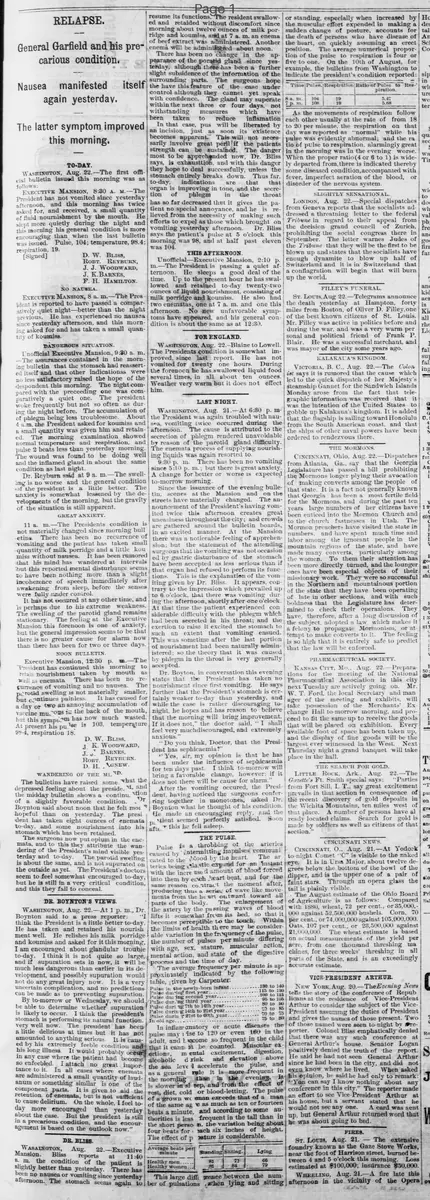
On August 22, 1881, bulletins from Washington reported slight improvement in President Garfield's condition after shooting: no vomiting, retained nourishment, but critical due to gland swelling and weakness; doctors cautiously optimistic.
Merged-components note: These components form a single coherent article on President Garfield's health condition, including detailed bulletins, medical explanations of pulse, and supporting data table. The table provides specific pulse measurements referenced in the explanatory text, indicating it was split during initial parsing.
Clipping
OCR Quality
Full Text
General Garfield and his precarious condition.
Nausea manifested itself again yesterday.
The latter symptom improved this morning.
TO-DAY.
WASHINGTON, Aug. 22.—The first official bulletin issued this morning was as follows:
EXECUTIVE MANSION, 8:30 A. M.—The President has not vomited since yesterday afternoon, and this morning has twice asked for, and received, a small quantity of fluid nourishment by the mouth. He slept more quietly during the night and this morning his general condition is more encouraging than when the last bulletin was issued. Pulse, 104; temperature, 98.4; respiration, 19.
[SIGNED]
D. W. BLISS,
ROBT. REYBURN,
J. J. WOODWARD,
J. K. BARNES,
F. H. HAMILTON.
NO NAUSEA.
Executive Mansion, 8 a. m. The President is reported to have passed a comparatively quiet night—better than the night previous. He has experienced no nausea since yesterday afternoon, and this morning asked for and has taken a small quantity of koumiss.
DANGEROUS SITUATION.
Unofficial Executive Mansion, 9:30 a. m.—The assurances contained in the morning bulletin that the stomach had reasserted itself and that other indications were no less satisfactory raised the hope of the despondent this morning. The night compared with the preceding one was comparatively a quiet one. The President woke frequently but not so often as during the night before. The accumulation of phlegm being less troublesome. About 4 a.m. the President asked for koumiss and a small quantity was given him and retained. The morning examination showed normal temperature and respiration, and pulse 2 beats less than yesterday morning. The wound was found to be doing well and the inflamed gland in about the same condition as last night.
Dr. Reyburn said at 9 a. m.—The swelling is no worse and the general condition of the President is a little better. The anxiety is somewhat lessened by the developments of the morning, but the gravity of the situation is still apparent.
GREAT ANXIETY.
11 a. m.—The President's condition is not materially changed since morning bulletins. There has been no recurrence of vomiting and the patient has taken small quantity of milk porridge and a little koumiss without nausea. It has been rumored that his mind has wandered at intervals but this reported mental disturbance seems to have been nothing more than a slight incoherence of speech immediately after awakening from sleep, before the senses were fully under control. It has not occurred at any other time, and is perhaps due to his extreme weakness. The swelling of the parotid gland remains stationary. The feeling at the Executive Mansion this forenoon is one of anxiety, but the general impression seems to be that there is no greater cause for alarm now than there has been for two or three days.
NOON BULLETIN.
Executive Mansion, 12:30 p. m.—The President has continued this morning to retain nourishment taken by mouth as well as enemata. There has been no recurrence of vomiting and no nausea. The parotid swelling is not materially smaller, but continues painless. It has caused for a day or two an annoying accumulation of vaccine mucous in the back of the mouth, but this symptom has now much wasted. At present his pulse is 103, temperature 98.4, respiration 18.
D. W. BLISS,
J. K. WOODWARD,
J. J. BARNES,
ROBT. REYBURN.
D. H. AGNEW.
WANDERING OF THE MIND.
The bulletins have raised somewhat the depressed feeling about the President and the midday bulletin shows a continuation of a slightly favorable condition.
Dr. Boynton said about noon that he felt more hopeful than on yesterday. The President has taken eight ounces of enemata to-day, and some nourishment into his stomach which has been retained. The surgeons now put opium in the enemata, and to this they attribute the wandering of the President's mind visible yesterday and to-day. The parotid swelling is about the same, and is not suppurated on the outside as yet. The President's doctors seem to feel somewhat encouraged to-day, but he is still in a very critical condition, and this they fail to conceal.
DR. BOYNTON'S VIEWS.
WASHINGTON, Aug. 22.—At 1 p. m., Dr. Boynton said to a press reporter: "I think the President is a little better to-day. He has taken and retained his nourishment well. He relishes his milk porridge and koumiss and asked for it this morning. I am encouraged about glandular trouble to-day. I think it is not quite so large, and if suppuration sets in now, it will be much less dangerous than earlier in its development, and possibly suppuration would not do any great injury now. It is a very uncertain complication, and no predictions can be made as to preventing suppuration. By to-morrow or Wednesday, we should be able to determine whether suppuration is likely to occur. I think the President's stomach is performing its natural function very well now. The President has been a little delirious at times but it has not amounted to anything serious. It is caused by his extremely feeble condition and his long illness. It would probably occur in any case where the patient had become so enfeebled. I attach no great importance to it. In all cases where enemata are administered a small quantity of laudanum or something similar is one of the component parts. It is given to aid the retention of enemata, but is not sufficient to cause delirium. On the whole, I feel to-day more encouraged than yesterday about the case. But the President is still in a precarious condition, and the encouragement is based on the outlook now."
DR. BLISS.
WASHINGTON, Aug. 22.—Executive Mansion. Bliss reports at 11:40 a. m. the condition of the patient is slightly better than yesterday. There has been no nausea or vomiting since yesterday afternoon. The stomach seems again to resume its functions. The President swallowed and retained without discomfort since morning about twelve ounces of milk porridge and koumiss, and at 7 a. m. an enema of beef extract was administered. Another enema will be administered about noon. There has been no change in the appearance of the parotid gland since yesterday, although there has been a further slight subsidence of the inflammation of the surrounding parts. The surgeons hope they have this feature of the case under control although they cannot yet speak with confidence. The gland may suppurate within the next three or four days, notwithstanding measures which have been taken to reduce inflammation. In that case, pus will be liberated by an incision, just as soon as its existence becomes apparent. This will not necessarily involve great peril if the patient's strength can be sustained. The danger most to be apprehended now, Dr. Bliss says, is exhaustion, and with this danger they hope to deal successfully, unless the stomach entirely breaks down. Thus far, to-day, indications are that that organ is improving in tone, and the secretion of phlegm in the throat has so far decreased that it gives the patient no special annoyance, and he is relieved from the necessity of making such efforts to expel as those which brought on vomiting yesterday afternoon. Dr. Bliss says the patient's pulse at 5 o'clock this morning was 98, and at half past eleven was 104.
THIS AFTERNOON.
Unofficial—Executive Mansion, 2:10 p. m.—The President is passing a quiet afternoon. He sleeps a good deal of the time. Up to the present hour he has swallowed and retained to-day twenty-two ounces of liquid nourishment, consisting of milk porridge and koumiss. He also had two enemata, one at 7 a. m. and one this afternoon. No new unfavorable symptoms have appeared, and his general condition is about the same as at 12:30.
FOR ENGLAND.
WASHINGTON, Aug. 22.—Blaine to Lowell. The President's condition is somewhat improved, since last report. He has not vomited for twenty one hours. During the forenoon he has swallowed liquid food several times, in all about ten ounces. Weather very warm but it does not affect him.
LAST NIGHT.
WASHINGTON, Aug. 21.—At 6:30 p. m. the President was again troubled with nausea, vomiting twice occurred during the afternoon. The cause is attributed to the secretion of phlegm rendered unavoidable by reason of the parotid gland difficulty. The enemata process of supplying nourishing liquids was again resorted to. 9:30 p. m. There has been no vomiting since 5:10 p. m.; but there is great anxiety. A change for better or worse is expected to-morrow morning. Since the issuance of the evening bulletin, scenes at the Mansion and on the streets have materially changed. The announcement of the President's having vomited twice this afternoon creates great uneasiness throughout the city; and crowds are gathered around the bulletin boards, in an excited manner. At the Mansion there was a noticeable feeling of apprehension; but the statement of the attending surgeons that the vomiting was not occasioned by gastric disturbance of the stomach have been accepted as less serious than if that organ had refused to perform its functions. This is the explanation of the vomiting given by Dr. Bliss. It appears, contrary to the impression which prevailed up to 6 o'clock, that there was vomiting during the afternoon, shortly after one o'clock. At that time the patient experienced considerable difficulty with the phlegm which had been secreted in his throat: and the exertion to raise it excited the stomach to such an extent that vomiting ensued. This was sometime after the last portion of nourishment had been naturally administered; so the theory that it was caused by phlegm in the throat is very generally accepted. Dr. Boynton, in conversation this evening states that the President has taken no nourishment since first vomiting. He says further that the President's stomach is certainly weaker to-day than yesterday, and while the case is rather discouraging to-night, he hopes and has reason to believe that the morning will bring improvement. If it does not, the doctor said, "I shall feel very much discouraged, and extremely anxious."
"Do you think, Doctor, that the President has septicaemia?"
"Yes, sir, my opinion is that he has been under the influence of septicaemia for ten days past. I think to-morrow will bring a favorable change, however: if it does not there will be cause for alarm."
After the vomiting occurred, the President, having noticed the surgeons conferring together in monotones, asked Dr. Boynton what he thought of his condition. He made an encouraging reply, and the patient seemed perfectly satisfied. Soon after this he fell asleep.
THE PULSE.
Pulse is a throbbing of the arteries caused by intermitting impulses communicated to the blood by the heart. The arteries being elastic expand for an instant with the increased amount of blood forced into them by each heart beat, and for the same reason contract the moment after, producing thus a series of wave like movements from the heart outward toward all parts of the body. The enlargement of the artery by the passing waves of blood lifts it somewhat from its bed, so that it becomes perceptible to the touch. Within the limits of health there may be considerable variation in the frequency of the pulse, the number of pulses per minute differing with age, sex, stature, muscular action, mental action, and state of the digestive process and the time of day.
The average frequency per minute is approximately indicated by the following table, given by Carpenter:
Pulse in the newly-born infant 180 to 140
Pulse during first year 115 to 130
Pulse during second year 100 to 115
Pulse during third year 95 to 105
Pulse during 7th to 14th year 80 to 90
Pulse during 14th to 21st year 70 to 85
Pulse during 21st to 60th year 75 to 80
In old age.
Pulse may rise to 120 or even 160 in the adult, and become so frequent in the child that it cannot be counted. Muscular exertions, mental excitement, digestion, alcoholic drink and elevation above the sea level accelerate the pulse, and as a general rule it is more frequent in women than in men. The pulse is slower in sleep, and from the effect of rest, diet, cold or blood-letting. The pulse of a grown woman exceeds that of a man of the same age as much as ten or fourteen beats a minute, and according to some authorities is less frequent in the tall than in the short person, the variation being about four beats for each six inches of height. The effect of posture is considerable.
Standing Sitting Lying
72 66 61
79
Number of pulsations or standing, especially when increased by the muscular effort expended in making a sudden change of posture, accounts for the death of persons who have disease of the heart, on quickly assuming an erect position. The average numerical proportion of the pulse to respiration is four or five to one. On the 10th of August, for example, the bulletins from Washington to indicate the president's condition reported:
Time Pulse Respiration Ratio of Pulse to Respiration.
As the movements of respiration follow each other usually at the rate of from 18 to 20 per minute, the respiration on that day was reported as "normal" while his pulse was evidently abnormal; and the ratio of pulse to respiration, alarmingly great in the morning was in the evening worse. When the proper ratio (4 or 5 to 1) is widely departed from, there is indicated thereby some diseased condition, accompanied with fever, imperfect aeration of the blood, or disorder of the nervous system.
| 8 a. m. | 104 | 19 | 5.47 |
| 7 p. m. | 108 | 19 | 5.68 |
What sub-type of article is it?
What keywords are associated?
What entities or persons were involved?
Where did it happen?
Domestic News Details
Primary Location
Washington
Event Date
Aug. 22
Key Persons
Outcome
slight improvement with no vomiting since yesterday afternoon, retention of nourishment, but still critical condition due to parotid gland swelling, weakness, and possible suppuration; pulse 104, temperature 98.4, respiration 19.
Event Details
Series of official and unofficial bulletins from Executive Mansion detailing President Garfield's condition: no nausea or vomiting, retention of small quantities of fluid nourishment like koumiss and milk porridge, quiet sleep, stationary parotid swelling, slight mental incoherence attributed to weakness and opium in enemata; doctors express cautious encouragement but note ongoing gravity and risk of exhaustion or suppuration.