Thank you for visiting SNEWPapers!
Sign up free
Editorial
June 25, 1910
The New Haven Union
New Haven, New Haven County, Connecticut
What is this article about?
Massachusetts legislature passes bill allowing New Haven railroad to hold Berkshire street railway, marking retreat from long anti-merger stance against Boston & Maine and New Haven interests. Editorial critiques prolonged conflict, highlighting lessons on rational railway dispute resolution.
Clipping
OCR Quality
98%
Excellent
Full Text
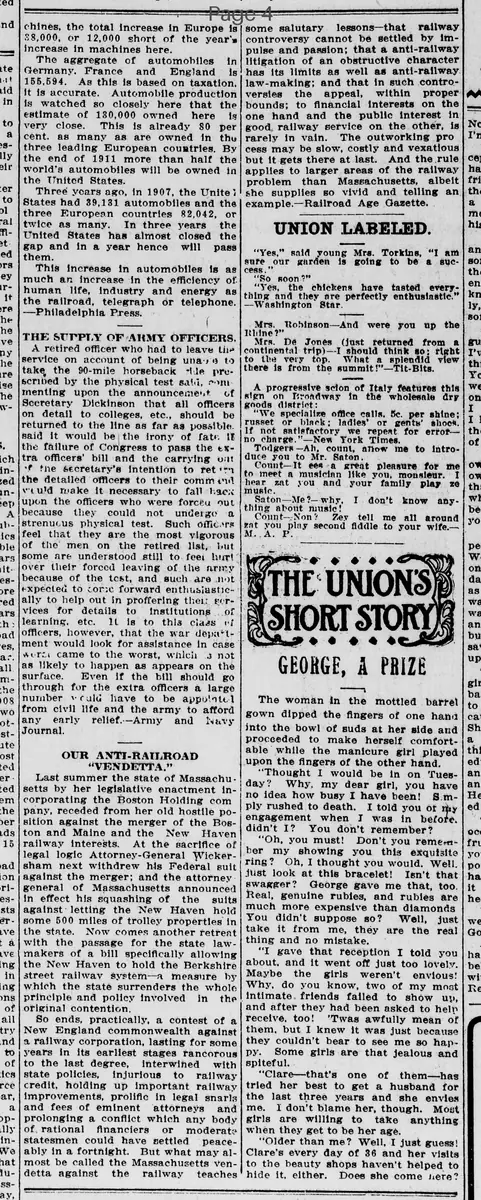
OUR ANTI-RAILROAD "VENDETTA."
Last summer the state of Massachusetts by her legislative enactment incorporating the Boston Holding company, receded from her old hostile position against the merger of the Boston and Maine and the New Haven railway interests. At the sacrifice of legal logic Attorney-General Wickersham next withdrew his Federal suit against the merger; and the attorney general of Massachusetts announced in effect his squashing of the suits against letting the New Haven hold some 500 miles of trolley properties in the state. Now comes another retreat with the passage for the state law-makers of a bill specifically allowing the New Haven to hold the Berkshire street railway system—a measure by which the state surrenders the whole principle and policy involved in the original contention.
So ends, practically, a contest of a New England commonwealth against a railway corporation, lasting for some years in its earliest stages rancorous to the last degree, intertwined with state policies, injurious to railway credit, holding up important railway improvements, prolific in legal snarls and fees of eminent attorneys and prolonging a conflict which any body of rational financiers or moderate statesmen could have settled peaceably in a fortnight. But what may almost be called the Massachusetts vendetta against the railway teaches some salutary lessons—that railway controversy cannot be settled by impulse and passion; that a anti-railway litigation of an obstructive character has its limits as well as anti-railway law-making; and that in such controversies the appeal, within proper bounds, to financial interests on the one hand and the public interest in good, railway service on the other, is rarely in vain. The outworking process may be slow, costly and vexatious but it gets there at last. And the rule applies to larger areas of the railway problem than Massachusetts, albeit she supplies so vivid and telling an example.
-Railroad Age Gazette.
Last summer the state of Massachusetts by her legislative enactment incorporating the Boston Holding company, receded from her old hostile position against the merger of the Boston and Maine and the New Haven railway interests. At the sacrifice of legal logic Attorney-General Wickersham next withdrew his Federal suit against the merger; and the attorney general of Massachusetts announced in effect his squashing of the suits against letting the New Haven hold some 500 miles of trolley properties in the state. Now comes another retreat with the passage for the state law-makers of a bill specifically allowing the New Haven to hold the Berkshire street railway system—a measure by which the state surrenders the whole principle and policy involved in the original contention.
So ends, practically, a contest of a New England commonwealth against a railway corporation, lasting for some years in its earliest stages rancorous to the last degree, intertwined with state policies, injurious to railway credit, holding up important railway improvements, prolific in legal snarls and fees of eminent attorneys and prolonging a conflict which any body of rational financiers or moderate statesmen could have settled peaceably in a fortnight. But what may almost be called the Massachusetts vendetta against the railway teaches some salutary lessons—that railway controversy cannot be settled by impulse and passion; that a anti-railway litigation of an obstructive character has its limits as well as anti-railway law-making; and that in such controversies the appeal, within proper bounds, to financial interests on the one hand and the public interest in good, railway service on the other, is rarely in vain. The outworking process may be slow, costly and vexatious but it gets there at last. And the rule applies to larger areas of the railway problem than Massachusetts, albeit she supplies so vivid and telling an example.
-Railroad Age Gazette.
What sub-type of article is it?
Infrastructure
Economic Policy
What keywords are associated?
Railroad Merger
Massachusetts Policy
New Haven Railroad
Anti Railroad Vendetta
Railway Litigation
Infrastructure Improvements
What entities or persons were involved?
Massachusetts Legislature
Boston Holding Company
Boston And Maine
New Haven Railway
Attorney General Wickersham
Berkshire Street Railway
Editorial Details
Primary Topic
Massachusetts' Retreat From Anti Railroad Merger Policy
Stance / Tone
Critical Of Prolonged Anti Railroad Conflict, Supportive Of Rational Resolution
Key Figures
Massachusetts Legislature
Boston Holding Company
Boston And Maine
New Haven Railway
Attorney General Wickersham
Berkshire Street Railway
Key Arguments
Massachusetts Recedes From Hostile Position On Railroad Mergers
Federal And State Suits Against Mergers Withdrawn
Prolonged Contest Injurious To Railway Credit And Improvements
Railway Controversies Best Settled By Rational Financiers, Not Passion
Appeal To Financial And Public Interests Effective Despite Slow Process