Thank you for visiting SNEWPapers!
Sign up free
Daily Richmond Whig
Richmond, Virginia
What is this article about?
A letter to the Editors of the Whig defending tobacco's virtues and history, from its origins in Tobago to its introduction in Europe by Sir Francis Drake and popularization by Sir Walter Raleigh. The author argues it is an innocent stimulant superior to alcohol, citing examples like Dr. Johnson and Dr. Rush using tea.
Merged-components note: This is a single letter to the editor split across pages due to page boundary; merged for coherence on the topic 'Powers of Tobacco'.
Clippings
1 of 2
OCR Quality
Full Text
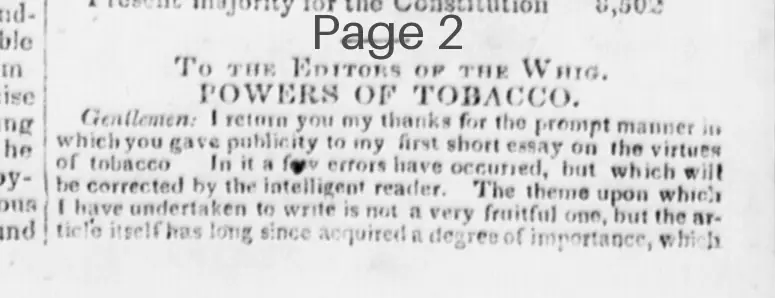
POWERS OF TOBACCO.
Gentlemen: I return you my thanks for the prompt manner which you gave publicity to my first short essay on the virtues of tobacco. In it a few errors have occurred, but which will be corrected by the intelligent reader. The theme upon which I have undertaken to write is not a very fruitful one, but the article itself has long since acquired a degree of importance, which
Upon superficial observation would not seem to attach to it.
From being an obscure untasted plant, it gradually rose into notice as an article of luxury and commerce the most extensive, and alike administered to the enjoyment and avarice of mankind.
The history of this plant, as well as its dominion over society in all states, is singular enough. From the best information, it appears to be originally a production of the little island of Tobago, a mere speck upon the map of the world; and from this point it has spread itself, and all its influences and fascinations, far and wide. It has generally been propagated by cultivation, but it is found growing spontaneously and luxuriantly in the southwestern States. It had its first introduction into Europe about 220 years ago, where it has ever since been cultivated on a small scale for medical purposes. The great naval hero, Sir Francis Drake, carried it to England, where it was rendered a fashionable luxury by the example and influence of Sir Walter Raleigh, who it seems was a great smoker at least. About this period, James I. was a violent enemy to the popularity of the article, and attempted an entire prohibition of its use, in the way of luxury, by issuing his royal denunciations against it; but his proscription, although it was acquiesced in by a few of his courtiers, was disregarded and unavailing. It seems to be a high and distinguishing propensity of man, to seek and use some exhilarating agent or other, to elevate him when depressed, or to compose him while laboring under distresses, whether of body or of mind; and as it is too frequently the case that he resorts to articles of a stimulating and a narcotic power, surely it is better to choose those of the most innocent character, or such as do not inflame his passions and subvert all his reasoning faculties, and at once degrade and sink him below the animal whose brightest attribute is instinct alone. It is ungenerous and contracted to proscribe any thing from which we may extract comfort in our afflictions, because it is prodigally instead of prudently used, and consequently converts a blessing into a curse.
Upon the same principle we might proscribe many savoury and delicious articles of aliment—tea and coffee have their charms, and in general are as innocent in their influence or effects as they are cordial and grateful; yet instances do occur in which deleterious consequences arise from an excessive use of them; but this proves nothing against the position assumed. Tea has been the intellectual stimulus of many eminent writers, both of this country and of Europe; and so has coffee, but not in so extensive a degree. The former was the mental stimulus of the great Doctor Johnson, whose stupendous intellect was often awakened by it to the most powerful and matchless exertions. And Doctor Rush, whose very name ought to be dear to every lover of science, patriotism, and virtue, made tea his principal mental stimulus, as he scarcely ever drank any thing else that had an exhilarating tendency.
Coffee was the stimulant best adapted to the mighty mind of Voltaire, whose infidel principles incurred the malediction, whilst the lustre of his talents commanded the admiration of mankind.
Now, as tobacco and these things have no tendency to infuriate and demoralize, but on the contrary, to lull grief or agreeably stimulate the mind, let us rather sanction than proscribe them, as at least comparatively innocent substitutes for all alcoholic liquors, which we all know exert the most unhappy influences over society, and which at once sap all the foundations of mind, constitution, and character!
I am, very respectfully,
Your obedient servant,
T. P. HEREFORD.
Hangmarket, Va., May 13, 1830.
What sub-type of article is it?
What themes does it cover?
What keywords are associated?
What entities or persons were involved?
Letter to Editor Details
Author
T. P. Hereford
Recipient
Editors Of The Whig
Main Argument
tobacco is an innocent and beneficial luxury that provides comfort and stimulation without the demoralizing effects of alcohol, and should be sanctioned rather than prohibited, as it serves as a better alternative to stronger stimulants.
Notable Details